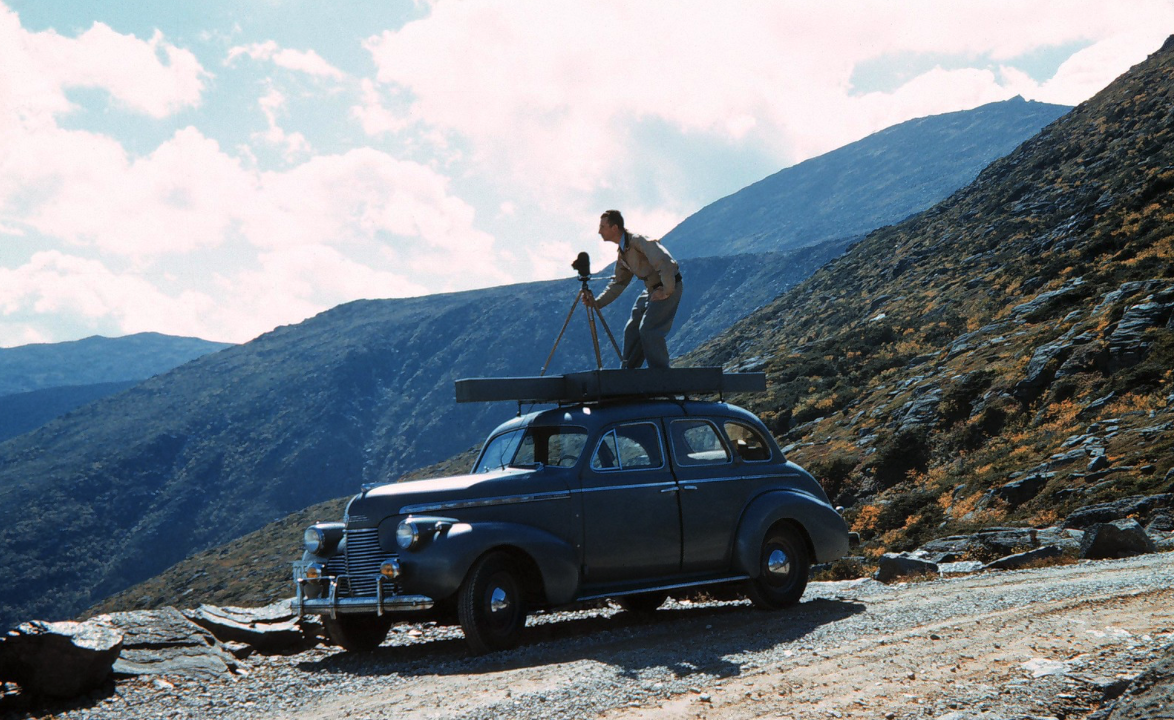
PEOPLE OF THE WHITES: Robert Scott Monahan (1907 -1994), Winston Henry Pote (1899-1989), and Samuel A. Bemis (1793-1881) – by Francis Woodard Richardson

Over the past several years Frances Woodard Richardson has profiled many New Hampshirites who have contributed to the development of outdoor life in New Hampshire.  Mountain Passages has published these profiles in a Series called ‘PEOPLE OF THE WHITES.’   Her other portrayals include Florence Morey (1886-1978), Bradley Washburn (1910-2007), Lizzie Bourne (1833-1855), Franklin Leavitt (1824-1898), Guy Leslie Shorey (1881-1961), Rodney Dallas Woodard (1905-1976) and Stuart Kimball Harris (1906-1969). Frances’ bios of Louis Fayerweather Cutter (1864-1945), Laban Merril Watson (1850-1936) and Leroy Reynolds Woodard (1903-1985)  can be found in the Mountain Passages Archives

Robert Scott Monahan (1907-1994)

Robert Scott Monahan was a naturalist and a politician. He was born on November 24, 1907, in Pawtucket, Rhode Island. He studied forestry, graduating from Dartmouth College in 1929. While there, he belonged to the Outing Club and was Captain of the Track Team.
During the 1926 Christmas vacation from Dartmouth, Robert led a group up Mount Washington to spend time at Camdon Cottage. They took instruments to observe the wind and weather. Joe Dodge of the Pinkham Notch Camp joined the group and was interested in the scientific aspect of his visit.
Robert Monahan received a Master’s Degree from Yale School of Forestry in 1931, then worked for the United States Forest Service for fifteen years.
Monahan’s interest in Mount Washington continued, and he assisted Joe Dodge with the Nansen Ski Club’s race down the eight-mile Carriage Road on Mount Washington on March 29, 1932. That same year, Robert, with Joe Dodge and others, established The Mount Washington Observatory. Alexander A. McKenzie, Robert S. Monahan, and Salvatore Pagliuca became the crew. It was there that the wind velocity was measured at 231 miles per hour on April 11-12, 1934. Being part of the crew, Robert S. Monahan wrote a book, MOUNT WASHINGTON REOCCUPIED, published in 1933, telling of his experiences of being a member of the observatory crew.
In 1947, Robert Monahan returned to Dartmouth College and became the college forester. He managed the college-owned land grants in northern New Hampshire and sold wood products made from the forests.
Monahan was also interested in politics and was elected to the New Hampshire House of Representatives and was Chair of the Resources and Recreation Development Committee in 1956. He served as the Majority Leader in the State Senate, where he introduced a bill to designate the Purple Finch as the State bird.
Robert Scott Monahan died in Laconia, New Hampshire, in 1994 at the age of 86. A Memorial Service was held at Christ Church, Hanover, New Hampshire, on March 12, 1994. He left his sons, Robert of Powell River, British Columbia, Daniel of Concord, Massachusetts, and a daughter, Linda Dresch of Cumberland, Maine.
Dianne Monahan of Concord, Massachusetts, his daughter-in-law, said. “His two biggest passions were politics and the outdoors.”
REFERENCES:
  • Mount Washington Reoccupied, by Robert S. Monahan
  • The Story of Mount Washington, by F. Allen Burt
  • Robert “Gramps” Monahan, by Old Hutcroo  Association

Winston Henry Pote (1899-1989)

Winston, the son of Henry Joseph Pote, 34, and Beatrice Amelia Wells, 22, was born on June 26, 1899, in Lynn, Mass.
Pote worked as a pharmacist in Swampscott, Mass. His interest in photography began in 1923 when he took a five-day excursion to Lincoln, N.H., given by Green Tours of Lynn and Boston, Mass. He took his Graflex camera to photograph Mount Washington. Later, he became the official photographer for Green Tours.
Winston returned to the mountains to take photographs of skiers. With Brad Washburn, Pote climbed Tuckerman’s Ravine headwall to photograph Charlie Proctor, the only American on the 1928 Olympic Team.
On June 20, 1929, Winston was at the Bretton Woods Base Station for Old Peppersass’ final climb up Mount Washington on the Cog Railway. He boarded the engine illegally to photograph the occasion. When Peppersass lost one of the wheel gears and raced down the track, Winston, carrying his camera to get one of the last shots, had to jump from the engine. He landed on a jagged rock and broke his jaw and other injuries. He spent time in the hospital.
After serving in the Military in 1942, he returned to Mount Washington to make movies and aerial images of the mountain. Pote published a book in 1985, MOUNT WASHINGTON IN WINTER, Photographs and Recollections, 1923 – 1940.
In the winter of  1931, he and his friend, Joseph Oliver, and his dog, Rex, of Lynn, Mass., spent two months in Camden Cottage on the summit of Mount Washington. Camden Cottage was built in 1922 to shelter winter hikers at the request of Patrick Camden, a veteran roadmaster on the Cog Railway. Winston and Joseph’s mission was to photograph the changing conditions from Winter to Spring on the mountain.
Pote took pictures of the first American Inferno Race on April 16, 1933. It was a risky ski race over the headwall of Tuckerman’s Ravine.
Winston Pote married Marion Louise Boothman on November 12, 1942, in Gorham, NH. He died in Lancaster, NH, on January 5, 1989, at the age of 89.
REFERENCES:
  • MOUNT WASHINGTON IN WINTER, by Winston Pote
  • THE STORY OF MOUNT WASHINGTON, by F. Allen Burt
  • MOUNT WASHINGTON REOCCUPIED by Robert S. Monahan
  • WINSTON POTE PHOTOGRAPHER and EPHEMERA Collection, by Winston Pote

Samuel A. Bemis (1793-1881)

Dr. Samuel A. Bemis was one of the first photographers in the United States to take pictures of the White Mountains of New Hampshire and Boston, Massachusetts. He was also a dentist and an estate builder in Crawford Notch.

Samuel was the illegitimate son of Samuel Bemis (1754-1816) and Hazadiah McWain (1769-1854), born on June 27,1793 in Putney, Vermont. In his youth, he was an apprentice to his father in the watch and clock-making business in Keene, NH, until 1809, when he moved to Putney, Vermont, and opened a shop, later moving to Boston, Mass. 

In 1810, he made a tooth extracting tool for Zabdiel Adams, and in 1822, Samuel opened a dental practice and became well known as a dental surgeon, earning a large amount of money. He later moved his business to Baltimore, Maryland.

In April 1840, Samuel attended a lecture by Francois Fanvel-Gourand on daguerreotype photography. Bemis became interested, and for $75.00, he bought a Giroux camera and  12 plates. and began taking daguerreotype pictures in Boston, and the White Mountains, where he vacationed at the Mount Crawford Tavern owned by Abel Crawford and his son-in-law, Nathaniel T.P. Davis. Bemis took a mortgage on the Tavern, and when they died, Samuel took ownership of the Tavern.

The property was about 6,000 acres in Crawford Notch and Bemis, known as  “The Lord of the Valley”, began naming a mountain, a brook, and a lake after himself. He named Frankenstein Cliff after Godfrey Frankenstein, a friend and outstanding painter.

Beginning in 1860, Dr. Bemis began building a granite mansion from stone  quarried along the Sawyer River. Dr. Samuel Bemis moved in on Christmas Eve, 1880, and became a recluse.

Dr. Bemis allowed the Boston and Ogdensburg Railroad to cross his land for a dollar, and later, a small station was built.

Interested in horticulture, he grafted trees and was awarded for the apples he grew on his farm.

Samuel A. Bemis died on May 22, 1881, and is buried in the Notchland Cemetery beside Abel and Hannah Crawford and others on his estate in Crawford Notch. He left his property to George Morey, his friend, caretaker, and manager of his farm. Morey’s daughter-in-law, Florence Morey, became the owner and operated the mansion as a Bed and Breakfast called The Inn Unique.

In the 1980’s, John and Pat Bernardin remodeled eleven bedrooms and opened the inn for business. In the1990’s, it was sold to Ed Butler and Les Schoof, who continue to run the estate as The Notchland Inn.

REFERENCES:

  • Find a Grave, by Kimberly Anderson Bloodgood and Shirley Mitchell
  • Samuel Bemis: Renaissance Yankee: Historical New Hampshire by Catherine Campbell
  • Wikipedia
  • Notchland and Samuel Bemis by Rick Russack
  • Bemis at Crawford Notch by Bartlett Historical Society