The AMC’s Century of Breaking Trail for Backcountry Skiers in New Hampshire and Beyond – by Ham Mehlman
September 4, 2026
Posted in
The following article was first published in the printed 2024 winter edition of the Mountain Passages newsletter
Ham Mehlman is Editor-in-Chief of Mountain Passages and an AMC-NH member. He skis, hikes and bikes New Hampshire’s backcountry, trails and byways when time allows.
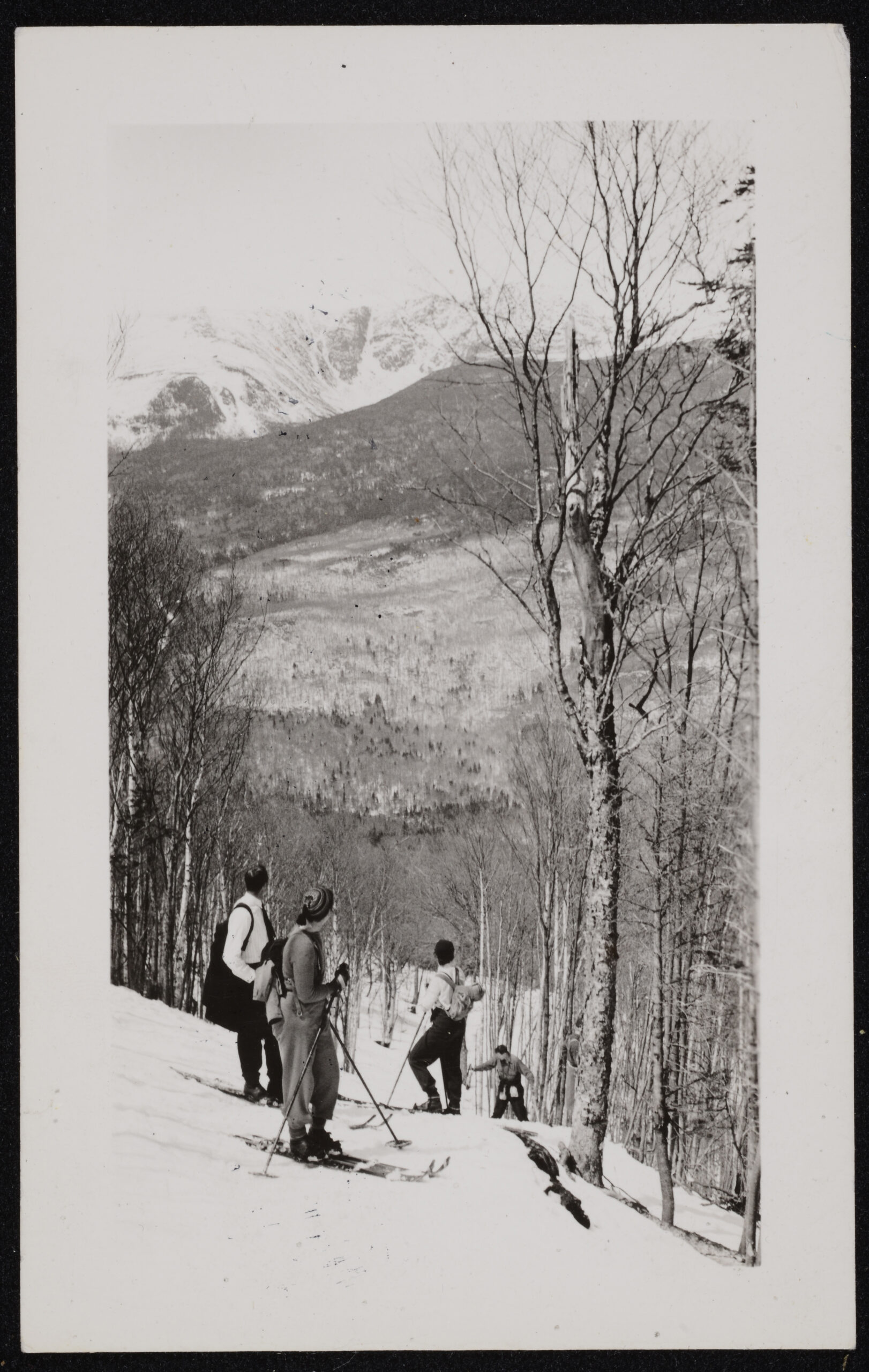
Skiers on Wildcat Trail looking toward Tuckerman Ravine, 1935 – Courtesy of AMC Archives
For alpine (downhill) skiing in North America, 1927-1936 were the “BC” years. “BC” in alpine ski history parlance refers to “Before Chairlifts.” But “BC”, by alliterative coincidence in the English language, could just as easily stand for “BackCountry” skiing. There were no ski areas with operating lifts during this period. You had to earn your turns then just as you do today (at least generally) for most backcountry ski adventures. (Yes, it is possible to ski in the “backcountry” or “off-piste” at many resorts without having to skin up – but this is just a definitional consideration.)
In the BC years, the Appalachian Mountain Club (AMC) led the way in establishing New Hampshire as the initial epicenter of recreational alpine skiing in the US, at least until Averill Harriman erected his chairlift on Dollar Mountain in Ketchum, Idaho in 1936 (now known as Sun Valley). In the process, the AMC catalyzed the differentiation of alpine trails, ski technique and equipment from its Nordic (cross country) progenitor in the US. By the time Harriman erected his chairlift, New Hampshire claimed some 90 ski trails covering 200 miles in length, mostly intended for the new sport of alpine skiing. Directly through its own volunteers and trail crews, and indirectly through the active involvement of the club and its members in initiating and managing State and Federal government programs, the AMC influenced the attributes and configurations of much of that trail network. Over time, lift service ski resorts including Wildcat, Cannon and Waterville incorporated some of these trails into their resorts. Other remnants, which faced extinction from ingrowth and lack of maintenance, are seeing their brilliance uncovered and restored by today’s burgeoning backcountry community.
And again, for the last 30 years or so the AMC has similarly catalyzed the reimagining of backcountry skiing in New England through promotion of trails. BC Skiing is the fastest growing ski segment today. While others, particularly the Granite Backcountry Alliance, have led the development of new terrain, the AMC has played a central function promoting knowledge and information about existing trails and capitalizing on the assets at Pinkham Notch and Cardigan Reservations.
Given its experience in developing hiking trails, it is not surprising that AMC crews would map, engineer and cut New England’s first purpose-built ski trails. As AMC Archivist Becky Fullerton points out, “The Appalachian Mountain Club has been interested in building trails since its founding year. One of the first committees formed when the club began in 1876 was that of ‘Improvements,’ and the first item on their list of priorities was ‘Paths to be made.’” Sometime between 1923 and 1927, depending on the reference, the AMC, likely at the direction of AMC member Arthur Comey, turned its focus to include cutting trails specifically for skiing, initially of the Nordic variety but rapidly evolving to a new and separate discipline of alpine or down-mountain sport. “When volunteer parties of Appalachian MC skiers, with axes and brush hooks in 1927 began chopping a ski trail over Barrett and Temple mountains in the Wapack range 50 miles northwest of Boston, we doubt if a single mile of downhill ski trail had been constructed (as such) or was even projected, anywhere on this continent,” speculated a ski publication in 1935.
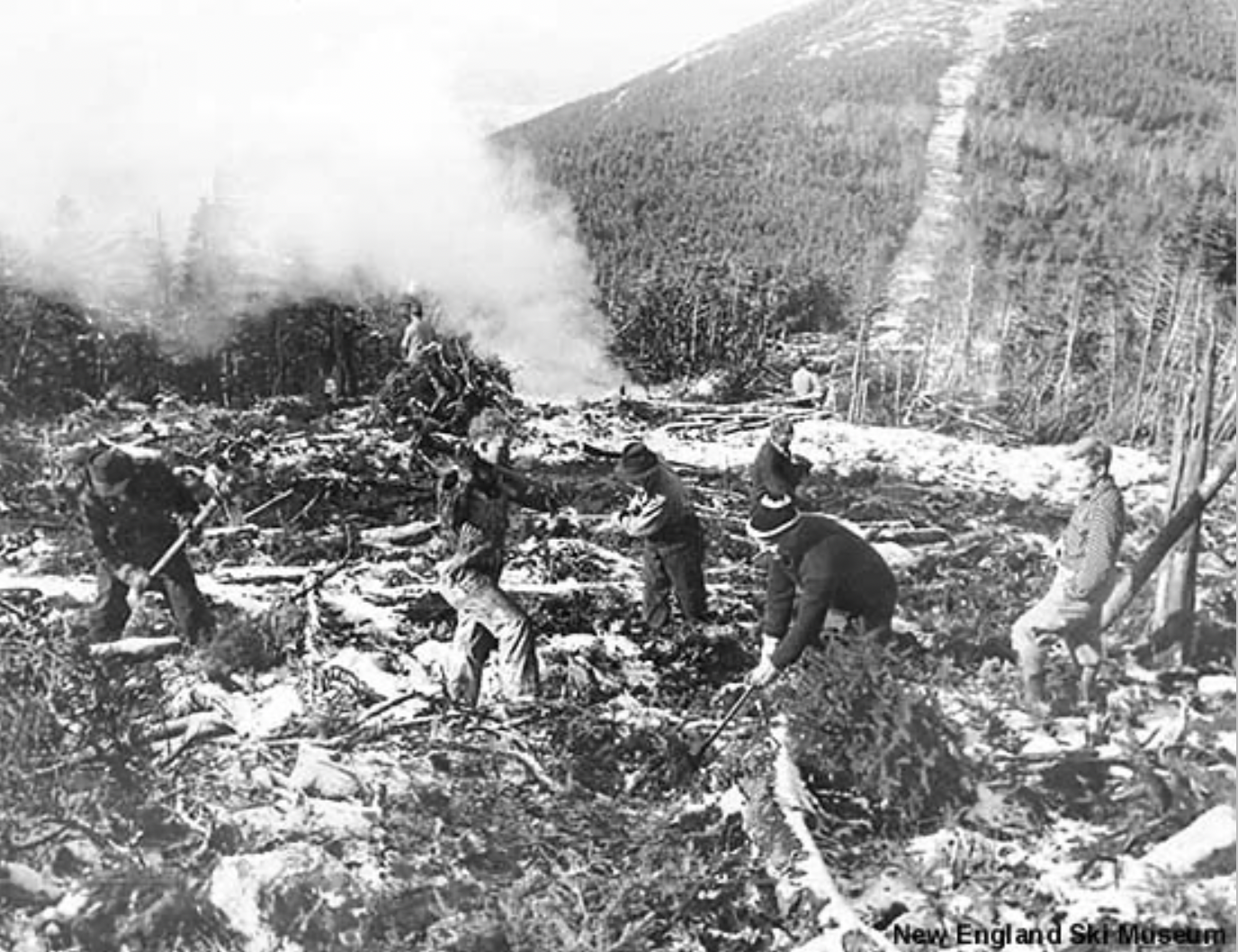
Trail crews clearing Richard Taft Trail in 1932. Source: New England Ski Museum
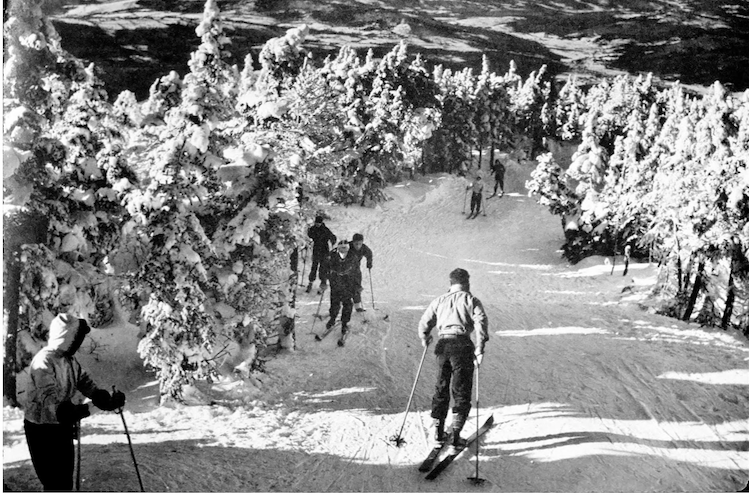
Skiers negotiate the Richard Taft Trail on Cannon Mountain in 1930s. Source: New England Ski Museum
New Hampshire State Development Commission Committee on Skiing – 1933
AMC trail crews would continue to add to and maintain select downhill terrain. However, the opportunity for the new downhill ski industry was enormous and needed significantly more labor and capital than an individual volunteer club could provide. Charles N. Proctor, an AMC member, avid skier and surveyor for much of the Pinkham Notch ski trail development would reflect in December 1934, “The emergence of ski running as a major winter sport during the past few years brought the problem of where to ski to an acute stage at the close of last season. The existing footpaths through the hills and mountains were recognized as inadequate….” In 1932, the AMC formally convened a “Ski Committee” chaired by William Fowler. Fowler, or possibly another AMC member, John Carleton, managed to sell the idea of investing in a ski industry for New Hampshire to Thomas Dreir, Chairman of the New Hampshire State Development Commission: “Dreir…is one of those folks who believes in hitching your wagon to a star, he would like to see New Hampshire rivaling Switzerland and Austria as a playground for skiers… There is no sense in spending money for advertising hotels and our snow-clad mountains unless we fix those mountains properly with needed ski trails and huts…if we developed the right kind of trails in the North Country the thousands of people seeking winter sports would be sieved through the lower part of the State and the whole State would prosper.” Importantly, since any program for forests in the big mountains would come under the purview of the forest services, NH State Forester, John Foster, a resident of Waterville Valley, supported the concept of developing NH mountains for skiing.
Carleton then persuaded James E. Scott, supervisor of the White Mountain National Forest, reporting to Fowler in May of 1933, “Mr. Scott, the Federal Forester, is friendly toward the general plan of having ski trails cut in the National Forest…. It strikes me that we have an opportunity of a lifetime and I want to urge you to be sure to be at the meeting which is at two o’clock in the Senate chamber…. He is anxious to have a representative group furnish him with definite suggestions as to what should be done and provide a capable supervisor.”
As Proctor recalls, “Then came invitations from the New Hampshire State Development Commission for a meeting in Concord to discuss ski-trail construction, addressed to representative ski runners and those New Hampshire hotel and resort owners genuinely interested in the development of skiing. The meeting produced an illuminating general discussion of the problem. It was agreed that ski trails would be a desirable and valuable addition to the recreational facilities of the State. It was also agreed that the trails should be built primarily for skiing, rather than as general-purpose footpaths, which experience had amply demonstrated to be unusable for general skiing.
“At the suggestion of William P. Fowler, chairman of the AMC Committee on Skiing, a representative ski trails committee was formed to cooperate with the Development Commission in furthering plans for trail construction. The committee consisted of John P. Carleton, Chairman; Alexander Bright, Boston; Arthur C. Comey, Boston; Miss Katherine Peckett, Franconia; David Austin, Waterville; and Gordon Langill, Laconia.”
The representation for the AMC here, at the highest levels of NH state government, is resounding – adoption of a “Committee on Skiing” proposed by the Chair of the AMC Skiing Committee (Fowler) and staffed by six people, half of whom were AMC members or proposed members (Comey, Bright and Carleton). The committee went on to engage another AMC member, Charles N. Proctor, to survey and direct trail design, particularly for Pinkham Notch.
Under the direction of this AMC-dominated committee, working through the Federal and State Departments of Forestry, this committee would oversee the development of many ski trails (some still functional today) that would launch the alpine ski industry in the US.
But they could design and dream all they wanted to. They still needed labor.
A “Tree Army” for the job
“Then came the magic of the C.C.C. Hundreds of sturdy youths were to be put to work in the mountains. From the ski runner’s point of view, what nobler purpose could be achieved than the construction of ski trails?”
The Depression created a vast labor pool of men looking for work. In the spring of 1933, the AMC, the State of New Hampshire, and a nascent downhill skiing industry found its labor pool in President Franklin Roosevelt’s Civilian Conservation Corps (CCC). The CCC put single men between the ages of 18 and 25 to work in programs to improve America’s public lands, forests, and parks. The AMC and its influential members, working through the New Hampshire State Development Commission and its newly formed Committee on Skiing, were instrumental in convincing the US Forest Service that construction of ski trails was a perfect application for CCC labor.
The Richard Taft trail
For all its prowess in building trails, the AMC played no role in the creation of the trail that became the prototype for forested ski trails of the modern era, the Richard Taft Trail (“The Taft”) on Cannon Mountain, a 4,000-footer in Franconia, NH. When cut in 1932 and 1933, the Taft descended 2,200 feet with trail widths ranging from 15-60 feet, much wider than the typical hiking path or carriage road used for skiing in New England up to this time. It was also steep, exceeding 30 degrees on some pitches, expert terrain by today’s standards. The trail was the brainchild of Katherine Peckett whose family ran the Arlberg Ski School on a small cow pasture in Sugar Hill, NH. Peckett, herself an alpine skier, worked with one of the school’s instructors, Duke Dimitri von Leuchtenberg, a Russian who learned skiing in Austria, to design a European-style trail compatible with “down-mountain” skiing. Duke Dimitri anticipated that even the best practitioners would need and want to “stem” their speed on the steep sections of the trail, at least if they had any concern for self-preservation. So, he cut space to “stem” (turn), particularly at the bends of the trail. Width became an imperative ski-trail design consideration and was highlighted in all the early reports on the new trails as they were built.
A local crew initiated the work in 1932, sufficient for Sigmund Buchmayr to make the first ski descent in February 1933. The CCC refined and finished the project later that summer. Per Jeffrey Leich of the New England Ski Museum, “The Richard Taft trail was the first trail to be attempted on a four-thousand-foot mountain…. The Richard Taft trail became the prototype for numerous ski-trail construction projects in the state, and, in turn, these projects would become a pattern for other New England states.”
The Taft Trail’s impact on the AMC, and more importantly its influential members, is apparent. Alex Bright, one of the best skiers of the time, and member of the NH Committee on Skiing, noted shortly after Buchmayr’s descent, “The course provides a ski-run equaled by nothing in the East.” Bright goes on to claim, “This trail is our nearest approach to what reasonably might be done with our apparently still unappreciated yet adequate mountains, for a skiing paradise in New England. This trail sweeps in grand curves and turns–in places sixty feet wide and at its narrowest fifteen feet–down a north slope where snows pile up and linger uncrusted until well into the summer.”
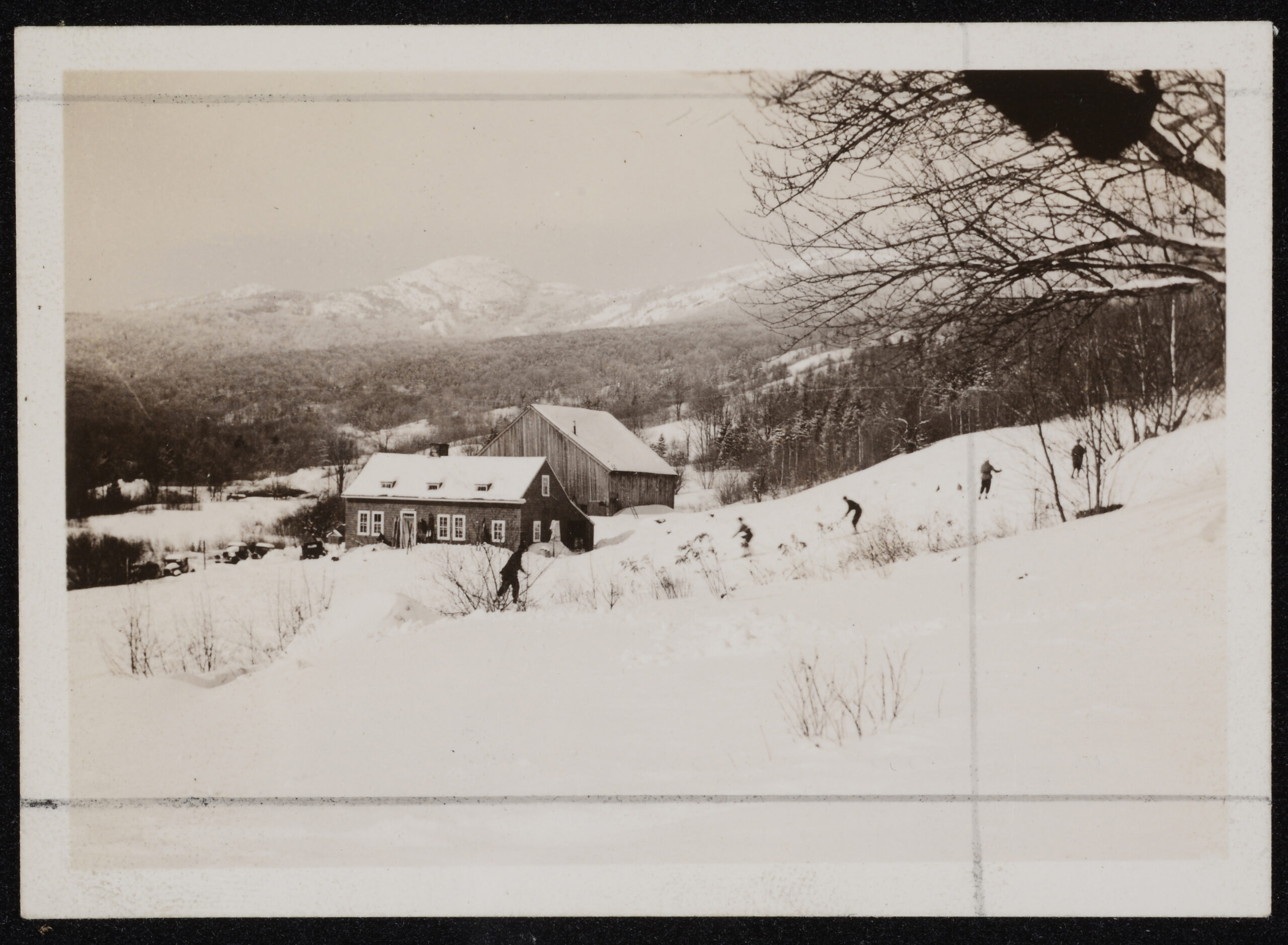
Cardigan Reservation. Source: AMC archives
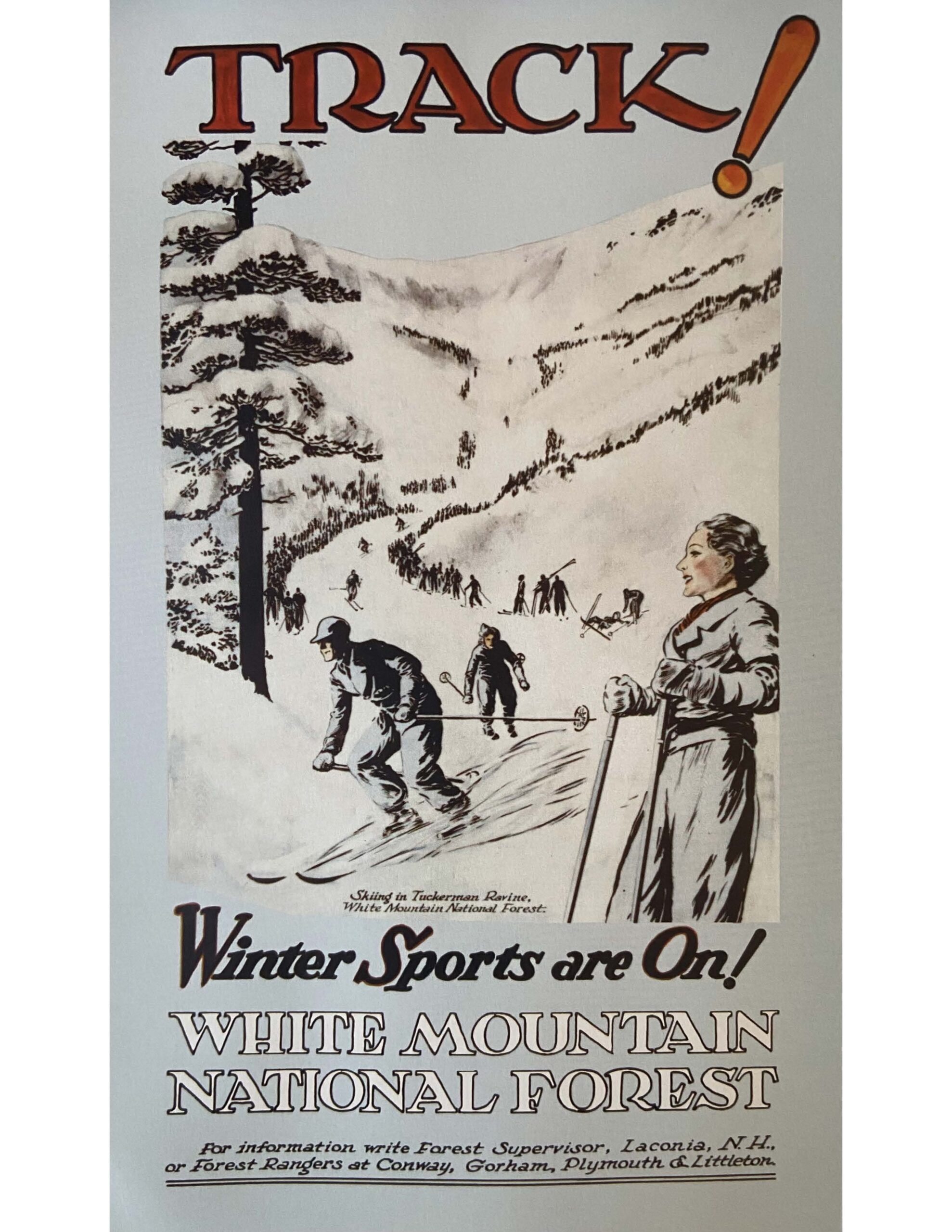
An early ski poster. Courtesy of: the New England Ski Museum
Per The Sportsman in December 1933, “With this trail as an example of what could be done on forested mountains and with the sympathetic cooperation of the C.C.C. officials, the whole network of new trails was laid out and more than forty miles of them were cut this past summer and are now ready for use. Particular credit must be given to John P. Carleton, Chairman of the New Hampshire Ski Trails Committee, [and] to Charles N. Proctor….”
Duke Dimitri von Leuchtenberg would go on to join Charles N. Proctor (AMC member) in working for the Ski Committee to survey and layout trails in Pinkham Notch and the Kinsman Range (Franconia and Easton, NH). In 1934, the AMC engaged Duke Dimitri to design trails at their newly purchased Cardigan Ski Reservation where he routed the eponymous and still functional “Duke’s Trail” and lower instructional slopes.
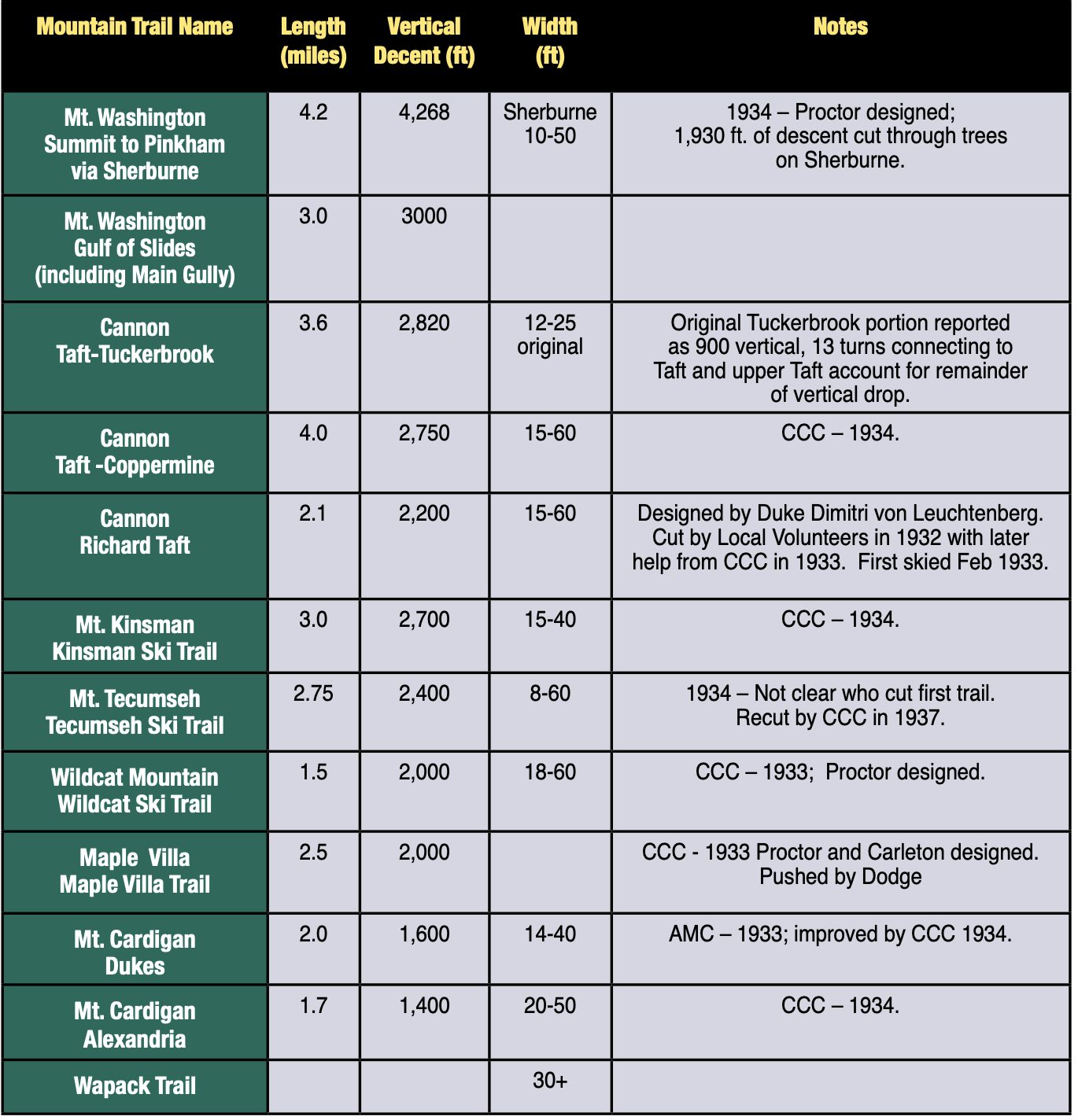
It is worth appreciating the scale of some of these trails, 2-4 miles in length and many dropping more than 2,000 vertical feet. (See the associated chart for a selection of AMC and CCC work loosely organized by the vertical relief of the work.) For comparison, Jackson Hole Resort in Wyoming boasts the biggest lift-serviced, continuous vertical drop of 4,105 feet, in the continental US. Descending from the summit of Mt. Washington to Pinkham Notch via Tuckerman’s and the Sherburne is 4,256 feet; granted there is no lift. In terms of labor for timbering, of course what matters is the extent of forested terrain required to cut. At Jackson Hole, you can ski the entire descent on open alpine slopes (via the Hobacks). Most Eastern ski terrain, excepting the higher peaks in the Presidentials (including the upper 2,200 feet on Washington) and a few other bald tops, starts in the trees and ends in the trees. The trails cut off Cannon and Kinsman wend down 2,700 to 2,820 feet of dense, mostly hardwood forests, almost comparable to the 3,267 vertical descent from the top of Aspen Mountain, where the forest is mostly pine and fir. Cutting these trails, and even just surveying them, was a monumental undertaking: tough work using two-person crosscut hand saw, axes, sledgehammers, dynamite and the occasional bulldozer. This work required a “Tree Army” and the CCC provided it.
Enduring legacy
Even before the disbanding of the CCC on the US entry into WWII, developers and resort operators assumed the initiative for developing the ski industry as we know it today – lift-serviced, destination resorts. The “mechanization” of skiing with lifts was outside of AMC ‘s mission and interest, that being “using skis as a means for the exploration of mountains and wilderness.” The AMC complex in Pinkham Notch remained hallowed turf as the gateway to some of most renowned “extreme ski terrain” anywhere. As backcountry skiing author David Goodman asserts, “The pilgrimage to Tuckerman Ravine is the world’s grandest, oldest, and biggest celebration of sliding on snow. Nowhere else on Earth do people come together so faithfully and in such numbers to revel in the joys of skiing.” The image of Toni Matt in 1938 essentially schussing down 4,200 feet on a pair of wooden skis strapped to leather boots from the top of Washington, over the lip of Tuckerman’s and through the forest on the Sherbie to the Joe Dodge Lodge in six and one-half minutes is still one of the most mind boggling and enduring legends in the history of ski sport. The AMC also maintained its Cardigan Reservation but just barely, suffering significantly from lack of interest. On occasion AMC did cut additional downhill trails, perhaps most notably adding the Avalanche Brook Trail, cut by AMC volunteers, to the Pinkham Notch network in 1975.
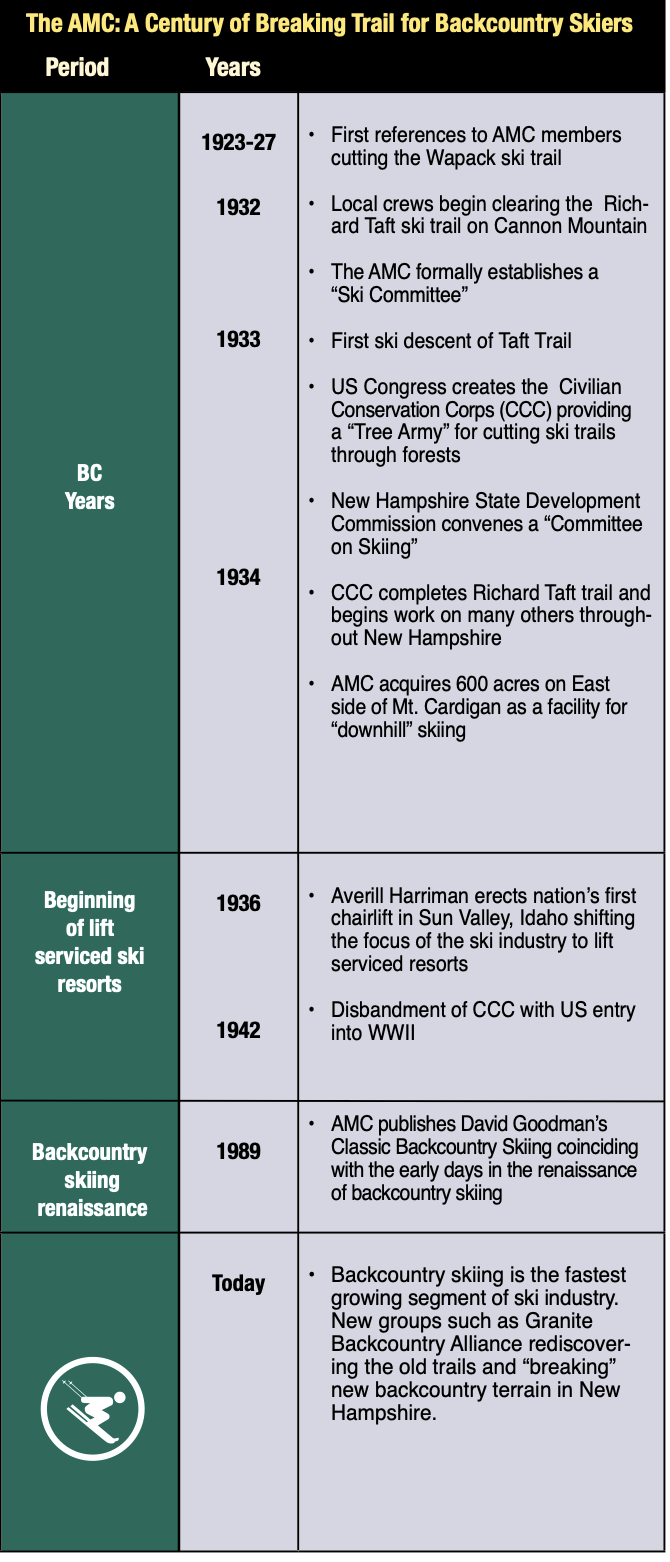
Over the last 30 years or so, AMC’s role has circled back to its backcountry origins, although playing its part in different ways to support the renaissance of backcountry skiing in the Northeast. Perhaps AMC’s biggest contribution to the revitalization of backcountry skiing has been information about trails and terrain. In 1987, Sue Cummings, Editor of AMC Books, engaged David Goodman to write a book on “backcountry skiing” in New England. Expectations were low, even regarded as “crazy” at AMC Books: “I heard after the publication of the first edition that the decision to publish a book about skiing was controversial, even radical, within the AMC of the 1980s. Some felt at the time that AMC was a hiking organization and had no business publishing a book about skiing. I found this amusing, since the AMC was in fact a major force in the development of skiing in New England in the 1930s, offering ski trips and instruction at Pinkham Notch and Cardigan Lodge. AMC was in fact one of the primary organizations promoting skiing in that era. My book Classic Backcountry Skiing simply reconnected us to our roots.” Whether Goodman was just in it to get paid for skiing or actually saw a trend probably draws a smirk: “I figured 100 skiers would buy it, and I would know 95 of them.” But give AMC Books credit for its perspicacity: “In the 1980s, only a handful of intrepid telemarkers were skiing in the great ranges of the Northeast. But I had heard stories about how skiers had been crisscrossing the high peaks of New England since the 1920s. I wanted to find out where these skiers had gone and hear their tales. Perhaps, I speculated, the seeds they planted could blossom again.” And that they have.
AMC Books published Classic Backcountry Skiing: A Guide to the Best Ski Tours in New England in 1988; the current edition, retitled Best Backcountry Skiing in the Northeast: 50 Classic Ski and Snowboard Tours in New England and New York came out in 2020. Simply put by Backcountry Magazine, Goodman’s guide is “the bible of Eastern backcountry skiing,” an epithet virtually no one disputes. It is available through the AMC online store.
AMC also fostered this blossoming with information from another often-forgotten asset: its maps. Finding some of these old trails, many reassimilated by Mother Nature and time, relied on knowing where they originally descended. This information was best found in period maps and the AMC has probably the most comprehensive database of maps for topography and trails of any agency in New Hampshire. In fact, the Club in the 1930s had specific committees for “Topography” and “Trails”. These committees recorded detailed notes on their activities in the club Bulletin and Annual Report. By tracking changes to maps over time, the ski community can rediscover the original existence, and approximate date of construction, evolution and current status of some of the trails which otherwise would be just names on a page.
The AMC Center at Pinkham Notch is as popular as ever as the epicenter of “extreme downhill skiing”. The Tuckerman’s Ravine and Gulf of Slides trails now serve as premier skinning tracks to access the alpine terrain above with the Sherburne providing the downhill exit through the forest for the Tuckerman drainage. And the destinations in the alpine terrain have extended to almost all of Mt. Washington: Oakes Gulf, Great Gulf, the other ravines – Huntington’s and Ammonoosuc – are all touring destinations for the intrepid. In fact, Brooks Dodge, a 1952 Olympian and son of “Mr. AMC”, Joe Dodge, would add 12 descent lines to Tuckerman’s including Dodges Drop and Cathedral with grades exceeding 45% in sections.
Mt Cardigan is enjoying a huge renaissance as a destination backcountry and Nordic facility. “With the revival of backcountry skiing that began in the 1980s, skier traffic on Mount Cardigan has once again picked up, and the venerable ski lodge, which underwent a major renovation in 2005, is filled most winter weekends. AMC Cardigan Lodge, with bunks for 60 people, currently offers full-service lodging on weekends and self-service lodging midweek. Skiers preferring a backcountry experience can stay two miles up the mountain at AMC High Cabin, a rustic self-service facility with bunks for twelve.” AMC volunteer crews today actively maintain the trails.
The AMC may be modest about its accomplishments, but it has been breaking trail for backcountry skiers for nearly a century.
For those interested in exploring the history of skiing in New England further, the AMC staffs an Archivist, Becky Fullerton, and stores volumes of Appalachia dating back to 1876, the AMC Bulletin and Annual reports and other materials at its Highland Center in Crawford Notch. The New England Ski Museum and Ski New England support websites and archives chronicling much of the history of alpine skiing in New England including archives with primary sources. John Allen comprehensively reviews the development of skiing in North America in his book From Skisport to Skiing: One Hundred Years of and American Sport – 1840-1940 published in 1993. The second edition of David Goodman’s guidebook: Best Backcountry Skiing in the Northeast: Fifty Classic Ski and Snowboard Tours in New England and New York is available through the AMC portal (https://www.outdoors.org). Goodman updated his guide with extensive additional material in 2020. Information on AMC NH ski activities (excursions and instruction) can be found on the Ski Page of AMC New Hampshire chapter website.