Still 48 4,000 Footers? – by Ham Mehlman
June 1, 2025
Posted in
Ham Mehlman is Editor-in-Chief of Mountain Passages and an AMC-NH member. He skis, hikes and bikes New Hampshire’s backcountry, trails and byways when time allows.
Oh the humiliation and shame.
In 2019, Mt. Tecumseh failed to make its number – 4,000 ft. The USGS (US Geological Society) slapped down a marker on the summit reading “elevation 3,997 ft.” Might as well read “foreclosed” or “condemned”. 142 years after first making the grade (so to speak) Tecumseh came up short. Its 142 year tenure as a 4,000 footer was longer than the US held onto the America’s Cup, its potential demise just as humbling – well let’s not hyperbolize too much. But Tecumseh was at risk of being cut from an important roster – the esteemed White Mountain 4,000 Footer list curated by the AMC, the highest honor for a White Mountain peak. For 88 years Tecumseh had been a respected founding member of the list first proposed by in a 1931 article in Appalachia Nathanial Goodrich. Would Shawnee Chief Tecumseh drop his endorsement after all these years? What happened? Too much Ozempic?
The Appalachian mountains have been shrinking for something like 240 million years (give or take a year…). Geologists speculate that, in eons past, tectonic forces pushed Mt. Washington above 15,000 ft. So the White Mountains have been shrinking for a while. Did Tecumseh finally shrink from old age?
Nope. Tecumseh may be a casualty of the digital age. And it may not be alone – the “NH48” might someday be the “NH46”.

Dartmouth Professor Elihu T. Quimby
Dartmouth College Geography Professor, Elihu T. Quimby, first pegged the elevation of Mt. Tecumseh at 4,003 ft. in 1877. Professor Quimby determined Tecumseh’s elevation using “triangulation”. History credits Dutch mathematician and cartographer, Gemma Frisius, for introducing the use of triangulation to surveying in 1531. Triangulation is still a standard method for surveying today despite the advent of global navigation satellite systems. Triangulation in surveying “is a method used to determine the position of points on the Earth’s surface by measuring angles to them from known points.” Knowing a specific length of a line between two endpoints, surveyors use the angles from the endpoints of the line to calculate the distance to an unknown point. For the original land surveys using this technique, the tops of mountains became important reference points in the surveys. For the purposes of determining angles Quimby used an instrument called a “transit theodolite”, credited to William Young in 1831. The same type of instrument, the transit theodolite, and a great deal of hand-calculated math were central tools for perhaps the most famous survey of mountains in modern times, The Great Trigonometrical Survey of India, which established heights for many of the Himalayan peaks, including Mt Everest in 1857. And Professor Quimby’s calculations, carried out to seven decimal places, were as impressive as any as seen in this image of his notes taken from Marshall Hudson’s 2019 article in New Hampshire Magazine entitled A 4,000-footer Controversy.
 Perhaps because of Professor Quimby’s meticulous methodology nobody felt the need to check his results, at least using triangulation, a theodolite and seven decimal point trigonometry. But along came LIDAR to revolutionize the toolset for surveyors. LIDAR is an acronym for “Laser Imaging, Detection and Ranging”. With LIDAR, surveyors use a laser to pulse a surface and measure the time for reflected light to return to the receiver. It is very accurate. Aerial LIDAR mapping systems can typically measure to within 2-4 cm vertically off a simple flat surface. Beginning sometime around 2007, the USGS began collecting LIDAR data on New Hampshire terrain, not exactly a simple, flat surface but not beyond the capabilities of the technology. The USGS is still adding to their datasets but by 2018 there was plenty of data for cartographers to recalculate elevations in the White Mountains. AMC cartographer Larry Garland “began analyzing the elevation data collected by USGS LIDAR surveys.” Garland found differences in the elevations for 45 of the 48 peaks on the White Mountain Four Thousand Footer list using the LIDAR data. For the most part the differences were minor and not consequential. South Hancock reflected the largest elevation change decreasing in height by 38 feet. Professor Quimby’s math and the theodolites instruments weren’t off by much, an amazingly durable process still respected today, but subtle differences can add up across big distances.
Tecumseh’s elevation decreased eight feet – relatively small drop; large implications for status. “4,000 Footer Drops Off the List” read the headlines. For hikers, the White Mountain Four Thousand Footer List is a pretty sacrosanct list. As of January 1,2025 over 19,000 people and 496 “canines” had earned their patch for tagging the summits of all 48 peaks. Revisions to the list – or worse, a list mistake – is a big deal, big enough that ten volunteers from the New Hampshire Land Surveyors Association (NHLSA) volunteered to cross check the result using GPS. And there was some reason to cross check for although LIDAR is highly accurate for clean surfaces topography in NH isn’t remotely simple and flat. Foliage, datapoint collection densities and even wind can affect the readings. GPS, itself, is also highly accurate but is not a popular method for measuring mountain tops given the significant amount of equipment and gear required to haul to the summit for a reading. But this was important as detailed in Marshall Hudson’s 2019 article, “Ten surveyors from all over New Hampshire converged at the foot of Mt. Tecumseh one foggy morning to tackle this project. There is no access road to the summit, so all equipment had to be backpacked to the top. The group of surveyors broke down into smaller teams to tackle different assignments, including recovering area benchmarks, occupying base stations, differential leveling, setting a permanent control point at the peak, and dispersing equipment to share the workload in hauling it up and hauling it back down the mountain.” The result: 3,997 feet, a measurement adopted as official by the USGS and memorialized in the brass marker found on the summit.

Tecumseh off the list? Hold on.
For the moment, the stewards for the White Mountain Four Thousand Footer list, a committee of 13 from the AMC Four Thousand Footers Club, is sticking with the historical list despite evident discrepancies. By vote in 2021, the AMC Four Thousand Footers Club elected to continue to recognize 48 peaks and their heights based on the Club’s 1998 revision for historical reasons, “at least until new USGS quadrangle maps are published.”

Mt Tecumseh on current Waterville Valley USGS Quadrangle
Despite the fact that the USGS marker started the ruckus, Mt. Tecumseh’s hopes of remaing on the NH48 may depend on USGS activities, specifically its process for updating maps, apparently an infrequent event. The USGS officially integrates its data into topographic maps called “quadrangles”. Most USGS map series divide the United States into quadrangles bounded by two lines of latitude and two lines of longitude. In the US, the quadrangles generally cover 7.5 minutes of latitude and 7.5 minutes of longitude and are therefore referred to as “7.5 minute quadrangles”. There are 197, 7.5 minute quadrangles covering New Hampshire. Mt Tecumseh lies in the “Waterville Valley” 7.5 minute Quadrangle. USGS does update quadrangles but focuses most of its efforts “in areas where change is occurring rapidly (urban and developed areas).” Apparently, change in the Waterville Valley quadrant is tortoise-like. The Waterville Valley quadrangle dates from 1980 based on work done in the 1970’s.
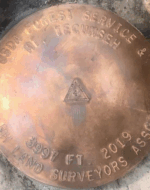
USGS marker atop Mt. Tecumseh
The LIDAR data may shuffle the White Mountain Four Thousand Footer list in other ways. Inclusion on the list also requires that peaks have a “prominence” of at least 200 feet. Prominence is “the vertical distance between the summit of a mountain and the lowest point on a ridge that encircles the mountain before rising to a higher peak. In essence, it measures the “independent height” of a peak.” A fuller explanation of prominence can be found in our post “All things 4,000 – Lists, Clubs, History and Experiences.” But suffice it to say that determining prominences historically involved a lot of approximations. This was true for Goodrich’s original list in 1931 and for the AMC 4,000 Footer Club committee in 1957 and presumably through its last revision in 1998. But terrain is complex. The more accurate and specific the data and the more of it, the better for mapping the undulations. The 48 summits on the 4,000 footers list are just 48 data points. Determining the contours of the surrounding topography could use an infinite number of data points. Until recently, determining prominences was almost an art practiced by cartographers meticulously studying contours of USGS quadrangle maps, some carefully measured, others estimates and everything in between assumed to be immaterial. But mapping contours has always been a function of data in/data out. The denser the number of elevation readings, the more data to inform mapping. And data generation and analysis is now the domain of machines. LIDAR massively increases the data inputs for map generation and computers and software replaced humans to crunch the numbers. In 2016-2017, computer scientist Andrew Kirmse created an algorithm that theoretically calculated the topographic prominence of every peak on earth. “Working with DEM (digital elevation model) data created by Jonathan de Ferranti (from SRTM and other sources), Andrew built upon the pioneering WinProm program written by the late Edward Earl. The results of this analysis were used to add prominence information (key saddle elevation and location) for many thousands of peaks.” Peakbagger.com now lists prominence data for thousands of peaks including the NH48. The elevation revisions to Mt Lincoln and South Hancock and new topographic data drop their prominences below the 200 foot criteria according to the Peakbagger.com data. By the Club’s criteria they too should drop from the list. Mt. Guyot, on the other hand, gains sufficient prominence to now qualify for the list. The USGS quadrant argument (excuse?) may not hold water for these peaks. While South Hancock is in the “Lincoln” quadrant which last updated in 1967, Lincoln and Guyot sit in the “Franconia” quadrant updated in 2015, presumably with significant LIDAR data.
After all revisions based on LIDAR, the White Mountain Four Thousand Footer list may someday total 46 peaks vs the current 48.
The 31st edition of the White Mountain Guide publishes two versions of the White Mountain 4,000 Footer list, the official one recognized by the AMC Four Thousand Footer Club based on currently published 7.5′ quadrant USGS maps and a second based on the LIDAR revision. Perhaps the Guide editors reveal a bias by locating the LIDAR list prominently on the inside front cover while relegating the official list to APPENDIX B on page 654. Still, we have to acknowledge that the White Mountain Four Thousand Footer list in its current configuration has served its function incredibly well over the years. Whatever its future, it has provided great challenges and adventures for thousands.
As for Tecumseh, no shame yet. He is still proudly wearing out the boots of many peak-baggers. And just in case, he seems to have sprouted a three plus foot cairn on top to ensure his status.
Selected References:
- AMC Staff, 4,000-footer Drops Off List of 48, Outdoors.org website
- Marshall Hudson, A 4,000-footer controversy, New Hampshire Magazine , 2019
- All Things 4,000, Mountain Passages post, 2024
