Her Quest to Climb 3.65 Million Vertical Feet in 2026, Really – by Ham Mehlman
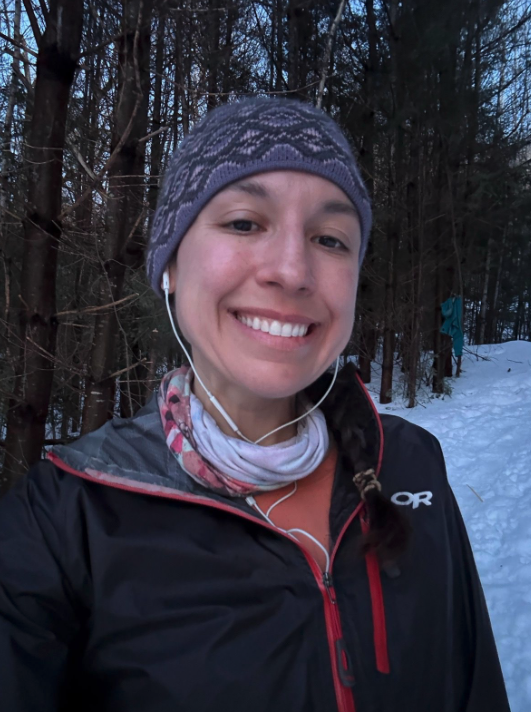
How to Follow Amber:
- Instagram: Constant0413
- STRAVA: Amber Constant
How to Donate to Support United Cerebral Palsy:
Ham Mehlman is Editor-in-Chief of Mountain Passages and an AMC-NH member. He skis, hikes and bikes New Hampshire’s backcountry, trails and byways when time allows.
“Wait, what? Did you say your goal is to climb 3.65 million vertical feet in a calendar year?” My mind struggles to chip the rust off the mental math registers to process the number of zeros in 3.65 million vertical feet. Perhaps the wind whistling across Lonesome Lake twisted the words, the chill air addling my brain already weary from hiking 1,000 ft. to the lake. Is climbing 3.65 million feet in a year possible? How do I put that effort in context. That’s 10,000 feet per day over 365 days. Who climbs 365 consecutive days? That’s 869 hikes up Mt. Washington from Pinkham Notch (assuming a 4,200 ft climb.), 2.38 ascents/day. You would have to hike the NH48 4,000 footers 48 times by the most efficient route – the White Mountain Directissima ~75,000 ft – to gain 3.6 million feet. Still unfathomable (but a nice, if coincidental, numerical symmetry.)
Well, meet Amber Constant. Climbing 3.65 million vertical feet is her goal for 2026. That might be a world record for those keeping track. Half way through the year, she is tracking near pace, booting up nearly 1.7 million vertical feet through June according to STRAVA. And she has the long summer days and perhaps more favorable weather in front of her.
Jan. 1 through June 30 (YTD):
| Activities | 171 |
| Distance | 2,903.0 mi |
| Time | 1,323h 37m |
| Elev Gain | 1,684,711 ft |
And her weekly results over the last 4 weeks:
| Activities / Week | 6 |
| Avg Distance / Week | 117.1 mi |
| Avg Time / Week | 57h 26m |
| Elev Gain / Week | 66,672 ft |
Editor’s note: On April 23, day 113 of her project, Amber surpassed 1,000,000 vertical feet climbed. Her accomplishment smashes the previous New England record time of six months to reach this milestone. As she writes on Strava: “Today, I broke the longstanding New England record of 1,000,000 vertical feet in 6 months in 113 days. And if I can keep going, every million from here should come faster. Eeeeeeek.” Congratulations Amber!
And if the ratio of Amber’s total distance to elevation gain holds, she will probably pace in excess of 6,900 miles over the course of her endeavor, 2.78 times the distance of NY to LA. And for those curious step counters, Amber is wearing out her boots with 52,907 steps/day (((6,900miles * 5,280 ft./mile)/313 days) * 2.2 ft. stride, (assumes climbing 6 days/week)). But this estimate assumes a normal 2.2 ft. walking stride length for a 5′ 5″ woman calculated on a level surface. Amber’s trails are not level. Yikes…
Amber agreed to answer a few questions in writing either before, in between, or after her laps about her background, motivation and routine for taking on this challenge. “Before” is apparently early based on receiving one of her emails at 4:06 am…
Background – Where did you grow up? How did you get into ultra sports? What were you doing before spending your entire day on Lonesome Lake trails?
I grew up in New Orleans, Louisiana. I got into ultra sports after a major injury. Prior to that, I never wanted to run more than 35 miles. However, after a fall that fractured my hip and tore ligaments, a subsequent surgical procedure accidentally nicked my sciatic nerve, leaving me with about 60% lasting motor and sensory damage.
I now have limited fine motor control, reduced proprioception, and some numbness in my right leg, which sometimes causes me to drag it while running. After doing everything I could to return to running over the course of three years, I felt like I had been given a second chance. My brain chemistry seemed to change, pushing me to complete four 100–200 mile races in the past year and ultimately leading me to this project.
Prior to Lonesome Lake, I was also training by doing repeats on mountain segments and spending most of my time on the Appalachian Trail in preparation for my last four projects in 2025. In the past year alone, I have trail run 1.2 million vertical feet in just seven months.
In addition, I have completed several vertical feats, including climbing 42,000 feet in 48 hours on my favorite mountains, being the first place woman at the Ascutney Vertical Backyard Challenge, climbing 77,000 feet in 64 hours, and setting several FKTs [fastest known times] on technical Northeast routes. These include the New Hampshire section of the Appalachian Trail (158 miles with 54,000 feet of elevation gain) and the White Mountain 100 Yo-Yo (190 miles with 71,000 feet of vertical gain).
What is the background for vertical climbing challenges? Do people keep records of this sort of thing? If so, what is the current hurdle?
In the United States, the primary area that attracts vertical challenges is the Manitou Incline in Colorado Springs. There, they have a tradition called “Vertober” which involves keeping track of vertical feet climbed in the month of October. People compete to see who can get the most. Additionally, most of the current records are held solely on the Manitou Incline, with the current male record around 3.65 million in a year, and female record around 2.4 million. I am waiting for confirmation on those numbers from Guiness World Records.
What were you thinking in deciding to do this? How did you happen to choose this challenge? Why 3.65m ft.?
I have always loved vertical, and once I finished the White Mountain 100 Yo-Yo, I knew this was the next move. 3.65 million is the overall record, set on the Manitou Incline, and I really want to highlight the White Mountains of New Hampshire. On the Manitou Incline, runners are climbing man-made stairs, and I want to do this on natural trails. I love these mountains and I feel that they don’t get the recognition they deserve. Also, I want to highlight the amazing community here! The trails are steep and the conditions are incredibly challenging, but the community is so supportive!

What is your typical daily and weekly routine?
My daily routine involves waking up early, preparing my snacks and meals for the day, and making a quick breakfast for the car. I also try to give my cat attention for 10 minutes and do mobility work before heading out. To lock in for the day ahead, I blast music in my car, and drink a Redbull. I do laps for around 12 hours, sometimes solo, and sometimes joined by friends! On the ride home, I put on music to decompress and think about the day. When I get home, I make dinner, shower, and wear recovery boots for 20-30 minutes before going to sleep.
What does your plan look like to get to 3.65m ft.?
The first month was “Phase 1”. During this phase, I started with a base of 8,000 feet per day and one rest day per week. The goal was to see if my body could tolerate that amount of load and begin to work up towards 12,000 feet per day. The second month was “Phase 2” where I started gradually increasing vertical by 10-15% per week, until I reached 12,000 feet per day. This amounts to 72,000 vertical feet and 120-130 miles per week. “Phase 3” started in March, which involves 12,000 feet everyday with one rest day per week. Next, I will start “Phase 4”, which will involve a few occasional 14,000-20,000 foot days. The determining factor for bigger days will be weather and trail conditions.
Funniest response to hearing your plan?
I don’t have a specific story! People generally have the same reaction and typically follow up with the same few questions. When I tell them the number I’m trying to get to, they are usually just amazed.
How do you select the trails you climb.? Do you have criteria for length, pitch, surface conditions etc.
The trail should have at least a 2:1 ratio of mileage to 1000 feet of vertical. Currently, I prefer grades of 24-38%. Once summer comes, and conditions are more consistent, I believe I will have more trails to choose from. To me, it doesn’t really matter how long the trail is, but the efficiency, or ratio, does matter. Surface conditions definitely matter. For example, right now [March], the Lonesome Lake Trail is in good condition, while the Old Bridal Path looks like Swiss cheese with the postholing. I prefer trails that are solid and relatively smooth underfoot to minimize how much I have to think about footing.
What are your preferred tracks?
In January I did mostly Liberty and Flume via the Liberty Springs Trail. In February, I moved to the small ski area right in front of my house, Monteau. It has a 0.5 mile trail with 550 feet of vertical gain. It was nice because the weather was more forgiving than the higher peaks and having no drive was great! In March, it’s been mostly Lonesome Lake with a few days of Liberty repeats. Once summer starts, I hope to be moving around the White Mountains much more, giving myself a bit more variety.
Doing this in the White Mountains introduces big seasonal differences. What is favorite time of year for training? Favorite surface conditions? Is climbing on snowpack easier or harder than a dry trail?
I prefer summer the most for trail running, and especially for this project. It brings nice weather and consistent conditions. However, when you have great winter conditions, the firm but soft ground decreases the impact on your body. That being said, in winter, the smooth ground means you are dorsiflexing your feet constantly and putting more stress on your Achilles. In summer, it’s nice to utilize big muscle groups such as quads and glutes on the rocks and dirt.


Do friends accompany you or is this mostly a solo effort?
When it’s bad conditions, it’s mostly me. On nice days, though, I see a lot of people and friends often join for a bit! I think when summer comes, I’ll have many people with me at all times. Right now, lots of friends are skiing and scared off by the notoriously bad spring conditions.
Any idea of your daily calorie needs? How do you manage fluid metabolism and energy needs. Do you monitor with an app. Do you follow a particular diet?
I don’t follow any particular diet, but I do prefer to eat healthier snacks and whole foods. Some things that I enjoy on trail are local sourdough bread, turkey, Kodiak protein granola bars, grapes, home-made pizza, kettle chips, etc. Earlier in the winter, when the temps were freezing every day, I would consume about 6,000-8,000 calories a day because it took more energy to stay warm. Now, I’m eating around 5,000-6,000 calories a day. For fluids, I drink about 3.5L per day. That includes Redbull!
Does anyone sponsor you in your effort? Are using your project to raise money for a cause?
I am mostly funding this project with my own savings! Sometimes people spontaneously send small donations which I really appreciate! I wish I had more sponsors for the project. A special shout-out to the generous support of Dr. Mike Nash, PT in Hanover, NH.
But I am raising money for United Cerebral Palsy in honor of my brother. Please visit my GoFundMe page. if you want to contribute. Your support is much appreciated!
Most important gear?
Poles. Trail Runners. Spikes. Running Vest.
Do you use poles?
I started using poles last year in November, just a few days before the Ascutney Vertical Backyard Challenge. I soon realized I should have been using them the whole time. Now, I can’t be without my poles on any mountain.
How many boots do you expect to go through?
I currently have 17 pairs of Hoka Mafates Speed 4 trail runners in my rotation that I stocked up on last year. During Winter and Spring, I wear spikes every day, so the tread isn’t getting worn out. However, once summer starts, I believe that every 300 miles I’ll have to throw a pair out.
How do you feel at the end of the day? Do you ever get blisters?
Very variable. If the conditions are good and I have friends with me, I’m in the best mood! However, if I’m alone, in terrible conditions, then I can be pretty miserable. I haven’t gotten a single blister yet, but I am well versed on foot care and I utilize toe socks.
Any injuries so far that have disrupted your schedule?
 I haven’t had any injuries that have disrupted my schedule. However, I got very sick in early February which forced me to take 3 days off, putting me a bit behind schedule. Despite this, I pushed through the tail-end of the sickness and eventually started developing pneumonia, which forced me to take antibiotics. For the rest of February, it was very difficult to get my mileage and vertical in while I was sick. I was eventually able to build back up, though.
Favorite story from the trail? Worst story?
The worst story would have to be the day of very deep postholing, in combination with premature failure in the monorails [packed snow trail] on trail. This was on Liberty Springs in early March when the temps rose to the 40’s-60’s. It took forever and was super hard to finish the vertical.
Another day, the snowfall was too great on Flume and Liberty, and I had to pivot at the last minute to the small ski hill in front of my house. That was the start of doing laps on Monteau all February.
My favorite trail story was Valentine’s Day when friends joined me all day on the mountain. We laughed for hours about nothing and really valued the day together.
What do you do in the few moments you aren’t climbing?
I take one day off per week, but honestly it really hasn’t been a full day given the nasty spring conditions. With the conditions, some days go 15-16 hours and go early into the next morning, which puts me behind. On my rest day, I am so exhausted that I can’t do much, but I usually just hang out and talk to friends.
Is there any weather in which you won’t hike? How does weather affect your days?
I hike in any weather, since I don’t have much of a choice if I want to break the record. If I have good weather, with pristine conditions, I can finish in around 11 hours. That includes chatting with people, resting, eating, peeing, etc. Horrible conditions with monorail failures, rain, high wind, wet snow, snowstorms, etc. have had me on the trail for up to 16 hours.
Other thoughts?
Shout out to two special people that have been helping me tremendously with this project: Joe Palisi & Chase Hall.
