AMC 150 HISTORY SERIES: Chapters 1-7 – by Becky Fullerton, AMC Archivist
February 28, 2026
Posted in
The Appalachian Mountain Club (AMC) celebrates the 150th anniversary of its founding in 2026. To recognize this auspicious milestone, we’ll be sharing historical highlights about the founding and development of the club. Everything from trails to trips, conservation to canoeing, lodges to lean-tos, with surprising stories and little-known facts in between. Though not a comprehensive history of AMC, this series is meant to help us connect to our heritage as the country’s oldest conservation and outdoor recreation nonprofit and to better understand our own place in this special community that has been helping people know and love the outdoors since 1876. Below you can read a compendium of all Chapters to date including:
- Chapter 1: The Origins of the Appalachian Mountain Club in 1876
- Chapter 2: Our Founding: “The Association Shall Be Called the Appalachian Mountain Club”
- Chapter 3: Death in the Mountains: The Curtis and Ormsbee Tragedy
- Chapter 4: Early AMC Land Conservation in New Hampshire
- Chapter 5: Appalachian Water Club: How Paddling Became Part of AMC
- Chapter 6: Oh Canada! AMC’s Early Adventures North of the Border
- Chapter 7: A Continuous Journey: From Charles E. Fay’s Vision to the AMC 150 Relay
Chapter 1: Before the Beginning
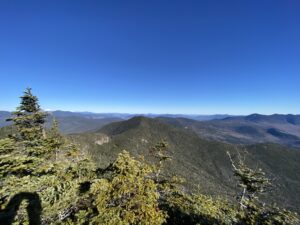
View from Mt. Osceola
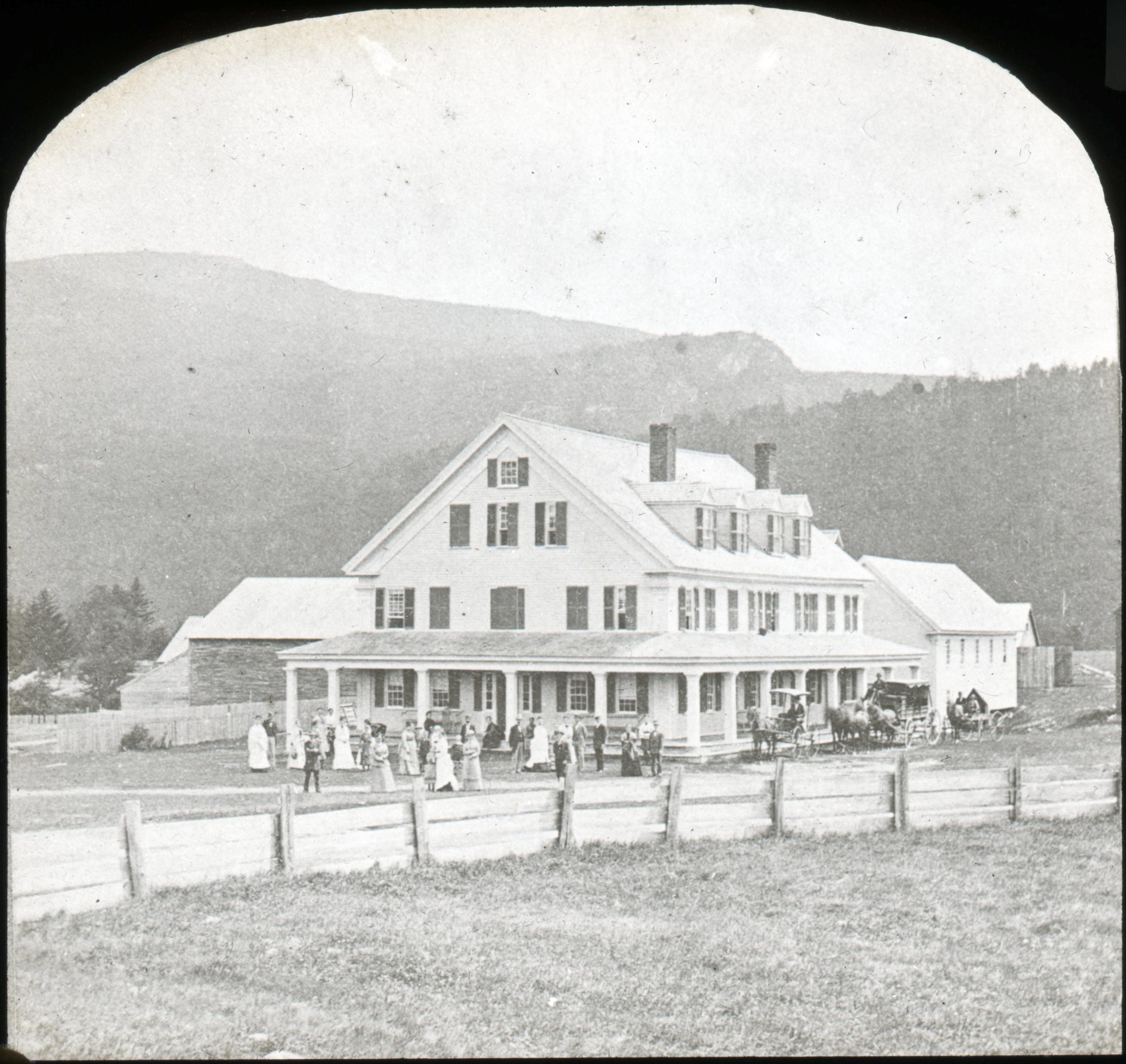
On a summer’s day in 1873, a trio of men stood on the summit of Mount Osceola, high above Waterville Valley in New Hampshire’s White Mountains. From this lofty vantage point, they could see the nearby Sandwich Range, the distinctive outline of Mount Carrigain, and the densely forested expanse of the Pemigewasset Wilderness. If the day was very clear, they could have seen the Presidential Range to the north, Lake Winnipesaukee to the south, and peaks of the Green Mountains to the west. A guidebook published that year claimed that on exceptionally crystalline days, one could see the Atlantic Ocean. The three had ascended the peak by way of a rough path from Waterville, possibly having stayed the night at the Greeley House, the valley’s only hotel in an area that attracted considerable summer tourist traffic.
How many of those annual tourists cared to climb mountains on foot is unknown, but at the time these men were in the minority. Two of the party, Edward Charles Pickering, age 27, and his teenage brother William, were experiencing their first summer in the White Mountains. They eschewed typical pursuits like carriage rides to scenic vistas, gentle walks on forest paths, and picnics beside bubbling streams. Arriving from Cambridge, Massachusetts, they were taking part in a city-dweller’s typical summer stay in the clean mountain air. However, they were there to explore the land on foot, fortunate to have found a willing accomplice in retired U.S. Army quartermaster and civil engineer Colonel Charles William Folsom. As they rested on the summit of Osceola that day, we can imagine Edward marveling at the thought of climbing all those mountains and wondering if others might hold the same interest in hiking and exploration. Though he did not know it yet, he was already building the community that would help him answer that question, and it would lead to the formation of America’s oldest outdoor recreation club.
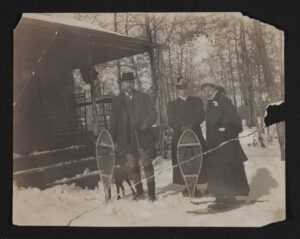
Edward Charles Pickering
During Pickering’s climb up Mount Osceola there was talk of a society of sorts. Decades later William would recall a conversation the party had on that day about forming a club. That summer Pickering ascended several peaks both with trails and those presumed to be without. The few established trails that existed would have been rough, with smaller, inconvenient trees cut out of the way and the occasional blaze made by chipping off a section of tree bark with an axe to expose the lighter wood of the tree beneath. He often found himself hiking “one of those many summits said to be unclimbed and inaccessible … only to find them frequently visited and presenting no difficulty.” This was likely indicated by well-worn bushwhack routes, summit vegetation cleared by an industrious hiker or signs of frequent camping. Pickering saw this as a sure sign that others not only wished to climb the area’s peaks but also wanted to open new areas to exploration. He made the acquaintance of other recreationists in the mountains that season as well as seeking them out upon his return to Boston and Cambridge.
In fact, he ‘discovered’ a few of these fellow hikers not by meeting them in person but by spotting them in “Summit Registers.” Just as tourists used hotel guestbooks to announce their presence, hikers found a way to note their trips in the wild where no guestbook or front desks were to be found. Starting around the 1850s, hikers began to leave Summit Registers on or near White Mountain peaks. They consisted of small, rolled notebooks tightly sealed in jars, bottles or metal containers placed among the rocks of a cairn. It was through one such register on the summit of Mount Adams that Pickering met William Gray Nowell, another early advocate of forming something like AMC.
Over the next few summers, Pickering became part of the budding recreationist community of the White Mountains. By the summer of 1875 he was out hiking with several people who would be critical to the launch and success of AMC. Civil engineer John B. Henck, Jr., soon to be the club’s first secretary, in a letter to Appalachia journal on the club’s twenty-fifth anniversary, recalled that it was while “standing upon the summit of one of those mountains, I think Mt. Attitash, with Professor E.C. Pickering, that the first conversation on the desirability and feasibility of such a club took place between us.”
Pickering let the club idea percolate as he focused on teaching, getting married, and setting up the very first physics teaching lab in the United States. Even when he did find time to formalize an outdoor organization, his life was incredibly full. The year AMC formed, not only was he a working professor at MIT but treasurer of the Boston Society of Natural History and recording secretary of the American Academy of Arts and Sciences. In October 1876, he was elected the new director of the Harvard College Observatory. He officially took up his post on February 1, 1877, and would spend the next forty-two years making it one of the most respected observatories in the world.
Nonetheless, once Pickering had been bitten by the hiking and exploration bug, the genesis of a new club around that idea seemed almost inevitable. In the summer of 1875 Pickering stayed in the same lodgings as John B. Henck, where they “brought the plans of a Club into more definite shape.” At the end of that year, they rallied their White Mountain and local outdoor enthusiast friends to come together. About fifty postcards dated Jan. 1st, 1876, were printed and mailed to men who they saw as kindred spirits, stating:
“DEAR Sir,
You are hereby invited with your friends to attend a meeting of those interested in mountain exploration to be held at the Institute of Technology on Saturday, January 8th, at 3 P.M.
Yours truly,
E.C. PICKERING”
To be continued…
-
Chapter 2: Our Founding: “The Association Shall Be Called the Appalachian Mountain Club”

An AMC outing in the 1880’s or 1890’s
“DEAR Sir,
You are hereby invited with your friends to attend a meeting of those interested in mountain exploration to be held at the Institute of Technology on Saturday, January 8th, at 3 P.M.
Yours truly,
E.C. PICKERING”
This is the text of the famous postcard sent out January 1st, 1876, by Professor Edward Charles Pickering to anyone in the Greater Boston area he thought might want to start a club for mountain lovers.
Three preliminary meetings of the yet unnamed venture were held in the Rogers Building at the Massachusetts Institute of Technology in Cambridge, starting on January 8th. According to the Boston Evening Transcript, “Thirty or forty gentlemen were present” at the first meeting. Two more preliminary sessions followed on January 12th and 26th, to discuss what the group wished to accomplish, draft a constitution, and give the society a name. Several names were proposed to varying degrees of enthusiasm. Some favored an Alpine Club, while others wanted a New England Geographical Society or even the Mountain Exploration Society. At one point the New England Mountain Club was unanimously recommended. However, “it was afterwards maintained that but one person took part in this vote, no one else being bold enough, on so important a question, to venture even informally to express what he thought!”
Knowing that mountains were to in some ways be the center of their world for study and enjoyment, the scientists among the group steered in a geological direction. They settled on the Appalachian Mountain Club since it highlighted their nearest mountain system and provided a wide scope in terms of territory, stretching across the East Coast. However, they did not feel bound by the Appalachian chain of mountains alone. In terms of their objectives of mountain exploration and scientific observation, everything from the Himalaya to the mountains of the moon were fair game.
The first “Regular Meeting” of the Appalachian Mountain Club was held on February 9th. Here thirty-five people were voted in as Original Members and officers were elected to form a Council. Leading up to the second meeting on March 8th, the Council published a notice about the new club in local papers. Professor Charles E. Fay made the specific suggestion that invites be sent to “ladies as well as gentlemen.” From the public invitation, two hundred men and women showed up. Attendees dove into discussions of mountains and science, hearing lectures on geography, geology, and an adventurous day on Mount Tripyramid. Two types of mountain barometers used in measuring mountain heights were displayed and explained. Additionally, they took the time, since many women had shown up, to vote in favor of admitting women to membership.
The first set of club Officers and Councillors (as committee heads were known) hailed from the tight-knit New England scientific and academic community. Almost all of them had connections to Harvard, MIT or Tufts. Pickering, as the instigator of the whole venture, was naturally elected President. His role, as laid out in the club’s first Constitution was to preside meetings and “prepare for the annual meeting an address upon some appropriate subject, with a review of the operations of the Club the previous year.” His team included a Vice President, Secretary, and Treasurer, plus five Councillors to chair committees on Natural History, Topography, Art, Exploration and Improvements.
With officers and committee heads in place, the club could move forward with the work they had set out for themselves and for growing the membership. Clubwide meetings were scheduled for the second Wednesday of each month from October to June, with an Annual Meeting in January, and summer meetings booked as the Council saw fit. Eleven members were required to form a quorum for business. New members were elected through sponsorship and an open vote. Should one wish to join AMC, two current members had to write nomination letters. The club Secretary delivered nominations to the Council, which voted on each nominee. Next, nominees were announced at a club meeting. Members had time to mull them over and vote on the nominee at the next meeting. Once that gauntlet was run, new members had to pay a two-dollar annual membership fee and sign the club constitution.
Through five committee (or ‘departments of work’ as they were often called): Natural History, Topography, Art, Exploration and Improvements; Council members committed to “carry on a systematic exploration of the mountains of New England and adjacent regions, publishing its results from time to time, and will collect books, maps, photographs, sketches and all available information of interest or advantage to frequenters of the mountains. It will also encourage the opening of new paths, clearing of summits from which views may be obtained, and other improvements.”
In return, the club requested active engagement from its members in these activities. Members were asked to collect all facts they could about the mountains, from special places that should be visited and where to stay, to “all such information as would be of interest to the artist, pedestrian or student.” Through these first proclamations, invitations, and entreaties, the club set out for itself an infinite number of tasks and pursuits. The industrious Council got to work immediately, discussing the composition of a map of the White Mountains, planning exploration trips to be made, and demonstrating and discussing the latest equipment in mountain climbing and documentation.
First Field Meeting
Since the whole idea of a mountain club was to get out and climb some mountains, the next step for AMC was to organize a trip and their beloved White Mountains were the obvious destination. One enthusiastic founding member, Reverend John Worcester of Newtonville, Massachusetts, offered up the study of his summer residence in North Conway, New Hampshire as a summer rendezvous of the club. With an official place to meet, the first White Mountains outing occurred between July 26th and 28th, 1876. The party spent the first day pleasantly engaged in hearing about what the club had accomplished thus far and making resolutions about the proper methodology for naming mountains. On Thursday, July 27th a group of thirty ascended Mount Pequawket (also known as Kiarsarge and later Kearsarge North). The following day about 175 people rode the train through Crawford Notch to the Fabyan House at Bretton Woods. The train stopped long enough at the Crawford House for some of the group to ascend Mount Willard. Overall, it was a successful Field Meeting and proof that the new club could organize grand adventures outdoors.
First Year’s Reports of the Councillors: What did they accomplish?
At the end of 1876, the five Councillors were requested to give a report on what they had accomplished that first year. Only two departments reported their progress. The Councillor of Improvements William G. Nowell shared his department’s endeavors in reopening, clearing, cutting, marking and scouting new trails in the White Mountains. Its first accomplishment was improving an existing path up 2,234-foot Boy Mountain in Jefferson, New Hampshire. The trail led from the Mt. Adams House, a 60-guest hotel, to a low, wooded summit. This was promptly cleared to allow for views out over the neighboring peaks of Mount Madison, Mount Prospect and Mount Starr King. One might think that a group of nature-lovers would leave the trees as they were, but the activity of clearing summits to obtain views was quite common among early AMC parties.
Councillor of Exploration, John Rayner Edmands, reported on his own puzzlement about what his department should be doing and how to go about it. He admitted that no one in his department had been out exploring places of interest in the White Mountains, but a few officers and members of the club climbed several trailless peaks. Charles E. Fay and Gardner C. Anthony climbed Sandwich Dome. William H. Pickering and a friend climbed Mount Webster and Mount Jackson, Mount Crawford, Mount Resolution and Giant’s Stairs over the last two days of August. Edward C. Pickering and B.P. Moore climbed Mount Liberty by first climbing up through the Flume Gorge at the beginning of August. And John B. Henck climbed Mount Tremont in early September. All wrote long and detailed reports about their routes, the time it took, and things they saw.
Although Councillor of Art Charles E. Fay had lofty goals and long lists, he freely admitted that there were as of yet no artists among the membership who could contribute to the Art Department and had little to report until early the next year. He suggested that members contribute paintings, prints, photographs and other visuals they might collect on their summer trips to start off a collection. He had more to say in 1877 when the committee held an art exhibition at Massachusetts Institute of Technology. It was a three-day show that consisted of forty-seven paintings, studies and sketches, more than half of which were by women. They included many views of Mount Washington and other well-known spots around the White Mountains. Among some of the more prominent artists to display work were Benjamin Champney, Frank Shapleigh, and Samuel Lancaster Gerry.
At the start of 1876, Councillor of Topography Charles H. Hitchcock discussed plans for a map of the White Mountains, but he did not report success at the end of the year. An 1875 sketch map by J.B. Henck, Jr. was published in the first issue of Appalachia, but it did not include topographic lines, altitudes, or the level of accuracy that the club craved. Although it included every stream, road, railroad, and path (plus proposed trail routes) the map was mostly meant to “indicate the relative positions of summits which are incorrectly given in previous charts.” Therefore, Hitchcock’s committee spent the first two full summer seasons in survey work, aiming for a more detailed map in the future. The club ultimately would not publish its own full map of the White Mountains until 1887.
Councillor of Natural History Thomas Sterry Hunt seems to have been in the same data collection mode as Hitchcock, imploring in his first few reports that members observe, collect and share information on the natural world. As a geologist, he was especially interested in any data on and unique specimens of rocks that members could supply. However, he did ask that hikers make observations on plant and animal species, particularly on the highest elevations at which these things were found. He also hoped members would “record the location of remarkable or rare trees.”
Summation of the First Year-Plus
The first full year (plus a few months) of AMC was marked by enthusiasm and energy. During his address at the club’s first Annual Meeting in January 1877, Edward C. Pickering notes that the “present condition of the Club is highly satisfactory.” Although he notes that most of the work, recruitment of new members, and presentation of papers at meetings was done by members of his own Council, he held high hopes that the general membership would take part in keeping their own club running. He applauded the fact that meetings and outings were well attended. At the start of the second year of the club, the membership was 134.
The mapping and trail building work of the first summer season was paying off as more visitors to the White Mountains took to well-marked paths. It is not to say that people were not climbing peaks in the White Mountains before AMC was founded, but the Council’s simple urging to gather information and the opportunities to explore with others certainly caused an uptick in the number of “trampers” on the trails. Additionally, AMC was providing a place for scientists, academics, science hobbyists, explorers and recreationists to come together, exercising their curiosity and bodies in cultivating their love of the outdoors. The combination of recreation and knowledge seeking prevented the club from becoming what Charles E. Fay dreaded might be “simply one more learned society, leading a cold and possibly precarious existence” rather than the “vigorous, full-blooded, ardent club” he saw it become.
Chapter 3: Death in the Mountains: The Curtis and Ormsbee Tragedy
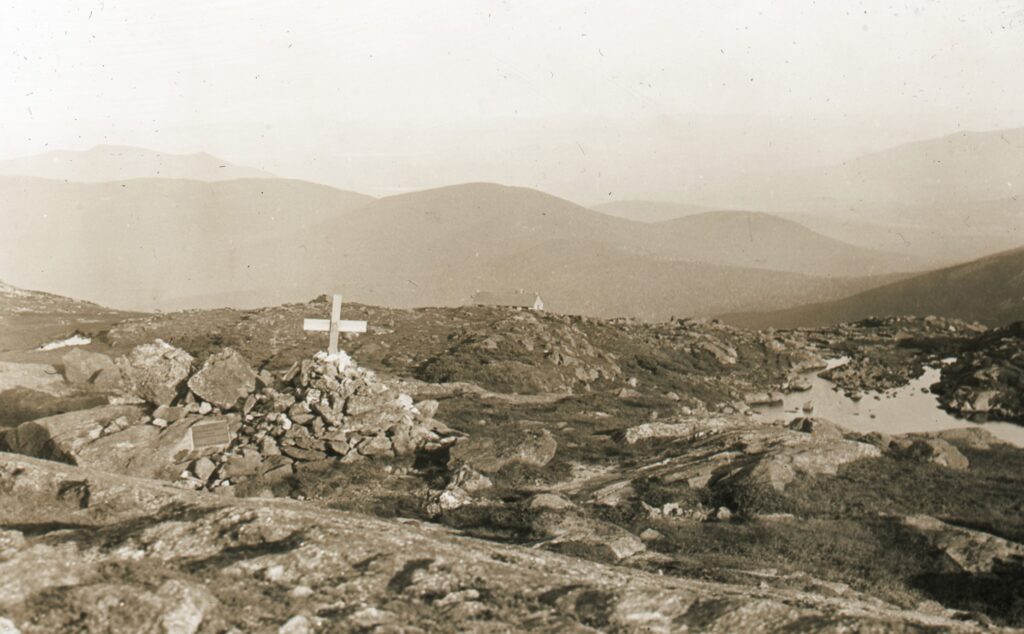
William B Curtis Plaque Near Lake of the Clouds in 1917. Courtesy of AMC Archives
June 30th marks the 125th anniversary of the 20th century’s first fatalities on Mount Washington. Since the first recorded death in 1849, over 175 people have perished on the Presidential Range. Though the leading causes are falling or being killed in an avalanche in Tuckerman or Huntington Ravine, dozens have died from hypothermia. By the turn of the 19th century, ten people had died on or around Mount Washington: four from hypothermia, three through accidents, one by drowning, one was crushed by ice in Tuckerman Ravine, and one went off on a hike and vanished, never to be found.
Many of these occurred before the founding of AMC, and none of the victims were members of the organization, so it came as a supreme shock when the club experienced its first Presidential Range death. On the last day of June 1900, club President Albion A. Perry kicked off the 35th Field Meeting of AMC at the Summit House on Mount Washington. The weather had been deteriorating throughout the day. After a windy night, an overcast dawn and socked-in summit awaited visitors ascending on foot or riding up the Carriage Road and Cog Railway for the week-long hiking and social extravaganza. Evening speakers were booked and excursions to points along the range scheduled. However, the opening Saturday and Sunday were better spent indoors. A party ascending Tuckerman Ravine on Saturday struggled with the wind, and a carriage on the road had to be weighed down with stones to keep from being blown off the mountain. The temperature on the summit that morning registered 25°F.
Less-menacing weather in the valleys below caused trampers to proceed, and it was with a hopeful outlook that many set out among the mountains that day. One solo hiker was Frederick D. Ilgen, a Brooklyn jeweler who planned to hike North and South Twin Mountains. For the week prior, he had been with fellow New Yorkers William B. Curtis and Allan Ormsbee. The trio left the city by steamboat on Friday, June 22nd, bound for Boston and by train to West Ossipee, New Hampshire. Ilgen notes that he and Curtis hopped off the train as it stopped along the way to sample any pies on offer, essentially eating their way north. Curtis also brought a supply of fruit for the trip, including a basket of plums that proved to be too sour to eat. The party stayed first at Wonalancet Farm, an inn run by Katherine Sleeper (later Walden), climbing nearby Mount Chocorua. From there they travelled in a clockwise circle around the White Mountains to climb peaks such as Passaconaway, Tecumseh, Welch, Moosilauke, Lafayette and Lincoln. Curtis took one day off at Waterville Valley to rest a knee he had strained the year before.
William Buckingham Curtis was known as “Father Bill,” and was considered by many to be a “Father of American Athletics.” Born in Salisbury, Vermont in 1837, his mother died of tuberculosis the following year and he contracted the illness when he was ten. His father, a Presbyterian minister, moved the family frequently, and when young William fell sick, he was sent to the mountains of Vermont to live with relatives. Under the influence of Henry Ward Beecher’s campaign of “muscular Christianity” – the promotion of athleticism to draw men to Christianity – Curtis recovered and eventually grew into a chiseled five-foot-nine-inch, two-hundred-pound hunk with blue eyes and a sandy beard. Starting with long-distance walking and mountain climbing, he picked up running, swimming, ice skating, gymnastics, weightlifting, rowing and track & field. His harness lifting record was 3,239 pounds and at the age of forty he could still run a 100-yard dash in 10.8 seconds.
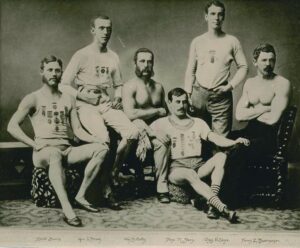
Curtis was a founder of the New York Athletic Club. Courtesy AMC Archives
He was twenty-four years old when the Civil War broke out and joined the 19th Illinois Volunteer Infantry Regiment. Staying on through the end of the war, he moved up the ranks to Captain and Adjutant. Afterwards, he moved to New York City and established the New York Athletic Club with Harry Buermeyer and John C. Babcock. He believed in the purity of amateur sport and wrote widely against the topic of fraud and gambling in athletics. Working as a journalist and editor of the Spirit of the Times, a sports newspaper, he spent his years writing, opening gymnasiums, acting as a judge at sporting events, and founding the Fresh Air Club. An additional hobby was visiting Coney Island dressed in poor farm laborer garb and exposing swindlers and con artists he encountered there.
Loved and scorned in the New York athletics scene for his strong opinions, he was respected for his efforts to encourage people to go outdoors and exercise for health. He joined AMC in 1898, visiting the White Mountains that year, but he was otherwise inactive in the club. The Field Meeting in 1900 was to be his first major excursion with the group. His companion for the trip, along with Fred Ilgen, was Allan Ormsbee, a member of the Crescent Athletic Club since 1895; though it is said he spent more time in the club library than participating in sports. He did, however, love trail work and rock scrambling. In 1899, he and Curtis marked out a trail from Cornell Mountain to Slide Mountain in the Catskills. Ormsbee worked for the Russell & Erwin Manufacturing Company, a maker of builder’s hardware. This was his first trip to the White Mountains.
At the end of a week of travelling and hiking together, Ilgen, Curtis and Ormsbee landed at the Rosebrook House in Carroll on Friday, June 29th. There Curtis and Ormsbee planned on making the train ride to the Crawford Depot the next morning, to climb short and sweet Mount Willard before ascending the eight-mile Crawford Path to meet up with the Appalachians on the summit of Mount Washington. Ilgen favored more exploration and decided to hike the Twin Range on Saturday.
The three men sat with other hotel guests in the dim dining room the following morning. Unable to differentiate one pitcher from the next in the low light, Curtis poured himself a tall glass of cream rather than milk. He did not realize the mistake until downing most of it, after which he set down his glass and quietly said, “Boys, I guess I made a little mistake.” Ever able to laugh at himself, he gave the party, if not the other guests, a good chuckle.
Here the trio split up. Ilgen went off for a cold, wet day on North and South Twin in which he was rained and hailed on. Returning to Fabyan’s station in time to meet an AMC group bound for the Cog Railway, he loaded his and the other two men’s luggage on the train so it would be waiting for them at the Summit House. The higher the Cog chugged, the worse the weather became. Violent winds and ice-covered rocks met the visitors as they deboarded and hurried indoors.
As Ilgen hiked, returned and rode the Cog, a different story was unfolding for Curtis and Ormsbee. After buying tickets at Twin Mountain, they rode the Boston, Concord, Montreal & White Mountains Railroad east to the Crawford House, where they asked a teamster passing by where the Crawford Path began. This was “somewhat before ten o’clock, or else about noon,” according to the teamster, who was interviewed later. The pair started up the trail under cloudy skies and reached the spur trail to the summit of Mount Clinton (Pierce), where they located the AMC Summit Register and signed their names with the date. Up ahead two workers from the Crawford House, James C. Harvey and his colleague “Smith” were cutting back vegetation on the side trail around the south side of Mount Pleasant (Eisenhower). Harvey reported that the weather had reached gale force by the afternoon. He spotted Curtis and Ormsbee as they turned up the trail over Pleasant and ran to persuade them to take the lower trail, but the men did not hear him in the wind. Harvey and Smith continued working until about three o’clock when the storm drove them down the mountain.
Further ahead, Curtis and Ormsbee passed Charles Allen and Walter Parker who were descending after tending to a group camping on the south side of Mount Washington. Parker exchanged greetings with the duo, while Allen asked the men, “How are you?” A simple “Hullo!” was the only response. Allen then warned of the worsening gale ahead and counseled them to go back. There was no reply, and all continued their respective courses. Allen noticed both men were minimally clothed for the conditions. He saw that Curtis was carrying a camera. In fact, both men had cameras with them, as well as some bread, a bottle of milk, and a pocketknife. Neither had extra clothing, hats, gloves or rain gear.
At the summit of Washington, Fred Ilgen checked the Summit House register for his friends. Calls were made to the Crawford House and other nearby hotels to see if they were there, but no one reported having seen them that day. A group of guides set out to search as it grew dark, but their lanterns were snuffed out and they were battered by the wind too much to go far on the icy rocks. The storm intensified in the night and blew continuously through Sunday. It eased Sunday night and the AMC party, essentially trapped in the Summit House for a day and a half, emerged to a bright, warming Monday morning. Accumulated ice fell in chunks from every surface – buildings, chains holding the buildings down, the Cog Railway tracks and platform.
Search parties descended in the direction of Tuckerman Ravine and the Lakes of the Clouds. Soon after, the empty milk bottle, bread, cameras and knife were found in a hastily cut shelter among the prostrate spruce on the east side of Mount Monroe. At about 11:15am on Monday, July 2nd, AMC cartographer Louis F. Cutter located the body of William Curtis about a third of a mile beyond this shelter, close to the lower Lake of the Clouds. He had clearly fallen hard, likely from exhaustion and hypothermia. He was found face-down in a ditched-out section of trail and there was a large bruise on his left temple.
Late in the afternoon, word arrived at the summit that Herschel C. Parker had found the body of Allen Ormsbee, not in the path, but among the rocks of the summit cone a short distance from the buildings on top. It is likely Ormsbee had tried to make a beeline for the summit. Struggling over the boulder field that makes up the cone of Washington, he must have stumbled and been blown over dozens of times on the icy rocks. Numerous cuts and fifty bruises were found on his body.
The two bodies were borne to the summit where they were laid out in a barn to await a Cog train to bring them down the mountain. It was dark by the time they were secured to cots and placed on top of the seats in a train car. Ilgen rode down in the unlit car but under a few gleams of light from the lantern in the engine ahead noticed that Ormsbee had not been securely tied in. He stood holding the man’s head so it would not swing loose over the edge of the cot. They were met by undertakers at the Base Station, and preparations were made for the long journey back to New York City. They arrived at Grand Central Station on the morning of July 5th, met by a crowd of members of the many athletics clubs of which they had been a part. A funeral for Curtis was held at the Madison Avenue Presbyterian Church on July 6th. He was buried at Woodlawn Cemetery. Ormsbee’s funeral was held at his family’s home in Brooklyn on the same day, and he was buried in a large family plot in Hartford, Connecticut. He was just shy of his twenty-ninth birthday.
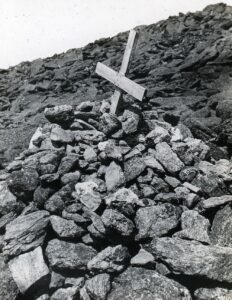
Ormsbee memorial on Mt Washington circa 1920. Courtesy AMC Archives
In the autumn of 1900, the Fresh Air Club placed two plaques on Mount Washington which, along with wooden crosses and cairns marked the spots where Curtis and Ormsbee had perished. While still meeting on the summit after the tragedy occurred, AMC discussed the construction of an emergency shelter on the upper reaches of the mountain. A circular was later sent to area hotels soliciting donations, but they were meager at best. Another plea was sent to club members in the spring with much better results. By June 1901, the committee formed to make the shelter a reality had visited the mountain. Only one builder bid on the job – F. L. Temple of nearby Whitefield, N.H. The shelter was built between July 8th and 14th, with Temple and his men staying at the Summit House each night. Materials were shipped up via the Cog Railway and carried the one-and-a-quarter miles down the Crawford Path.
The Refuge, as it was known, consisted of a ten-by-ten-foot building with a slanted roof ten feet high at the front and two and a half at the back. A door and two small windows faced south, and two closable vents at the back helped with air circulation. The flooring, roof and walls were made of spruce and insulated with Cabot’s Sheathing Quilt, a thermal and sound insulation made from dried eelgrass sandwiched between layers of paper or cloth. The whole structure was attached to heavy sills bolted to the rocks below. Inside a bed of fir boughs was laid out and six blankets hung on a rail. A bucket, water can, candles, matches, candle holder, lantern and a logbook were also left inside. Signs were placed along the trail a quarter and a half mile below the shelter to guide hikers in need.
The committee stressed that the shelter should only be used in emergencies and a large sign reading “Not for pleasure camping” was hung on the door. However, by the end of the year they were reporting violations of this rule as people took advantage of free lodging on New Hampshire’s highest peak. The goods inside offered another temptation. During its second year of operation, two blankets disappeared, taken by boys hiking the Crawford Path. They were ultimately recovered, but replenishing the refuge with emergency gear was a constant frustration. Jars of crackers were raided for hiker lunches, matches were used to light pipes, and a can of kerosene was used to light unnecessary fires. During one season, a stone fireplace was assembled inside the wooden refuge and the ashes of a fire were found therein. In his regular column titled “The Mountaineer” in Boston’s Evening Transcript, John Ritchie, Jr. scolds the public for these and other transgressions, like the theft of trail signs “ruthlessly torn away by persons who should have learned better manners.”
The struggle continued in making the public use The Refuge only for its intended purpose as an emergency shelter until the end of its existence. After Lakes of the Clouds Hut opened nearby in 1915, the shelter became redundant. The club tossed around the idea of building another emergency shelter near Boott Spur, but the idea never came to fruition. Finally, in 1926 the shelter, “long an eye-sore” was torn down.
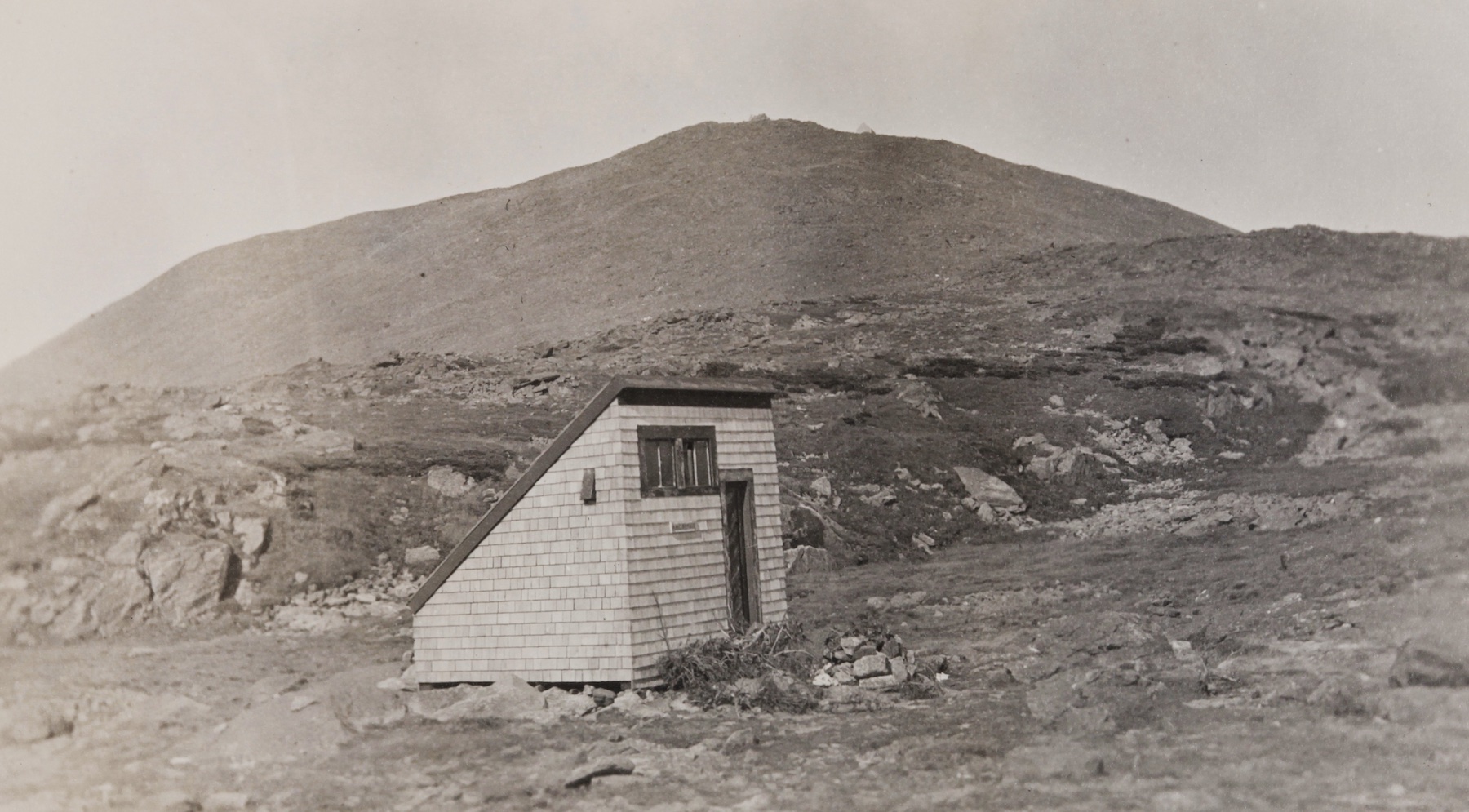
The Refuge on Mt. Washington
Chapter 4: Early AMC Land Conservation in New Hampshire
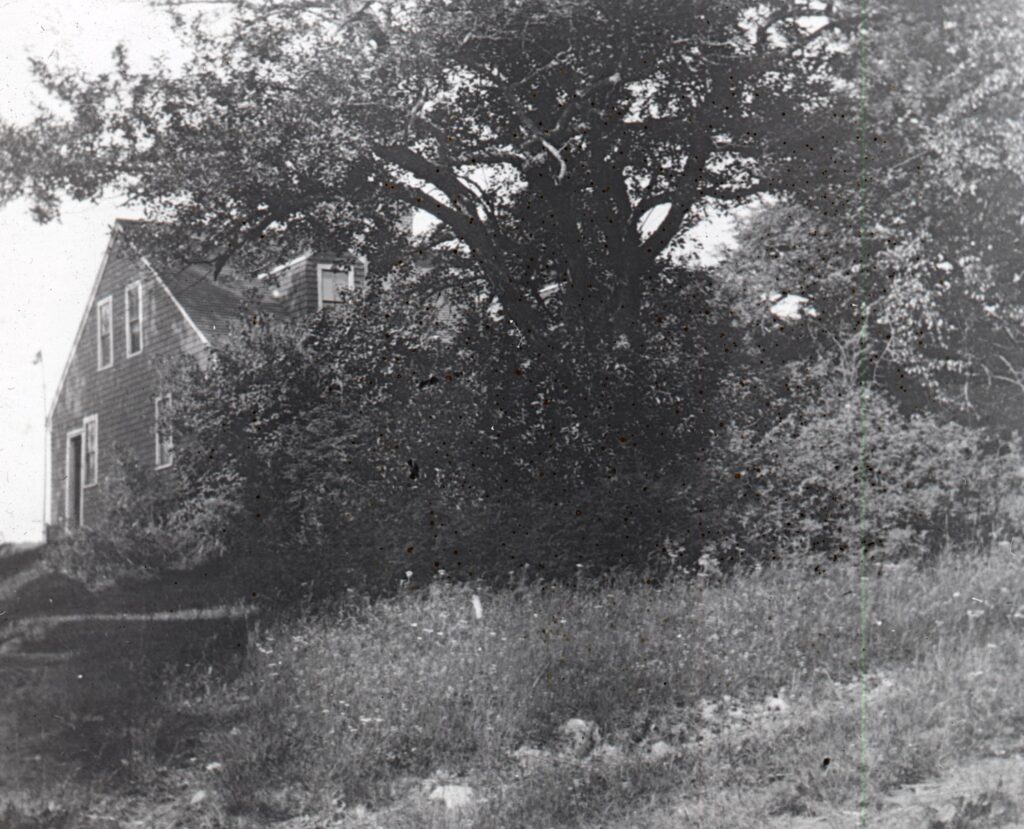
East Side of ‘The Old Patch Place’ at AMC Rhododendron Reservation -1907
Spoiler Alert: The Appalachian Mountain Club was not a conservation organization when it began. Exploration of mountains, recreation, and the pursuit of natural science knowledge were its primary goals. One would think that a group that is renowned for pushing the passage of legislation like the Weeks Act of 1911, which led the way to the creation of the White Mountain National Forest, would have conservation in its DNA. However, conservation advocacy only truly developed within AMC several years after our founding.
We might also imagine that logging was seen as a destructive force leading to the ruination of the natural beauty of the places AMC members loved best and that we were doing something about it from the start. But in the first years of AMC, logging was seen mostly as a nuisance when it encroached on trails the club had built. For example, in the 1880 Report of the Councillor of Improvements, Augustus E. Scott states that extensive logging had occurred over the winter near two trails on Mount Adams. He notes that “considerable labor was required to remove the debris and the numerous windfalls,” but makes no statements of general disapproval of logging.
Eventually, the tone of reports on logging near trails shifted to one of annoyance and avoidance. In 1885, for instance, Councillor of Improvements Isaac Y. Chubbuck advocated for the abandonment of a trail up Moosilauke from Thornton, citing “extensive lumbering operations in that region.” At the same time, thoughts within the club were turning toward preservation and the idea of forest reserves was gaining momentum. Rather than dodge logging operations or clear trails through the mess they made, what if we simply found a way to keep logging off the land entirely?
The club began its own New Hampshire Forestry Fund to start purchasing land in the state in 1893. At first, they hoped to buy land on Mounts Passaconaway or Chocorua. But failing this, they located an ideal tract to save while protecting one of their own cherished trails in the White Mountains. Logging was becoming a regular sight on the northern slopes of the Presidential Range where the club already had a strong foothold with trails, camps and Madison Spring Hut. Aside from a single acre of land around the hut, the club owned none of it, and their trails existed only by the kindness of property owners, including logging companies and private citizens hoping to eventually harvest the trees on the land.
When the club was notified in January 1895 that Ravine House proprietor, guide, trail and hut builder Laban M. Watson was starting to harvest on his land up the northern slopes, they arranged a purchase to spare some of the natural beauty along Snyder Brook. The AMC Council swiftly raised funds, and the deed was recorded in the Coos County Registry on June 13th. The thirty-six-acre tract began at the Boston & Maine Railroad track at the Club’s own whistlestop shed known as “Appalachia Station.” (The trailhead at this location is still known as Appalachia). The tract then wove up the gentle slope for about a half mile, covering three hundred feet on either side of the brook and containing hundreds of ancient hemlock trees, some of which first sprouted in the late-1600s. The boundaries of the preserve were posted, and the club felt the first thrill of protecting a place of natural beauty. Harvey N. Shepard, Chair of the Board of Trustees, found it “an auspicious beginning, though on a small scale, of a work which we trust will reach much larger dimensions in the near future.” The gesture of purchasing the land along Snyder Brook to protect it from logging and preserve its scenic beauty set the tone for the decades to come. Although now part of the White Mountain National Forest, you can still visit the magnificent hemlocks in the Snyder Brook Scenic Area.
Now that the club was a known landowner, new opportunities appeared. The next was in Shelburne, where Boston sculptor and poet Anne Whitney owned a farm. Although she was a figurative sculptor, Whitney had a passion for the landscape and appreciated the beautiful views to be had in her summer haven. She wrote that she knew of “no view in New Hampshire or elsewhere that surpasses in combined beauty and grandeur that from the Lead Mine Bridge in Shelburne.” However, the river was a useful power source, and a mill and worker housing had been built on the shore some decades before, marring the view upriver toward the Northern Presidential Peaks. To restore its scenic charm, Whitney purchased the buildings and twelve acres around them, had the structures removed, and turned the property over to AMC in February 1897. Today it is part of the White Mountain National Forest.
The donation of Lead Mine Bridge Reservation, as it was known, set off a decade of land gifts. The largest in this first rush was that of Sarah Bryant Fay in the towns of Lincoln and Woodstock. In the autumn of 1898, Fay gave about 160 acres along the Pemigewasset River to the club in memory of her father. Dubbed the Joseph Story Fay Reservation, AMC built trails and bridges, cleared blowdowns and promoted it as a local forest retreat. More land was added over the years until it exceeded two hundred acres. In 1933, AMC turned the property over to the State of New Hampshire and it was renamed Fay State Forest.
One of the next real estate donations was small but consisted of more than just land. In October 1901, Hattie A. Knight Farrar of Boston offered the club four acres with a house, barn and spring on the south shoulder of Pack Monadnock in Temple. Having a tiny outpost property in southern New Hampshire turned out to be unsustainable. The club could not find a tenant to act as caretaker or keep up with repairs. The roof leaked. At one point, someone posted a notice of occupation on the place; not having consulted the club at all. Seven years later the club arranged with Farrar to exchange the property for another adjacent tract with no buildings, although this was eventually turned over to the state as part of Miller State Park.
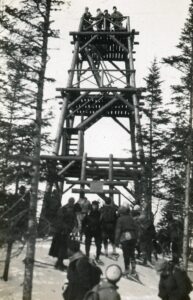
Snowshoers visiting the tower at the Walter Rockwood Davis Reservation on Black Mountain, Jackson, NH, 1914 – AMC archives
The club was accruing many small properties scattered far and wide around New England in this period. There was a concentration of them in the White Mountains, but this did not help much with the burden of maintaining all of them. In 1902, Carolin E. Clay donated two plots of ten acres each on top of South Baldface Mountain and Kearsarge North. The Kearsarge tract came with a small “refuge house,” a remnant of a former hotel. The house, and the summit general, were described as in “a most squalid and disgusting state, as a result of the untidiness of picknickers.” AMC hoped to clean the place up and hire an onsite caretaker, though this never panned out. The South Baldface tract consisted of ten acres on the summit and was devoid of any infrastructure other than trails. It was unfortunately marred by a disastrous fire soon after the acquisition. Although the region between it and the Carter Range was scorched, it still boasted one of the best views of the Presidential Range, Chocorua and the mountains of western Maine. Both tracts were eventually absorbed by the White Mountain National Forest.
To add even more to the club’s plate, in the autumn of 1902 yet another property was scouted for preservation. A large stand of native rhododendrons in Fitzwilliam was under threat by logging operations. Botany enthusiast, sponsor of Harvard’s Ware Collection of Blaschka Glass Models of Plants, farmer and Rindge native Mary Lee Ware bought the property and deeded it to AMC on April 1, 1903. It included a farmhouse, forests and rhododendron stand totaling 300 acres, the largest property yet in the club’s portfolio. The twelve-acre rhododendron swamp was designated as a public reservation to be protected in perpetuity. After several decades of renting out the cottage, the property was turned over to the N.H. Division of Parks and Recreation in 1946 as the system’s only designated botanical park. You’ll still find the rhododendrons blooming here (Rhododendron State Park) every summer.
Two more properties came our way in the early 20th century. One was a hundred-acre tract known as Sky Pond Reservation in New Hampton, given to the club in 1910. The other was the Walter Rockwood Davis Reservation on Black Mountain in Jackson, which came along in 1913. As with all the properties discussed above, these two were turned over the State of New Hampshire and the U.S. Forest Service, respectively. However, at the height of its 20th century land ownership, the club held over 750 acres in New Hampshire (plus many more tracts in other New England States). Although this pales in comparison to the over 114,000 acres we currently manage in Maine alone, AMC was a pioneer in protecting forested landscapes in New England from overuse and development.
Have you visited all these former AMC land conservation projects in New Hampshire? Did you know their stories and past connections to AMC? Visit again with fresh eyes and celebrate a piece of our conservation history.
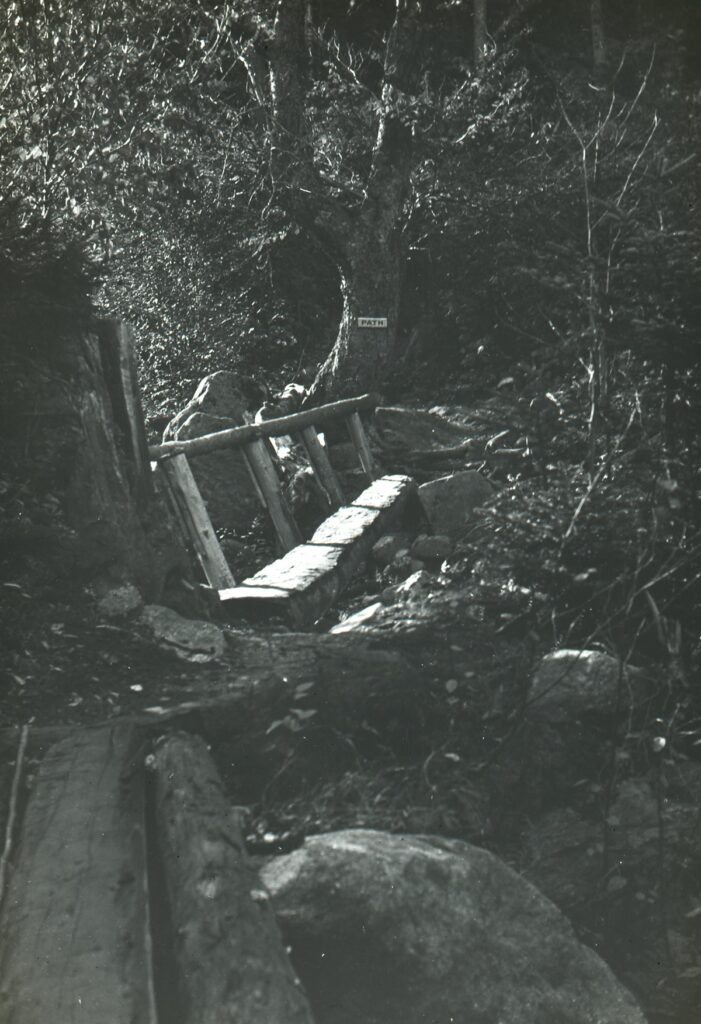
Footbridge and trail sign on the Valley Way through Snyder Brook Reservation – 1918 – AMC archives
Chapter 5: Appalachian Water Club: How Paddling Became Part of AMC
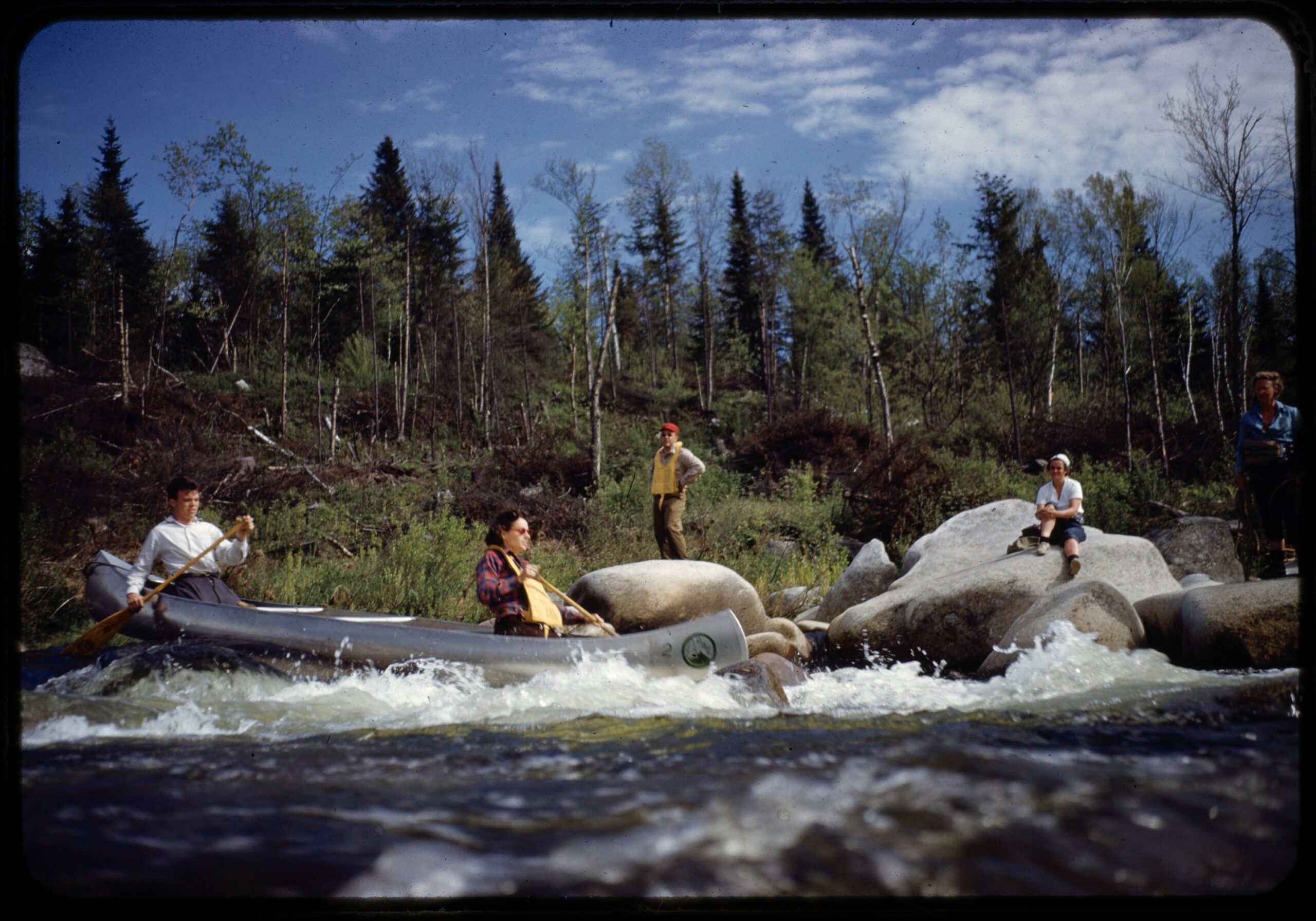
AMC members running the Ammonoosuc River in New Hampshire in the 1950’s – courtesy of AMC archives
Although initially dedicated to exploring mountainous regions, Appalachians have enjoyed water travel from an early stage. There were boating enthusiasts among the first members, and a few accounts of canoe expeditions, especially in the Maine Woods, appeared in Appalachia in the 1880s. Two frequent visitors to Katahdin and its surroundings on foot and by water were George Henry and Sarah Pattee Bean Witherle of Castine, Maine. Among other accounts, they published a story on their month-long trip with guides in the autumn of 1883 from Medway up the West Branch of the Penobscot River to Abol Stream, where they set off on foot to climb Katahdin. The paper was read before AMC in Boston in June of the following year, sparking the imagination of those present. The lore of Thoreau’s travels through the area in the 1850s was canonical by this time and further motivated visitors with an adventurous spirit.
In an even longer expedition starting on the last day of July 1889, two women and a man set off from Boston for the wilds of Maine for four weeks of canoeing and camping. In a report published by the women in Appalachia, they dubbed themselves the “Old Camper, a Younger Camper, and a Novice.” The Young Camper was 24-year-old Ellen Leonice Sampson of Newton, Massachusetts. The Novice was Mary Elizabeth Hardwick of Quincy, Massachusetts. The Old Camper is unnamed in the article, but in 1900, Robert Luce gave an illustrated lecture to the club on a remarkably similar trip. Was he the Old Camper?
The three campers travelled by train as far as Greenville, Maine, then took a steamer across Moosehead Lake to the Mt. Kineo House, where they met their guides: two Penobscot men and one white man from Downeast Maine. The group of six travelled two hundred miles by canoe, visiting twenty lakes and ponds. From Moosehead they headed to North East Carry where their boats were taken by wagon to the West Branch of the Penobscot River. From there they followed the river in a wide, northeasterly arc through Chesuncook and Ripogenus Lake, making a diversion on foot to climb Katahdin. Swinging back south, they continued on the West Branch to Medway where it joined the main Penobscot River. They eventually floated into Old Town, greeted by the sounds of sawmills and civilization.
Even fewer members were finding themselves on rapid rivers in the region, paddling short stretches just for fun. A small selection of images in the AMC Archives depict boaters shooting rapids on the Millers, Souhegan and Ammonoosuc Rivers between 1908 and 1910. However, canoeing and kayaking were slowly becoming a significant part of the club’s activities. By the 1890s, large, organized trips like August Camp included canoes as essential gear. The August Camps of 1889, 1891 and 1896 at Mooselookmeguntic and Moosehead Lakes all relied on canoes to explore the scenic gems beyond their camping grounds. When Three Mile Island Camp on Lake Winnipesaukee was established in 1900, canoes and motor launches were the only way to reach the camp (other than walking across the frozen lake in winter).
The first official “Canoe Trip” was organized by Boston realtor Charles Alexander Newhall over the Memorial Day weekend of 1914. Twenty-seven members in eleven canoes paddled the Saco River from Bartlett, N.H. to Lovewell Pond in Maine over four days. Their baggage was sent to their lodgings for the night, and the paddlers were shuttled to and from their put-in and take-out points by rail, wagon or on foot each day. This section of the river is mostly smooth, with a few easy stretches of rapids. In more challenging stretches, the experienced paddlers shuttled willing passengers through while others watched from the shore. There were plenty of capsizes the first day as the paddlers became accustomed to their boats, but the weather being warm and sunny, no one minded the impromptu bath. Though seemingly fun, canoe trips like this were rarely replicated over the next decade. Though a few paddlers were visiting lakes and ponds and running rivers for fun from the 1900s through the 1910s, the logistics of getting people and boats to the water made it difficult as a club sport.
The Saco River trip was revived in 1923 and 1924, and in 1926 a young man named John Coolidge Hurd led a weeklong trip down the Piscataquog River. The water was high that year and the river fast, but the many inexperienced paddlers came out unscathed. This kind of single day or weekend trip presented even more challenges. Hurd records the difficulties in “Twenty Years of White-Water Canoeing,” published in the June 1947 issue of Appalachia, looking back on AMC paddling:
We had to hire canoes and have them trucked in near the rivers during the fall, because in the spring all but a few main roads were deep in mud. We had to go north by train and team. Hotel accommodations had to be planned far in advance. After the run, Canoes were inspected and damages recorded. Then they were trucked back to the canoe house, and a bill of fifty to one hundred dollars for repairs was not unusual, for livery canoes have to be kept in first-class condition.
Nonetheless, with each year new rivers were scouted and more trips planned. As enough boats and private vehicles could be borrowed to help paddlers reach the quickwater rivers in spring, the club’s General Excursion Committee lent its support. In 1933, Lawrence Irving Grinnell also introduced the use of motion-picture cameras on the riverbank, filming club paddlers as they navigated rapids. It was an effective way to show new paddlers proper technique in the off-season and drum up interest. Some of these film reels still exist in the AMC Archives.
For almost ten years, paddling trips were managed under the umbrella of this general committee, but a Special Canoe Committee formed briefly around 1934, to investigate the idea of the club owning its own fleet of canoes for use by whitewater paddlers in the spring and on the calm waters at Ponkapoag Pond Camp outside Boston in summer. By the next paddling season, the club was the proud owner of six used canoes with paddles and back rests secured for $115.
Kenneth Atwood Henderson took up the reigns of the canoe sub-committee just after Hurd. Henderson was a world-class mountaineer, rock and ice climber who dressed in old business suits he no longer wore to the office as an investment banker. On rivers, he was often found paddling with Marjorie Hurd, an attorney from Cambridge and the older sister of John C. Hurd. Women were welcomed into the paddling group from the start, though at first, they were not allowed to navigate canoes on their own or in tandem on club trips. They were generally placed in the bow with a man at the stern.
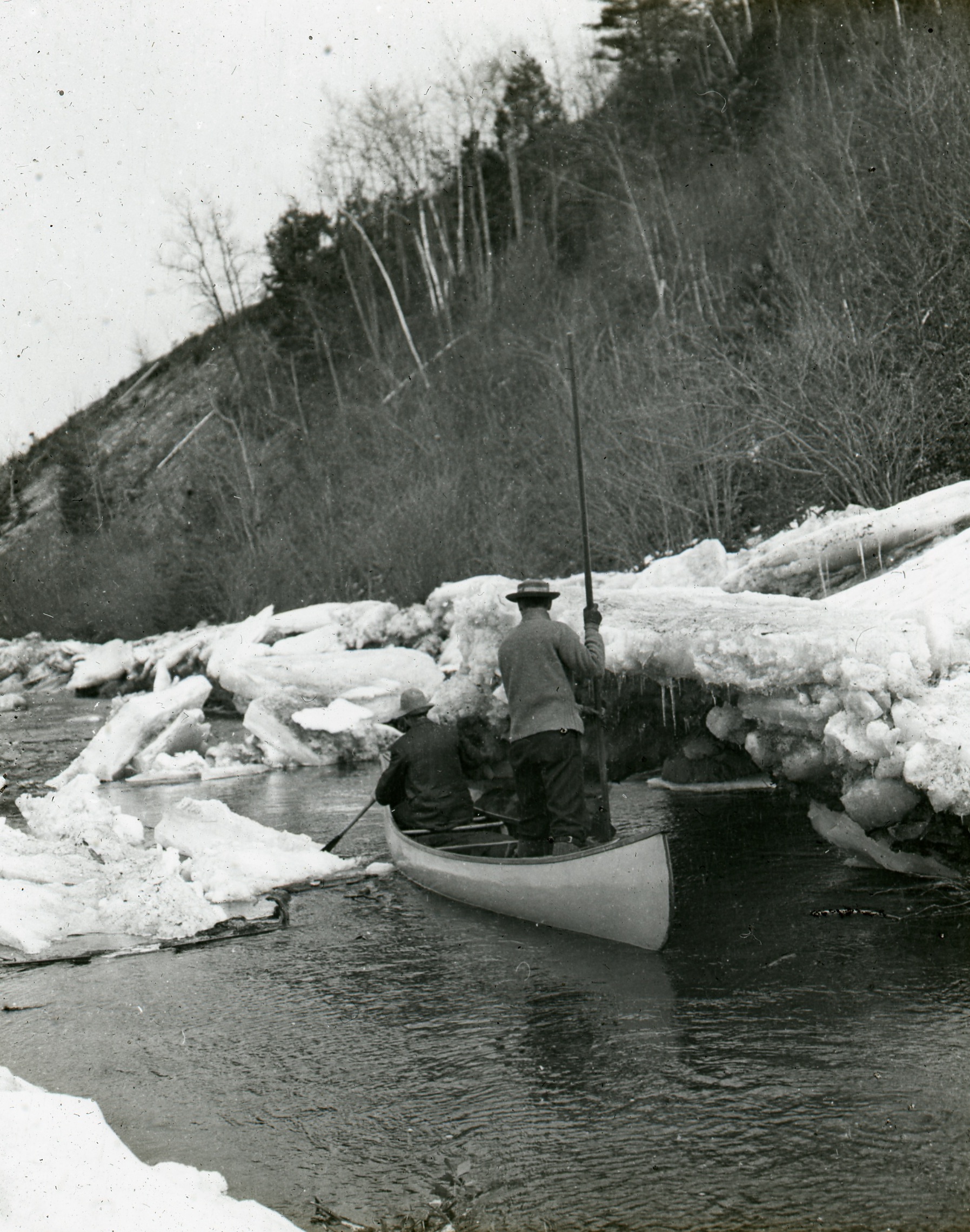
AMC canoers navigating the ‘bergs on the Souhegan River in New Hampshine in Spring, 1910. Photo taken by Sinclair Kennedy – courtesy of AMC archives
An official, freestanding Canoe Committee formed in 1942, just in time for wartime gasoline and rubber rationing to put a damper on their fun. They were able to run eight trips during the spring but had to cancel a Memorial Day weekend paddle on the Saco in exchange for a day on the Sudbury River close to Boston with a night of camping out. The following year, they managed only one run in April. Although they discussed the possibility of running trips using railroads to transport boats and boaters, coordination proved impossible. The committee ceased operations until the war was over. Joyous reintroduction to club whitewater trips occurred in March 1946, with an introductory meeting, the showing of color films, and work parties to repair and repaint the committee’s four remaining wood and canvas canoes that had lain dormant in storage for several years.
Although their activities had been curtailed during World War II, the Canoe Committee benefitted in one way from this world-shifting event. During the war, Grumman Aircraft Engineering Corporation (now Northrop Grumman) was building planes for the U.S. Navy. When the demand for aircraft dried up at war’s end, the company sought other commercial opportunities with plentiful materials like aluminum. After lugging a sixty-plus wooden canoe around the Adirondacks on a fishing trip, Grumman’s chief tool engineer William Hoffman proposed building lightweight boats from aluminum. At the same time, sportsman and designer Russell Bontecou was working on his own aluminum canoe idea. The two men were brought together, and Grumman soon released a 13-foot, 38-pound canoe in 1945. The AMC Canoe Committee purchased two in 1946, and they proved superior in their durability and handling. Instances are recorded of aluminum canoes wrapped around rocks. Where such accidents would have proved fatal to a wooden boat, the metal ones need only be pounded back into shape to paddle another day. With further Grumman purchases, the committee’s major problem became where to store them in the off-season.
Whitewater paddling was becoming ever more accessible to members with the Canoe Committee’s equipment, planningand low-cost trips (a general trip and canoe rental fee applied). Safety and the need to effectively train new paddlers before releasing them into serious rapids was a priority, but accidents were inevitable. The committee witnessed its first fatalities during a trip on the Deerfield River in April 1950, when tandem paddlers Joseph W. Hammond, 42, and his fiancé Mary Jane Marston, 24, were one of three boats that capsized in the aggressively high water. Hammond had paddled with the club before the war but had only come out once since 1949. He brought Marston along as a guest, introducing her as a “competent paddler.” As they shot the rapids below the New England Power Company’s Deerfield Number 5 Station hydroelectric dam in Monroe, Mass., their boat became swamped. Marston disappeared under the water first and her body was recovered about two miles below the put in. Hammond was seen clinging to the canoe after falling in. He eventually let go and missed a rope thrown at him. After disappearing, his body would not be found until three days after the incident, when the dam gates were closed to allow the water level to sink in aid of the search. His body was spotted caught on a stick mid-river less than half a mile from where he was last seen.
It is not recorded in any reports of press if any of the paddlers in this group were wearing life jackets (descriptions of Hammond and Marston’s outfits indicate they were not) and this was not a required item at the time. Vetting of paddlers was far more casual. In this case, Hammond had paddled little with the group since before the war, and he needed only to vouch for Marston’s abilities for her to join the trip. In the wake of the tragedy, the Canoe Committee addressed these serious issues by instituting more instruction on safety into workshops and trips, closer screening of would-be paddlers, and by requiring participants to bring life jackets on every trip (they did not have to be worn unless the trip leader deemed them necessary). Not long after, these were required regardless of conditions. By 1955, paddlers wishing to join the group had to prove they knew how to swim, handle a canoe on flatwater, and be in good physical condition. You had to verify your abilities on an instructional trip to be allowed on subsequent trips.
As interest in the sport grew, the Canoe Committee strove to fill its season and beyond with new trips. A weeklong wilderness canoe camping trip on rivers like the Saint John River in Maine and Quebec sprang up, as did autumn whitewater runs on regional streams when water levels were sufficient. Members participated in New England whitewater slalom races as that twist to the sport took hold. Flatwater boating excursions pulled up almost even with their quickwater counterparts. In 1960, the committee, whose name had morphed into the White Water Canoeing Committee, changed its name to just the Canoeing Committee to account for its broader interests.
Early season instruction went indoors around this time, with the first pool sessions to demonstrate and teach technique. Kayaks begin to appear among the boaters in this period as well. An announcement for a kayak practice session using folboats (kayaks made with a waterproof fabric skin stretched over a wood frame) appears in the June 1960 issue of Appalachia Bulletin. When hardshell kayaks and decked canoes began to appear on rivers, the club quickly welcomed them among its ranks. The club therefore had a thriving paddling community on all kinds of water as the sport of whitewater boating took hold in the 1970s. AMC paddlers had also taken to saltwater in the prior decade with coastal camping trips in Maine. The club purchased Beal Island, Maine in 1969, after years of exploring and camping in the area, and later established Knubble Bay Camp as a permanent launch site. In addition to the club-wide Canoe Committee, all of the existing chapters had paddling committees by 1970.
Now almost as old as the club itself, enthusiasm for people-powered boating is alive and well within AMC. From the first wood and canvas Old Town and E.M. White canoes of the 1880s to the slickest fiberglass slalom and touring boats of today, the club still strives to introduce new boaters and continually sharpen the skills of old hands in the joys of travel by water.

Chapter 6: Oh Canada! AMC’s Early Adventures North of the Border
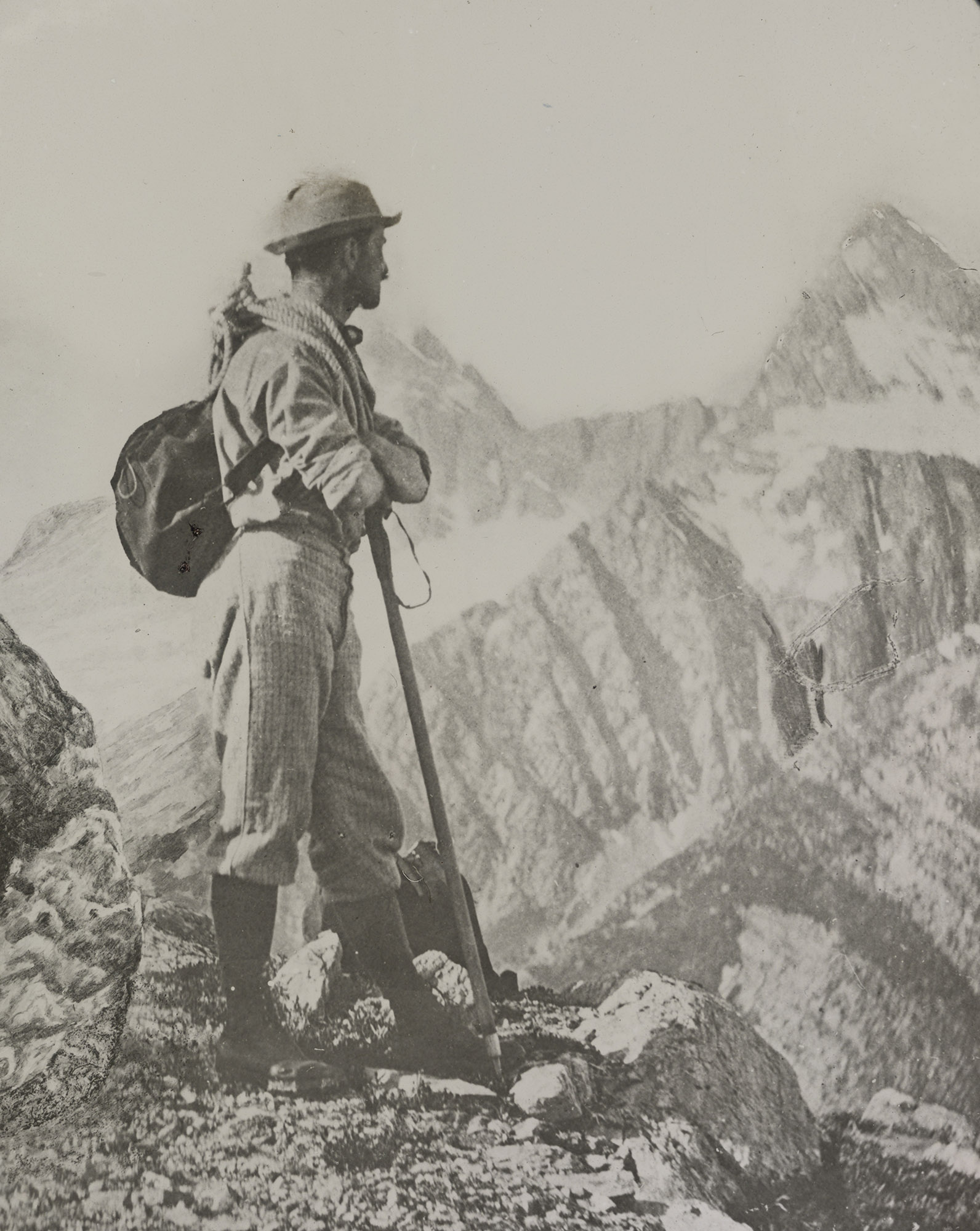
Philip Stanley Abbot at Glacier Crest, British Columbia ~1895. Courtesy of AMC Archives
On September 8, 1890, Tufts College Professor Charles Ernest Fay and Harvard Observatory librarian John Rayner Edmands stepped off a Canadian Pacific Railway train at Glacier House in Rogers Pass, British Columbia. They were returning east by a circuitous route after a trip to southern California, with stops along the Pacific Coast, where Edmands frequently misidentified in newspaper social pages as “J.R. Edwards.” Their stay in the Selkirks would be brief: less than twenty‑four hours before their eastbound train departed the following day.
Though neither man had climbed mountains during the rest of the journey, and Fay later remarked that he had not felt particularly tempted to do so, the ascent through Rogers Pass stirred him deeply. That afternoon he hiked to the terminus of the Illecillewaet Glacier, gazing up at the surrounding peaks and weighing which might be climbed the next morning. These two modest outings marked the beginning of Fay’s lifelong, and sometimes turbulent, devotion to mountaineering in the Canadian Rockies.
Fay’s early climbing experience had been limited to the White Mountains of New Hampshire and other northeastern ranges. In his twenties and thirties he favored long hikes and wooded summits over technical ascents, often climbing trees to gain views. He did not climb above 10,000 feet until his forties, during his first western expedition in 1888. That summer, with Frederic H. Chapin, Edmands, and others connected to the Appalachian Mountain Club, he climbed Mount Shavano and Blanca Peak in Colorado. Although impressed, Fay would later find that the Canadian Rockies exerted a far stronger pull on his imagination.
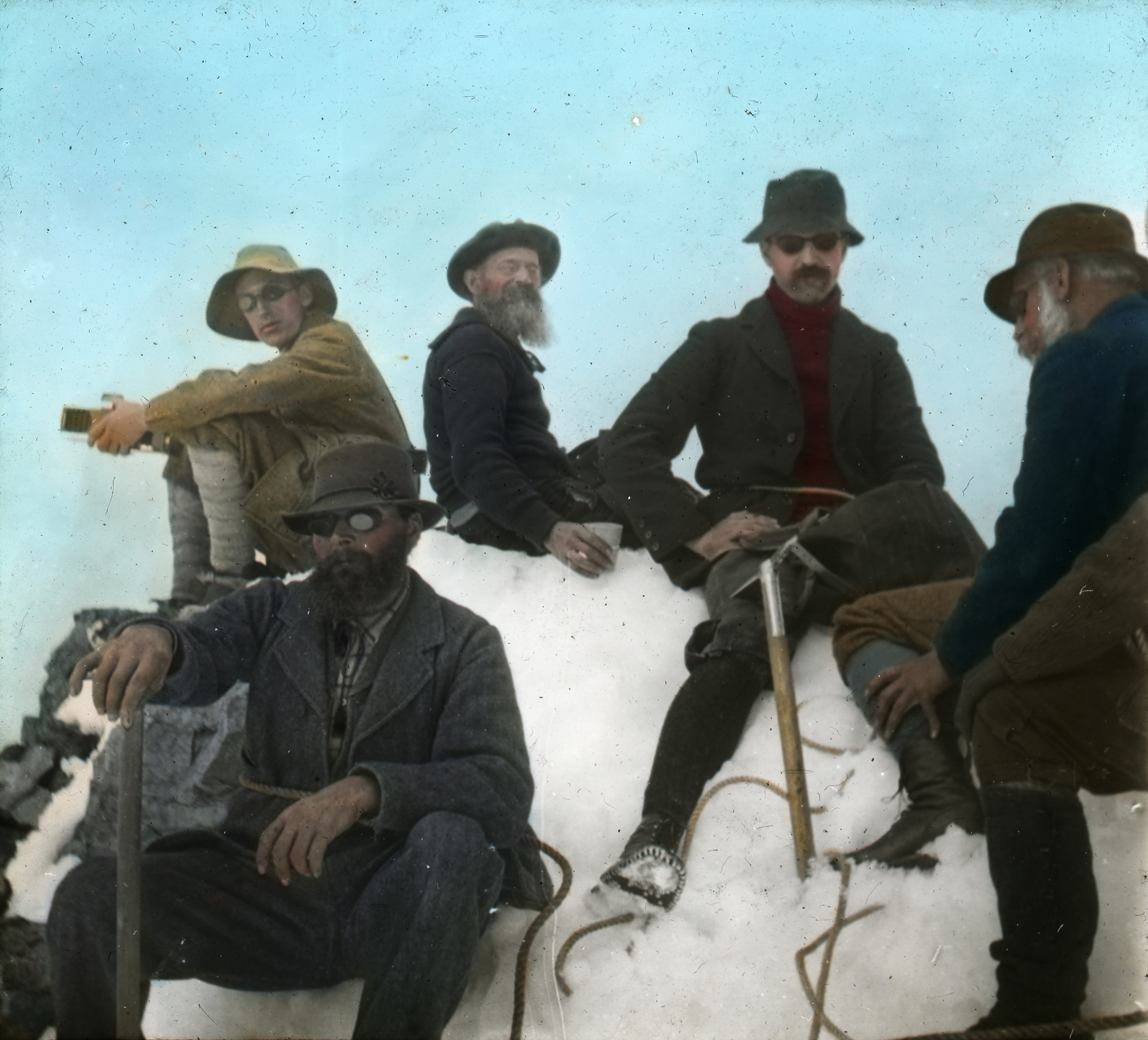
Peter Sarbach (foreground L), J. Norman Collie, Charles E. Fay, Charles Thompson and Harold Dixon (L to R) on Mount Lefroy summit, British Columbia. August 3, 1896. Courtesy of AMC Archives
At 7:45 a.m. on September 9, Fay set out alone toward 10,774‑foot Mount Sir Donald, first climbed only two weeks earlier by Swiss climbers Emil Huber and Carl Sulzer with their porter Harry Cooper. Coincidentally, Huber and Sulzer had departed Glacier House the previous day; their westbound train had passed Fay’s eastbound one en route from Vancouver. Unable to persuade Edmands to accompany him, Fay climbed rapidly, reaching the glacier’s foot within half an hour. Dense scrub soon halted his progress, forcing him onto open rocky slopes and snowfields higher up. Near the base of a ridge descending from the summit, he was overcome by a sense of “powerlessness,” unsure whether fatigue or altitude was the cause. Pressing on, he encountered a sheer rock wall barring the final cone. With time running short before his train left, Fay turned back, reaching Glacier House at 12:45 p.m. in time to pack and depart.
Though he did not summit Sir Donald, Fay returned east transformed. He would come back to the Rockies repeatedly, each time with greater technical skill and deeper commitment.
Fay did not publish an account of this first Canadian trip until December 1893, in Appalachia, but word of his exploits spread quickly. In July 1891, the White Mountain Echo of Bethlehem, New Hampshire, described him as “a lithe and slender man of 40 or so [he was actually 46], bearded and spectacled…[who] climbs like a goat,” recounting his near‑summit attempt on Sir Donald without rope, alpenstock, or ice axe.
The next AMC figure to explore the Canadian Rockies was Reverend Harry Peirce Nichols, an Episcopal priest from Salem, Massachusetts. Unlike Fay, Nichols had climbed extensively in the Alps beginning in his late twenties. In 1881 he encountered Theodore Roosevelt in Zermatt, where Roosevelt was attempting the Matterhorn. Nichols would later become a founding member of the American Alpine Club in 1902 and serve as its president from 1923 to 1925; Fay would serve as its first and fifth president.
Nichols was also deeply rooted in the White Mountains, staying at the Ravine House in Randolph, later purchasing property in Intervale, and helping lay out trails on the Presidential Range. He befriended Joe Dodge shortly after Dodge became the manager at Pinkham Notch Camp in 1922, officiated at Dodge’s wedding, and baptized his children. Even in retirement Nichols remained vigorous, climbing Mount Washington twice in one week at age seventy‑nine.
In 1893 Nichols spent six weeks climbing around Glacier House. With Charles Sproull Thompson and Samuel Evans Stokes Allen, he made the second ascent of 10,486‑foot Mount Fox, first climbed in 1890. Fay later credited Nichols with “putting upon record the first ascent of importance” in the Selkirks by an AMC member. Following this climb, Nichols preached a sermon at Glacier House on “The Glory of Aspiration,” then spent the remainder of his stay teaching his son, John Donaldson Nichols, to climb.
Nichols was captivated by the region, writing enthusiastically of a mountain range “rivalling the Alps…with peaks not only unexhausted, but even unnamed and unseen.” During the trip he climbed an unnamed peak with Allen, who proposed naming it for Nichols. The name did not endure; the mountain was later designated Collier Peak after Dr. Joseph Collier, who climbed it in 1903. Nevertheless, Nichols’ and Fay’s advocacy firmly established the Canadian Rockies as a destination for American mountaineers.
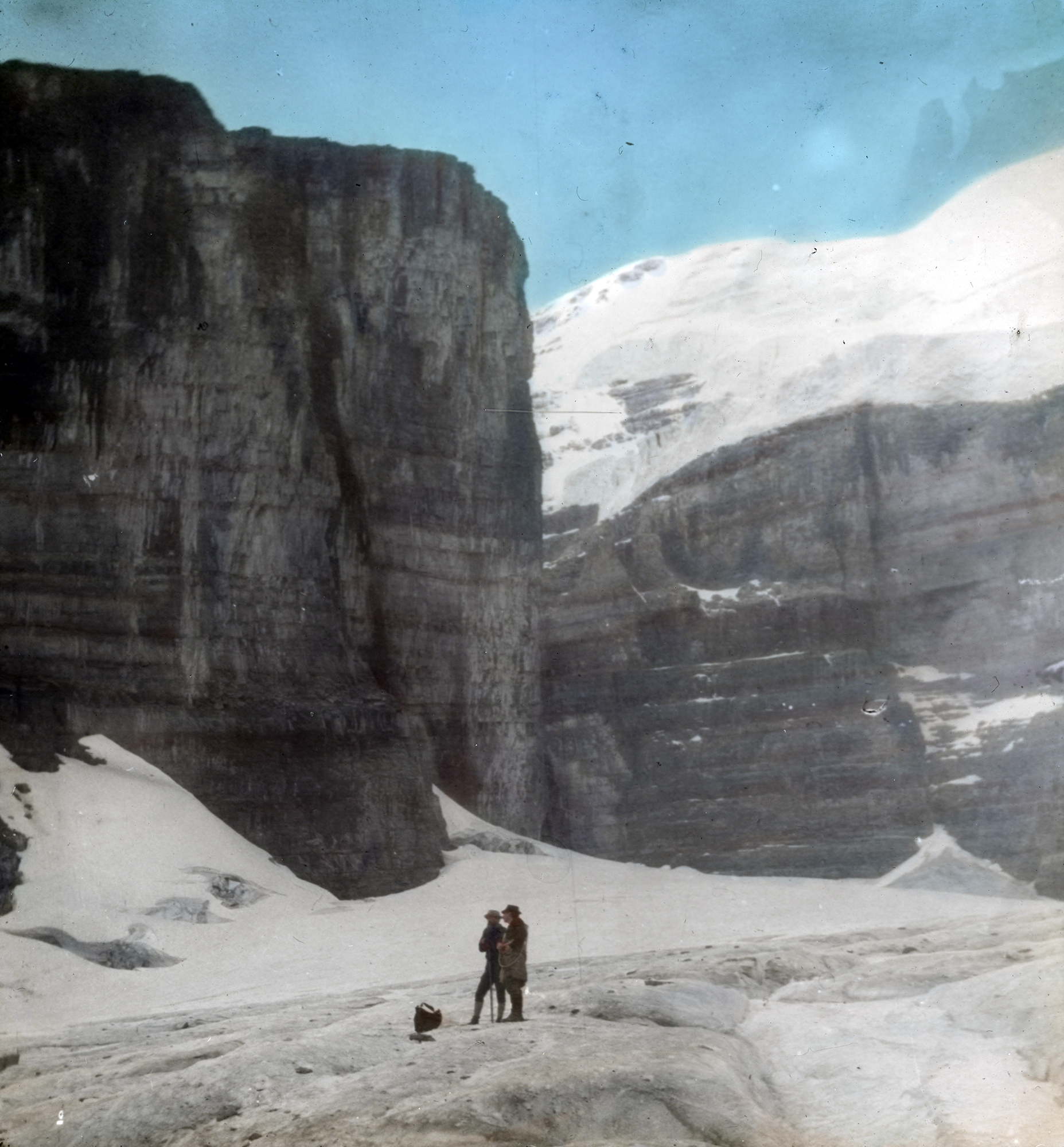
Cliffs on the western face of Mount Lefroy, British Columbia by Charles S Thompson. Courtesy of AMC Archives
AMC climbers returned in force in 1894. Fay climbed Mount Stephen with Rest F. Curtis (without reaching the summit), successfully ascended Mount Abbott, and bivouacked on Eagle Peak after failing to summit. Samuel E.S. Allen returned to complete the ascent of Mount Temple after an unsuccessful attempt the year before. Accounts of these climbs filled the opening articles of the June 1895 issue of Appalachia.
As AMC members were “discovering” the Canadian Rockies, a younger climber was assembling a remarkable résumé. Philip Stanley Abbot, born in Brookline, Massachusetts, in 1867, was introduced to climbing as a teenager in England’s Lake District. In 1887, while on leave from Harvard for health reasons, he traveled with novelist Robert Welch Herrick from Cuba through Mexico, California, and Alaska. During this journey Abbot climbed Popocatepetl, explored Yosemite and the Sierra Nevada, and visited Alaska’s Muir and Davidson Glaciers.
After graduating from Harvard in 1889 and later completing a law degree, Abbot devoted the summer of 1892 to intensive alpine training. He hired Swiss guide Peter Sarbach and climbed widely in the Alps, later describing the experience as attending “the university of mountain‑climbing.” Upon his return, Abbot presented papers to AMC on his climbs. When Fay organized a major AMC expedition to Canada in 1895, Abbot was a natural choice to invite.
The 1895 expedition marked a turning point for AMC. It was the first trip planned more than a year in advance and the first to extend far beyond the White Mountains. The itinerary included Banff and Field in British Columbia, followed by the Selkirks. Twenty members departed Boston on July 22, traveling by rail to Montreal, then west in a private Canadian Pacific Railway car for three weeks. Reverend Nichols joined them in Minneapolis. After three weeks in the mountains, the group continued to Vancouver and Victoria, sailed to Tacoma, and returned east via Seattle and the Great Northern Railway, with additional steamship excursions on the Great Lakes. They arrived back in Boston on August 31 after nearly six weeks of travel, drawing praise in newspapers along the route.
At least six women were among the participants. They joined every excursion except the most technical climbs and ascended partway up Mount Stephen before being asked to turn back. The climbers sorely wanted the women to reach the summit. Fay, in a published account, decried, “Did not Club loyalty – to say nothing of gallantry – demand of us to make an effort at least to put one high summit of the Canadian Rockies under the foot of feminine “Appalachians”?”
Although the women did not complete first ascents, they were instrumental in another lasting contribution. Before leaving, the party persuaded the Canadian Pacific Railway to construct a trail along the ridge between the Illecillewaet and Asulkan Glaciers, naming it Glacier Crest. Women in the party assisted in this trail building effort.
Several first ascents were achieved. On July 30, 1895, Abbot, Fay, and Charles Thompson, with guide T.E. Wilson and a porter named Hiland, climbed 11,135‑foot Mount Hector. Abbot described the climb as straightforward and uneventful. On the summit, Thompson built a cairn, Fay took photographs, and Abbot took a nap. They sealed their names in a jam jar inside the cairn. Later, near Glacier House, they made the first ascent of Mount Castor (now Jupiter) and named another peak Mount Afton, from their initials.
Between these climbs, the trio reconnoitered Mount Lefroy on the Continental Divide, coming close to the summit before retreating due to failing daylight. The following morning they missed their train deliberately to attempt Lefroy again, but warming temperatures and water‑filled ravines forced another retreat. Lefroy would wait until the following year.
The 1896 return trip began poorly. Luggage was misrouted, and Fay was incapacitated by an injury sustained on Mount Chocorua back in New Hampshire. On July 29, Charles Thompson and George T. Little attempted a training climb of Ross Peak wearing inadequate footwear. A steep snowfield delayed their descent until twilight. The next day, Little, Thompson, and Abbot completed a grueling twenty‑three‑hour first ascent of Mount Rogers. After resting, the group traveled east to Lake Louise.
On August 3, 1896, the now recovered Fay joined Abbot, Little, and Thompson for a full attempt on Mount Lefroy. They crossed Lake Louise by rowboat at dawn and climbed the moraine to the Victoria Glacier. Roping up, they entered a narrow gorge known as the “Death Trap,” notorious for avalanches and icefall. Before noon they reached the Continental Divide. Looking out over the incredible panorama of mountains and up toward the summit of Lefroy itself, Abbot proclaimed, “The peak is ours!” It was here the group left the remainder of the food and extra clothing they were carrying to speed the final push to the summit.
The party had hours of climbing left to do. The next stretch included the monotonous cutting of steps over ice and snow as they inched forward. At five-thirty they reached the base of a wall they estimated to be seventy-five feet high. To their right lay a rough ridge that they deemed impassible. To the left was a gently sloping icefield over which they might have trod, but the time needed to carefully cut steps over it would leave them descending the mountain in the dark; something for which they were sorely unprepared in the era before headlamps and flashlights.
Abbot, who was leading the group, discovered a cleft in the rock just beyond where they were standing. Here he asked Fay and Thompson to unrope from him and Little before clambering ahead some thirty feet further to a ledge. Little, one of the strongest rock climbers in the group, began to follow but he was given a glancing blow from a small rock loosened by the rope running over it. Another rock came down, partially severing the rope between him and Abbot. At this juncture, Fay suggested that they give up on this route, but the idea was dismissed. Next Abbot requested that Little disconnect his now damaged rope as well. He then proceeded around a corner of the ledge to where he found a gully to ascend. Now Little voiced his concern as well, suggesting that they continue further along the ledge to a better point of ascent. Abbot declined, replying, “I think not. I have a good lead here.”
These words would be his last. Be it from a foothold or handhold that gave way, Abbot suddenly fell, plunging past the men backwards and headfirst. He struck the ice slope below and began to roll, quickly tangling up in every foot of rope that the party had with them. The remaining three climbers watched in horror as their friend rolled nine-hundred feet down the mountain. In Fay’s description of the accident, he notes with irony that although their rope was now gone, it slowed the relentless descent of Abbot’s body and kept it from falling off the cliffs below and into a gorge. Under the extreme shock and trauma of this moment, the men now had to cope with the additional, immediate problem of Little being stranded above them and their overall precarious situation. Little urged them to attend to Abbot, but there was clearly no living soul there left to save. With the aid of their ice axes, which they still fortunately possessed, they helped Little down from the ledge.
Making the long descent to where Abbot lay, they found him unconscious but mortally wounded and he soon died. They bivouacked in freezing conditions and returned to Lake Louise the next morning to report the tragedy. Abbot’s body was retrieved several days later and returned to Cambridge, Massachusetts. He was buried at Mount Auburn Cemetery on August 12, 1896, three weeks before his twenty‑ninth birthday. The accident was the first fatality associated with AMC and the first recorded mountaineering death in North America, and it sparked widespread debate. Some called for bans on mountaineering. Fay defended the sport, arguing that its rewards outweighed its risks in an age increasingly devoted to comfort.
In 1897 AMC returned to the Rockies with British climbers, including Harold Baily Dixon and Dr. John Norman Collie, and with Swiss guide Peter Sarbach. On August 3, 1897, the first anniversary of Abbot’s death, nine climbers summited Mount Lefroy, quietly triumphant. They placed a written record in a cairn on the summit. The party continued climbing for weeks, summiting Mount Victoria, exploring the Bow River Valley under guide “Wild Bill” Peyto, and conducting scientific observations. The success of Sarbach’s guidance led to the hiring of Swiss guides by the Canadian Pacific Railway, shaping the future of mountaineering in the region.
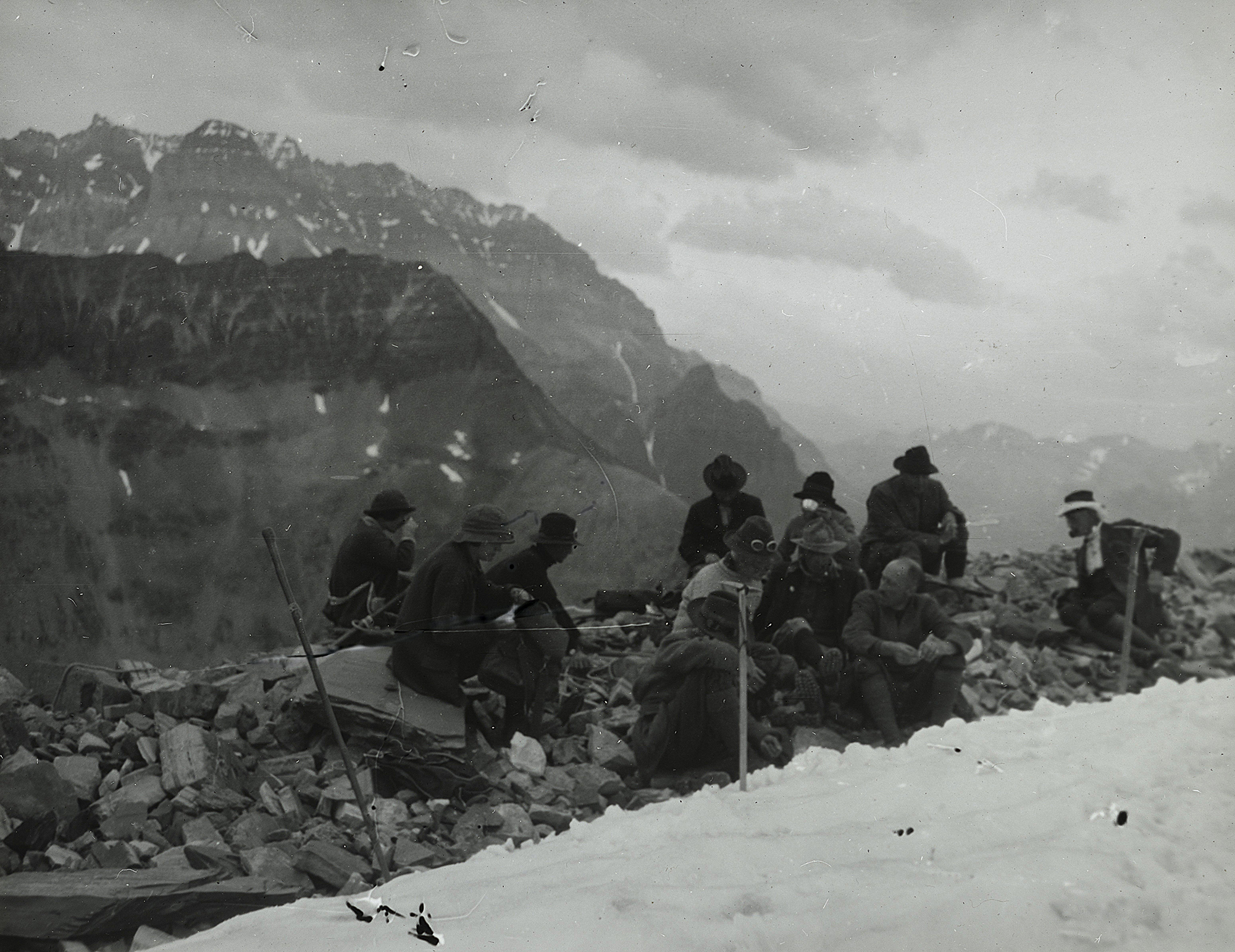
AMC climbers on Park Mountain, British Columbia, 1921. Courtesy of AMC Archives
AMC members continued to return in subsequent decades. In 1923, Dean Peabody Jr. led a six‑week expedition that included attendance at the Canadian Alpine Club’s dedication of Abbot Pass Hut, built near the site of Abbot’s fatal fall. (Due to erosion from melting glacier ice, the hut was demolished in 2022). Another hut would be built and named for Charles E. Fay in 1927. The 1923 party was thrilled to see glaciers up close, climb peaks over ten thousand feet, and behold the landscapes their predecessors had witnessed. Additionally, the trip included a 320-mile horseback trek from Field, B.C. to Mount Robson in Alberta, requiring eleven staff, two pack trails and sixty horses. Despite their wide roving, the group acknowledged having just scratched the surface in experiencing the Canadian Rockies. Writing of the trip in Appalachia, Peabody proclaims:
“That is just the way the trip left us. We want more. More time to camp beside some gem of a lake, or by some rushing, storming river. More time to choose our peak, according to our daring and ability, and make each one his individual first ascent. We want more days in sun or shower, trailing behind the pack horses, munching our lunch, or crossing our feet on the horse’s backbone to ride dry shod at some deep ford. We have not seen it all, but we console ourselves by remembering that we did see perhaps quite as much as any other mountaineering party in the same short time of six weeks.”
We continue to visit this incredible landscape. August Camp has been to the Canadian Rockies a handful of times since 1959, AMC’s President’s Society last visited in 2022, and two Adventure Travel trips are listed for 2026. Though few go realizing the deep AMC history present in the region, the signs are present in place names like Abbot, Allen, Afton, Fay, Little and others; along the Glacier Crest Trail that members helped lay out in 1895, and in the descendants of Swiss guides that still reside there.
Chapter 7: A Continuous Journey: From Charles E. Fay’s Vision to the AMC 150 Relay
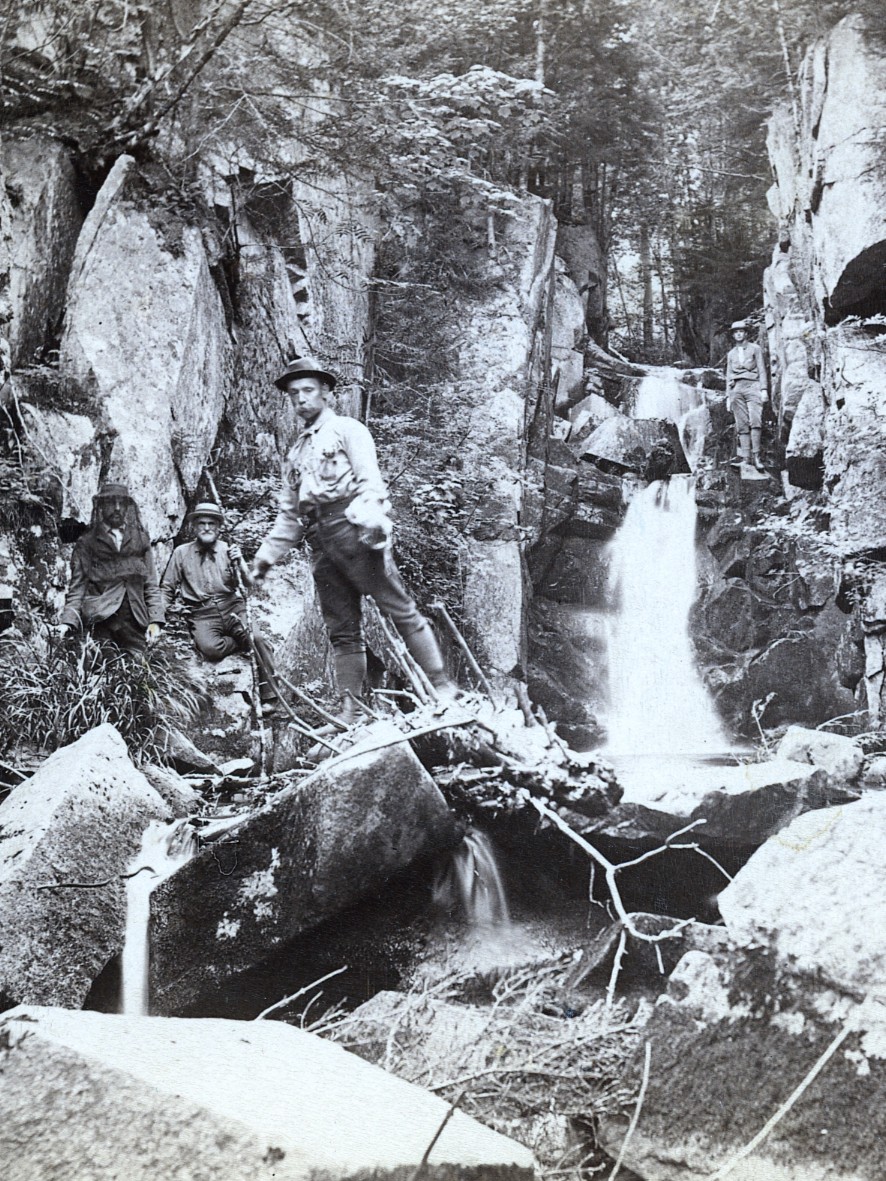
Four AMC hikers at dixvilli Flume, NH 1889
In January 1878, Charles Ernest Fay was elected President of the AMC, succeeding Samuel Hubbard Scudder, an entomologist and paleontologist. During his presidency, Scudder also served as a leader within the Boston Society of Natural History, an assistant librarian at Harvard, and librarian for the American Academy of Arts and Sciences. He was, in every sense, a scientist and data specialist. Fay, by contrast, claimed he was not a man of science, though he was a professor of mathematics and modern languages. In his retiring address, he noted that he had been elected for precisely that reason. Fay was deeply committed to what he described as the club’s “dual nature,” its devotion to science and knowledge alongside the physical, social, and aesthetic dimensions of outdoor recreation. This distinction set the AMC apart from its peers. He recognized the pure joy inspired by time in nature and believed the club was “perhaps the sole representative on this continent of the interests of aesthetics as related to the realm of nature,” and therefore duty-bound to encourage people outdoors. While the club continued its work exploring, mapping, studying, and analyzing the region’s mountains, Fay also expressed a central truth: people wanted to hike, and they wanted friends with whom to hike.
It took time to work out the logistics of hiking as a group. In the club’s first year, the only organized excursions were those associated with the inaugural Field Meeting in North Conway, New Hampshire, in July 1876. After a day of meetings, lectures, and discussions, a party of thirty climbed Kearsarge North. The following day, 175 members rode the Portland and Ogdensburg Railroad through Crawford Notch to the Crawford House, where some climbed Mount Willard. The following year’s Field Meeting, again in the White Mountains, accounted for most club hikes in 1877, though two day trips near Boston were also organized. Otherwise, hiking was largely undertaken by individuals or small groups in support of committee work in exploration, mapping, and trail building.
It took more than six years from the club’s founding to organize excursions in every season and just as long to venture beyond Massachusetts and New Hampshire. However, the hikes that were organized were strikingly well attended. It was not unusual to find a party of twenty or more hiking into Tuckerman Ravine. In August 1879, one hundred members made that journey, arriving by wagon and leaving forty-one horses tethered at the trailhead for the day. In May 1883, 210 participants joined an outing to the Middlesex Fells just north of Boston. Despite this success, the club did not establish a formal Committee on Field Meetings and Excursions until 1888.
AMC 150 RELAY CLEBRATION
In celebrations like the current AMC 150 Relay, where participants collectively traverse hundreds of miles in a continuous journey, we see a living expression of those early outings: a little bit nerdy, obsessed with maps and route planning, well-organized, safe, welcoming, and brimming with AMC’s classic exuberance for all things outdoors. As the Relay enters New Hampshire at the end of June, I hope you will find yourself on one of over sixty legs and events happening across the state to mark 150 incredible years. See Here for more information about AMC 150 – Becky Fullerton

Straw wagon ide for AMC members circa 1870’s
Much about the logistics of these early outings remains unclear. Advance notice appears to have been limited to occasional mentions in Boston newspapers, and it is unknown whether members registered beforehand or how attendance was managed. Travel and lodging arrangements were left to individuals, and it is not always evident whether hikes had designated leaders. The group size limits and liability waivers familiar today were entirely absent.
Scientific inquiry remained central to many excursions. During a one-day Field Meeting at Lexington, Massachusetts, in June 1877, about one hundred members were hosted by the Lexington Field and Garden Club, an organization founded just after AMC in May 1876 and still recognized as the oldest garden club in the United States. The AMC party traveled together by train from Boston, arriving at nine o’clock in the morning and remaining for the day. An article in the Boston Home Journal describes the inquisitive visitors ascending Hancock Heights, also known as Granny Hill (elevation 362 feet), where they “produced their barometers and angle-measuring telescopes, and other instruments, and made such an investigation and analysis of the position and field of view as time would permit.” In keeping with another longstanding AMC tradition, the group was provided a lavish lunch, reportedly more than even their “mountain appetites” could finish.
Journalistic observers, who likely did not know what our hikes into the backcountry of the White Mountains were like, often described us in more pedestrian terms. A writer for the Davenport Daily Gazette of Davenport, Iowa, observed in 1883: “There is an Appalachian Club in Boston, the members of which take long walks, always making their route along a railroad or a shore, so that they can get into a car or boat when overcome by fatigue.” It is true that we were fans of outings accessible via public transit before it was cool, but not every hike was overseen by bail-out vehicles.
The majority of contemporary press coverage, however, was positive, if occasionally tinged with curiosity. The Bangor Whig and Courier writes in July 1888: “It is the custom of the Appalachian Club to spend a week during the early part of the season at some of the summer retreats where there are numerous mountains to climb, and they go climbing like a swarm of bees, usually a hundred strong. The club, as now constituted, has nearly 1,000 members of a class whom it is delightful to meet, and their week among the mountains is one of the keenest enjoyments of the season.” A journalist in Staunton, Virginia, encountering an AMC group during its first trip to the Southeast in 1886, called them “one of the happiest parties we have ever seen.”
The descriptions largely fit all these decades later. These early accounts reveal that AMC’s greatest achievement was not simply in charting peaks or cataloging natural history, but in discovering how to bring people together in the landscape itself. What began as loosely arranged outings; part scientific inquiry, part social experiment, quickly evolved into something far more enduring: a community bound by shared effort, curiosity, and joy. Fay’s conviction that the club must serve both intellect and spirit proved prescient, as the AMC’s identity took shape not in lecture halls alone, but on trails filled with conversation, laughter, and discovery. Long before formal structures caught up, the spirit of the club had already found its footing, rooted in the simple, powerful idea that the outdoors is best experienced together, and that in seeking it out, people were also finding one another.
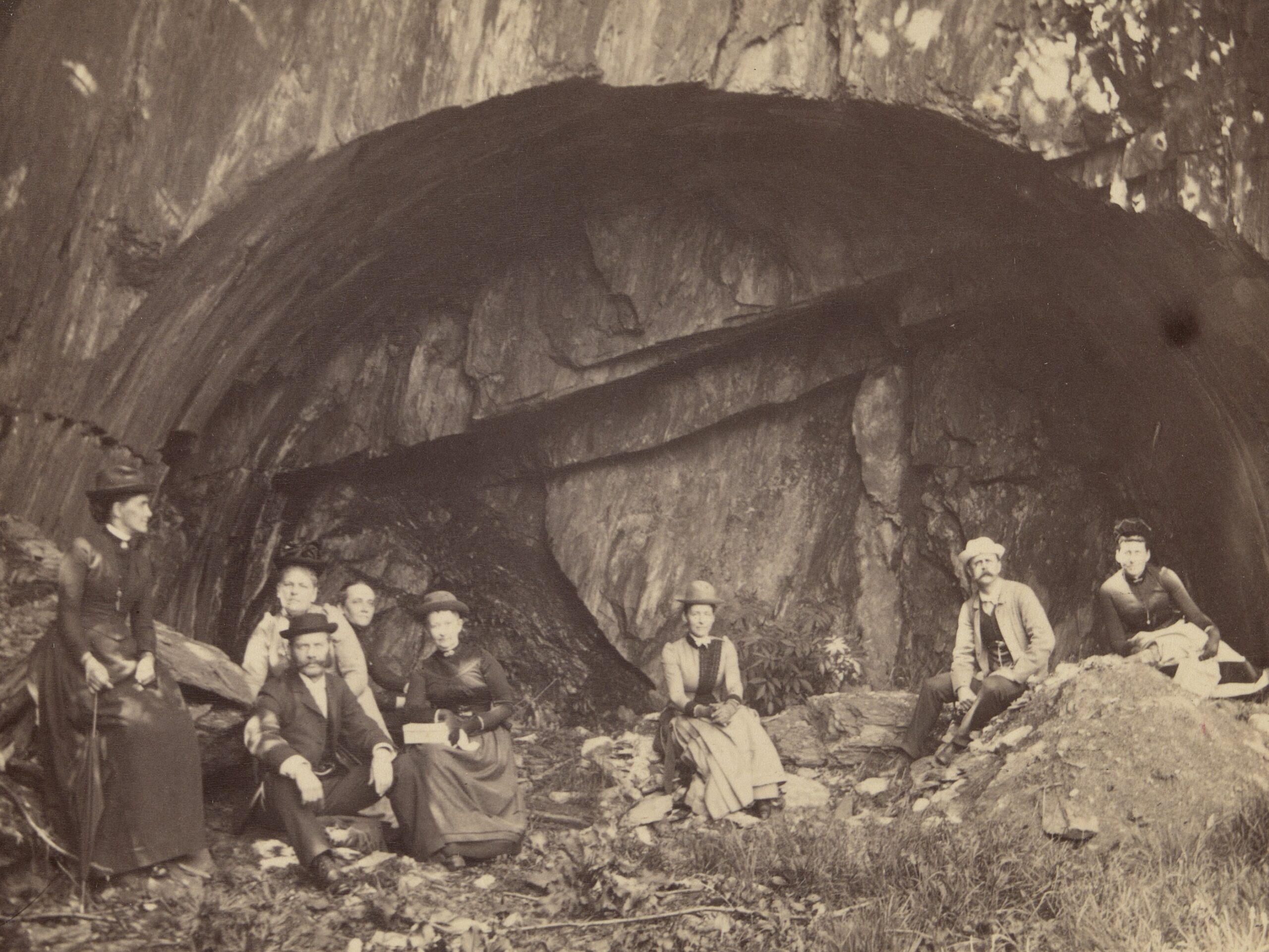
AMC group at Hoosac Tunnel tes portal in Florida, MA – 1890
The AMC Library & Archives hold thousands of photos spanning and chronicling 150 years of club history. The Lary House photo seen here is the oldest image of club members in the collection, dating from our founding year. The White mountains and neighboring Adirondacks were only just starting to attract interest as a leisure destination, a product of a nascent affluent class in the America. You can access the digitized portion of the collection (which is always growing!) at outdoors.catalogaccess.com.