If You Hike in Winter, Make Sure You Are Prepared – by Bob McLaughlin
March 20, 2024
Posted in
General Tips for Winter Hiking
Wear proper gear and attire, including sturdy, comfortable boots. Check out the recommendations in the two articles in this issue of Mountain Passages. However, it is worth repeating that winter hiking demands moisture-wicking synthetic fabrics that keep your skin dry and help regulate your body temperature. This is important advice in both cold and warm weather, but is particularly important in lower temperatures! Avoid cotton; it holds moisture and actually will make you colder.
While footwear is also important in warmer months, in the winter its importance in multiplied. Wet feet are cold feet, cold feet are more than uncomfortable, they are hazardous. Winter boots are different than summer boots. Look for boots that are insulated, waterproof, sturdy, and comfortable. Check out the recommendations in Larry Yetter’s detailed article, Winter Hiking–Getting Started with the Right Boots.
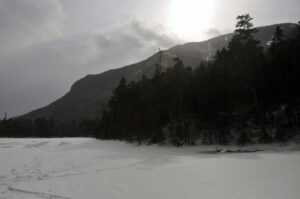
You don’t have to climb to the top of the mountain for views in the winter!
But getting the right boots is not the end of your shopping list. You need traction devices, such as microspikes and crampons, for icy and packed snow conditions, and snowshoes for deep snow. Never plan to bare boot on snowy trails. If you do, you will likely post-hole which is tiring and dangerous for you and dangerous for others who follow you on the trail. Also, consider using trekking poles to improve balance, and reduce leg fatigue and joint pain.
Finally, days are short in the winter and it is important to keep track of the time. A watch or other time-keeping device is essential. You cannot rely on your cell phone, because its battery may die quickly in the cold. Also, make sure you pay attention to the time and do not hesitate to turn back if conditions require it.
Modifications to the Ten Essentials for Winter Hiking
In past issues of Mountain Passages we have reviewed the Ten Essentials when you hike. For example, see the article Take the Time to Check What’s In Your Pack in the Summer 2020 issue and What’s In Your Pack—The Ten Essentials Revisited in the May/June 2018 issue. Both issues, as well as issues back to 2015, are available at www.amcnh/newsletter/archive/.
The Ten Essentials described in those articles still apply, but winter hiking demands some modifications. With regard to the Ten Essentials, winter does require some additional equipment while it eliminates the need for others.
NAVIGATION
Winter is the time when familiarity with a map and compass skills are most important. Trail signs and markings may be obscured or even below the surface of the snow, and winter is not the time to get off course or worse. Always carry a compass and a map with appropriate scale. Don’t think about relying on the “Compass App” in your cell phone; at best they are of dubious utility, at worst, the phone’s battery has died.
If you want to carry a GPS system as well, that is great. However, it is not a substitute for a map and compass. The screen of even the best GPS is tiny compared to a good map. Also, as with any electronic device, a GPS is only as good as its batteries. Unless it is a rechargeable model, always carry extra batteries. If it is rechargeable, expect it will die before you finish anything more than a short winter hike.
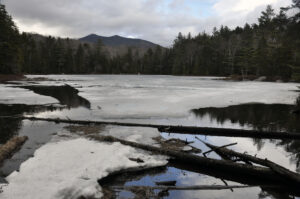
Some views are actually improved by winter conditions!
INSULATION
As described in detail in Christina Cozzens’ article Layering for Cold Weather Hikes, base layers, insulation layers and one or more waterproof/windproof jackets of different temperature ratings are essential. In addition, insulating hats, gloves and socks should always be carried. Carrying extras is never a bad idea.
Also, you need to carry or wear a balaclava that covers your entire face except the area around your eyes. Other head coverings can suffice in milder conditions, but you will want the full protection in the extremes. You will also need goggles which when combined with the balaclava will completely protect your face.
LIGHT
Sunset comes early in the winter. Having headlamps and flashlights and extra batteries can make the difference between an inconvenience and a disaster if you are caught on the trail after dark
FIRST AID/REPAIR KIT/FIRE
For these three Essentials, what you have in your pack in the summer should be adequate for winter hiking. However, you might want to add chemical heat sources to your pack and make sure that you have fire-starting materials that will work in conditions when the ground is snow covered and the available fuel is saturated.
NUTRITION
You will burn through calories even faster on a winter hike. Pack high protein and high calorie items and plenty of them. Also, remember that your food may freeze in your pack. You may want to break food into small pieces before you leave so that you can pop them into your mouth to melt. You can also pack the food in the center of pack to try to avoid freezing. But, like everything else in winter hiking, plan for the worst and be pleasantly surprised rather than sorely disappointed.
HYDRATION
While you should sweat less hiking in the winter, the consequences of dehydration are worse in the cold. So, make sure you carry enough water. Another major problem you can face in winter is water freezing in your pack. If you use water bottles, fill them with hot water and pack them in the center of your pack. Packing the bottles upside down can help avoid the bottle becoming blocked by ice. If you use a water pack, insulate the tubing and pack the bladder in the center of pack to avoid freezing. Another trick is to put electrolytes or sugar drink mix in the water at home to provide some antifreeze for the water in your pack.
SUN and INSECT PROTECTION
This is the one Essential that you can cut back for winter hiking. It is most unlikely you will ever need insect repellent or a bug net on a winter hike. But, sun is still a major factor and may actually be worse in the winter. Ever hear of snow blindness? So, make sure you pack your sunglasses and sunscreen. Again, sunscreen can freeze or at least solidify, and you should protect it in the pack.
EMERGENCY SHELTER
An unplanned night in the woods in the warmer months is unpleasant. An unplanned night in the woods in winter may be your last if you are unprepared. While it may seem like overkill, carrying a tent, a sleeping bag and a tarp could save your life. There are lighter alternatives which may be adequate including mylar tube tents, sleeping bags and space blankets. Whatever you choose, you should be confident you can survive a night in the winter woods if necessary. Anyone can become disoriented, or misjudge time, or become injured.
Final Tips for Winter Hiking
These points are important for any hike at any time of the year, but take on greater importance in the winter.
- Plan where you’re going, and plan when you expect to return.
- Research and check trail conditions before hiking.
- Check the weather forecast and current conditions on the day of your trip. Also, check the weather forecast for the night of your trip and the next day so you can be prepared for an unexpected night in the woods.
- Know what time the sun sets and plan your hike to return before dark. Keep track of time and remember it will take you at least as long to return to your starting point as it did to get to where you are going.
- Let someone know where you are going and when you expect to get out. If there is a trail register, sign in and include the time. When you get out, note that you are out in the trail register, and let the person you told of your plans know that you are out safely. Some people also leave their plans on the dashboard of their cars, but this has its advantages and disadvantages. It is another way to make sure someone knows where you are, but it could allow the bad guys to know how long you will be gone.
- Stay with your party; don’t split up and don’t take different trails.
- Carry out any wastes and dispose of them properly. It is particularly important to follow the Leave No Trace principles when winter hiking.
Winter hiking can be a great experience, but it requires more complete preparation.
Be adventurous, but be safe!