“Cal” Harris – A Soul of the Whites and 4,000 Footer Pioneer – by Sandy Wilbur
October 24, 2025
Posted in
Sandy Wilbur is a wildlife biologist, retired from the U. S. Fish and Wildlife Service after 34 years of researching endangered birds, and administering National Wildlife Refuge programs. At 85, he doesn’t get out into the mountains much, anymore, but he writes about them whenever he gets a chance. Stories about the Presidentials, the High Sierra, and a variety of other mountain ranges can be found on his website: writing-it-down.com
A brief confession and clarification: Sandy admits to doing his early backpacking and mountain climbing in California’s High Sierra – where the mountains don’t START until they are over 6,000 feet high, and where most 4,000 footers might not even qualify as hills. Nevertheless, 40 years of living and hiking in the mountains of New Hampshire’s North County convinced him that mountain ranges are not to be COMPARED, but to be enjoyed for what each has to offer. The “little mountains” of New Hampshire pack a big punch.
My mother-in-law, Calista (Crane) Harris (1902-1993) – “Cal,” to several generations of White Mountain folks – deserved the description of “remarkable,” for a number of reasons. Born to two medical doctors, Clarence and Stella (Spaulding) Crane, she grew up on her parents’ farm in Dover, Massachusetts. Later, she received a Master’s Degree in Geology from Boston University, then worked for a time in the Boston Natural History Library, which was part of the museum facility that eventually became the Boston Museum of Science.
Her experiences in the New Hampshire’s mountains began in her teens as an attendee and then a councilor in summer camps for girls. In her own words: “It all started in 1920 when I went from summer camp for a 4-day trip in the White Mountains. We got off the train at Appalachia. I slept in the old Madison Hut, the Tip Top House bunkroom, and Carter Hut. I began my mountains with Madison and Washington. In 1921 I went with the same camp as councilor and stayed at Lakes for the first time, adding Mt. Monroe to my list.”
On one of her mountain trips in 1927, she met an AMC hut man, Stuart K. “Slim” Harris. They married in 1929, and spent the next 40 years enjoying the mountains together. Slim became a professor of botany and ornithology at Boston University, and spent those 40 years becoming an expert on the unique flora of the Presidential Range. His pen-and-ink drawings grace the pages of the AMC’s “Mountain Flowers of New England,” a book he co-authored with Miriam Underhill and Fred Steele.
In 1945, with most eligible young men involved in the War, Joe Dodge offered Slim and Cal the job of hutmasters at Zealand Falls. They spent the entire summer there, with their two children. Sally, my future wife, at age 8, may have been the first of a long line of “hut girls.”
When Slim died of cancer in 1969, Cal could have considered herself too old and too frail to continue the mountain life by herself. After all, she was “old” (67) by 1969 standards, small in stature and slim in physique, and (although not without her own experiences and skills) a product of those generations when men were supposed to be the leaders and protectors, and women the followers and the protected. Still, she loved the mountains, and had a lifetime of memories to treasure and (hopefully) to add to. Encouraged by family and friends. she found her own new place in the mountains. She was already well-known and liked, as “the Professor’s wife.” Now, she was regularly encountered on the trails in the White Mountains, sometimes with friends but often on her own. She regularly stayed at Appalachian Mountain Club huts, sometimes as an official AMC visiting naturalist, and often just as another trail hiker enjoying the mountains and the company. Everybody either knew, or knew about, “Cal” Harris, and everybody had a story about her. The stories were mostly true.
Cal continued to frequent the mountains for almost 20 years after Slim’s death, standing on the summit of Mt. Washington for the last time in 1987, at age 85. But age and health issues were taking their toll, and in 1992, she came to live with Sally and me at our home in northwestern Oregon, within sight of the elegant Mt. Hood.. For weeks, she managed an almost daily walk around our neighborhood. Only days before her death of congestive heart failure on March 16, 1993, we had taken a short walk among the big-leaf maples and tall cliffs of the Columbia River Gorge – not her chosen mountains, but a pretty good way to exit
A personal note on Cal Harris: Sometimes, people like Cal who develop an inner drive and toughness are not that easy to be around. Suggest that to Cal’s hundreds of mountain friends, and see what laughs you elicit. Or, think of all the mother-in-law stories you have heard, then picture me, her, Sally, and our two kids living (happily!) together in a one-room cabin (our off-the-grid retreat in Dummer, New Hampshire) for weeks at a time. That should tell you something about her!
***

Cal Harris in her early White Mountain days. A portrait painted on Randolph Hill by another well-known White Mountain personality, Roy Woodard (1903-1985)
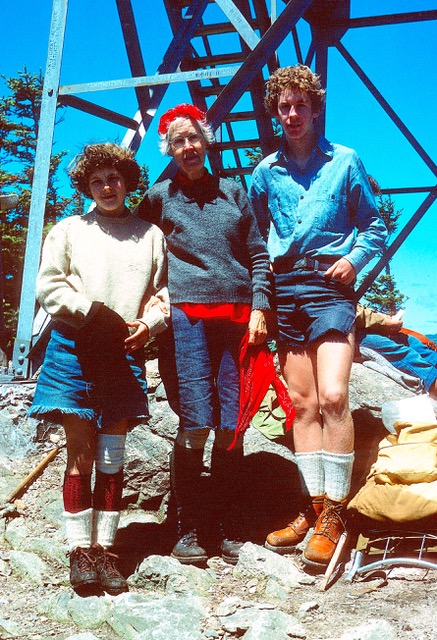
It took Cal 50 years to climb all the 4,000 footers for the first time, from Madison and Washington in 1920 to Owl’s Head in 1970. She climbed them all again, after she had turned 70 (1972 to 1977). I was pleased and honored on a day in July 1977 when I, Cal, and her two grandchildren, Shawn and Sara Wilbur, stood atop Mt. Carrigain, and celebrated the 6-year feat of endurance and pleasure.
***
Among Cal’s papers, I ran across a two-page handwritten narrative, in which she describes her first climbing of all the New Hampshire 4,000 footers. She did this between 1920 and 1970. I don’t know when she wrote the paper. It ends with the 1970 climb of Owl’s Head, but may have been written more recently. It’s a nice piece, and details some of the ascents that are mere hikes now, but were without trails and far from access roads when she first did them.
You might notice that she talks about climbing 46 peaks. Currently, 48 are recognized. However, there have been various additions and deletions over the years, as more precise measurements have been made of actual elevations, and also on the distance between the base and the summit of the individual mount. Whatever list you use, Cal climbed them all, some a number of times.
Climbing the 4,000-footers
Calista Crane Harris
“Climbing the 4000 footers has really been a life long joy for me. It all started in 1920 when I went from summer camp for a 4-day trip in the White Mountains. We got off the train at Appalachia. I slept in the old Madison Hut, the Tip Top House bunkroom, and Carter Hut. I began my mountains with Madison and Washington. In 1921 I went with the same camp as councilor and stayed at Lakes for the first time, adding Mt. Monroe to my list.
“It was in 1927 when a friend took a trip with me that I added Moosilauke, Carter Dome, and the Wildcats, and also met at Lakes a nice hutman, Slim Harris, who married me in 1929. Then my climbing began in earnest. By 1933 I had listed 22, and was making my own list of 4000 footers, which of course was slightly different from the present accepted list.
“In September 1933, we took the most memorable of our trips. It was backpack camping with equipment all home made and not as light as present day material. We began with the Sandwich Range, Tripyramid, and the Waterville Mountains. Then, with no trail at all, we followed the Hancock Branch to Lincoln, over the Franconia Ridge, Garfield, the Twins to Zealand, Lakes of the Clouds, and Great Gulf. It took three delightful weeks to do it. My list had climbed to 31.
“The next high spot was 1945. The hut boys were all at war, and Joe Dodge asked Slim and me to run Zealand for the summer. When we asked him what we should do with the children, he said “Bring them!” So Sally, 7, and Kim, 4, were with us all summer. I was very busy, but I managed to add five peaks. We all did Hale and Zealand. Sally did the Willey loop over Willey and Field with me. I left for Carrigain alone about 6:30 one morning and got back about 7 that night. I guess I liked that climb the best of all. The count was now 36.
“For 20 years I kept climbing, but not the ten peaks I needed. Then, in 1965 I got busy and added the Carters, Tom, the Kinsmans, and the Bonds. Now Slim and I had done all but the Hancocks and Owls Head. But Slim was always so busy checking on mountain flowers, we did not do the remaining mountains.
“In 1969 Slim died, and it was up to me to finish without him. My climbing companion, Dotty Goldenberg, and I left her Berlin home early and drove through to the Kankamagus Highway. We got to the end of the trail about nine o’clock. I was a little hesitant about the trip because the area was so little known to me. What little I had done there was before the highway was put through.
“The trail sign at the start was missing but we were sure we were in the right place. We knew we had a long trip before us, so we went along as steadily and easily as we could. The trail was lovely. It was late August, pleasant and not too hot. The trail is wide and smooth, and for a long ways almost level. We decided to do the South Peak first. As we turned from the Cedar Brook trail to approach the mountain, we lost our level trail. We kept remembering the Guide Book phrase, “unbelievably steep.” It was so true. I like to climb slowly enough so I can keep a steady pace without stops, but on this trail I needed a few breathers, as well. But we didn’t really sit down to rest until we ate half our lunch on top of the South peak.
“I enjoyed the mile between the peaks especially. The trees were very dense and the natural beauty less changed than in most places. We met a man climbing alone, doing the loop in the opposite direction. He was about halfway through the 4000 footers. My companion was doing her eleventh and twelfth. After today, I would have only Owl’s Head to complete mine.
“This Hancock climb was one I had wanted to do since 1933. Then, it was often done as a bushwhacking trip from Carrigain. The dense foliage between the summits made me glad I waited. We finished our lunch on the second summit. It was hard to tell which trail to take down, but I didn’t want to get out on the slide, so I took the more southern one. I knew that the trail was very new, and I thought it might be rough and hard. Many thanks should go to the trail makers. It is well built and nowhere difficult.
“When we were between the peaks, we began to hear little rumblings of distant thunder. I prefer my thunder storms at lower elevations, so we made our stop brief. It was not hard to keep a steady pace down, anyway. Part of the way down, we met a man starting up. He must have had a hard rain before he finished. The clouds were increasing as we got to our car, and the rains began as we drove toward Conway. We were lucky.
“I did Owl’s Head a few days later with Miriam Underhill and Louise Baldwin. We left Randolph about 6:30 a.m., and drove to the Wilderness Trail on the Kankamagus Highway. It was Saturday in late August, and the many people along the trail were much amused to see the three white-haired hikers going along at a clip fast enough to do the 16.4 miles in the daylight hours. It was an uneventful and thoroughly delightful trip. I made my 46th summit soon after noon, then down again and back to Randolph in time for dinner at 6:30.”
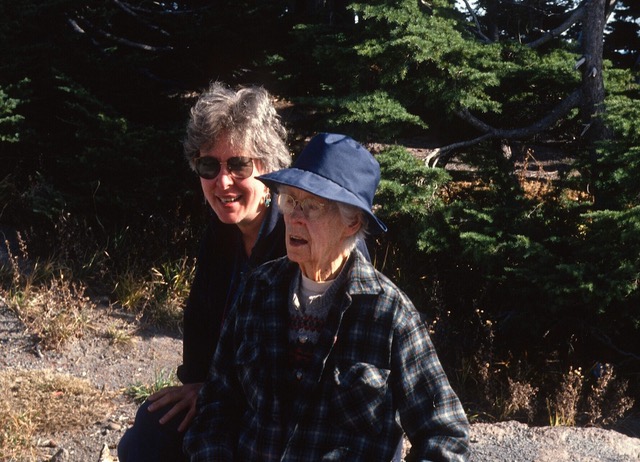
Cal at age 90 shortly before her death