Do What You Can: Sexual Assault Awareness 2026 – by MJo McCarthy
March 6, 2026
Posted in
AMC SAAM 2026 hike schedule
– April 4 – Mt. Kearsarge (South)
– April 11 – Moose Mountains Reservation: Beauty Ledge and Phoebe’s Nable
– April 18 – Pawtuckaway: North and South mountains
– April 25 – presentation to Spring School at Cardigan Lodge
Click on trip or visit AMC Outdoor Connector to register
The National Sexual Violence Resource Center reports:
- 4 out of 5 women have experienced sexual harassment or assault in their lifetime.
- 1 in 5 women have experienced rape or attempted rape
- 51.1% of rapes committed by an intimate partner and 40.8% by an acquaintance.
- 1 in 4 men have experienced some form of unwanted sexual contact.
If you are experiencing or have experienced sexual assault/abuse, resources can be found at RAINN (Rape, Abuse & Incest National Network)
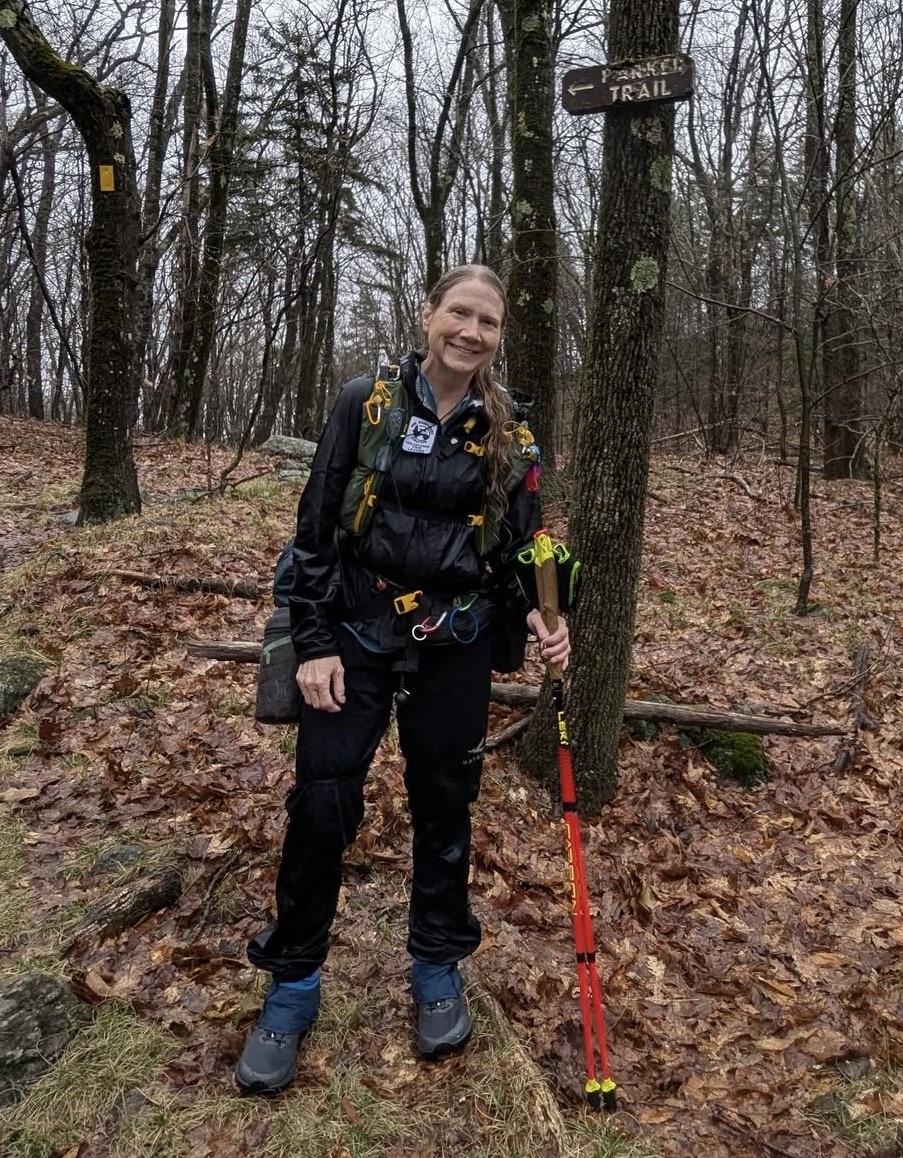
MJo McCarthy is an AMC hike leader. She recently completed her NH48 4,000 footers and is working on her Winter NH48 and 52 With-A-View. When not hiking, she is spending time with her family and trail running with her dog, Buttercup.
On April 9, 2025, New Hampshire Public Radio (NHPR) aired an interview with MJo entitled “NH AMC hike leader raises sexual assault awareness in new hiking series.”
In April 2025, I introduced a hike series for Sexual Assault Awareness Month (SAAM), an experience thoroughly rewarding from soup to nuts. The AMC’s enthusiasm and support in the spirit of “time and talent” is humbling. It was personally stretching, unquestionably helpful, and outdoors. What more could I possibly hope for?
In introducing the series, one of the points I made is how women are bombarded with the topic of sexual assault in the media and elsewhere as a matter of course. Here we are in 2026, and we are all getting a seemingly endless new awareness of sexual assault in the media. To many of us, this is not news. To some of us, it is. To anyone with a conscience, it is horrifying. How do we coexist with this oppressive awareness while remaining hopeful and affecting some meaningful change?
If you are feeling frustrated or wondering what on this green earth you can possibly do, maybe this is it or maybe it at least gives you some healthy ideas. There is very little that being outdoors doesn’t magically transform into something even just a little bit better. Whether you participate in this year’s SAAM hike series, engage in conversations with others on your own, or just give it some contemplation while out in the woods, I invite you to use April as a time to do something positive.
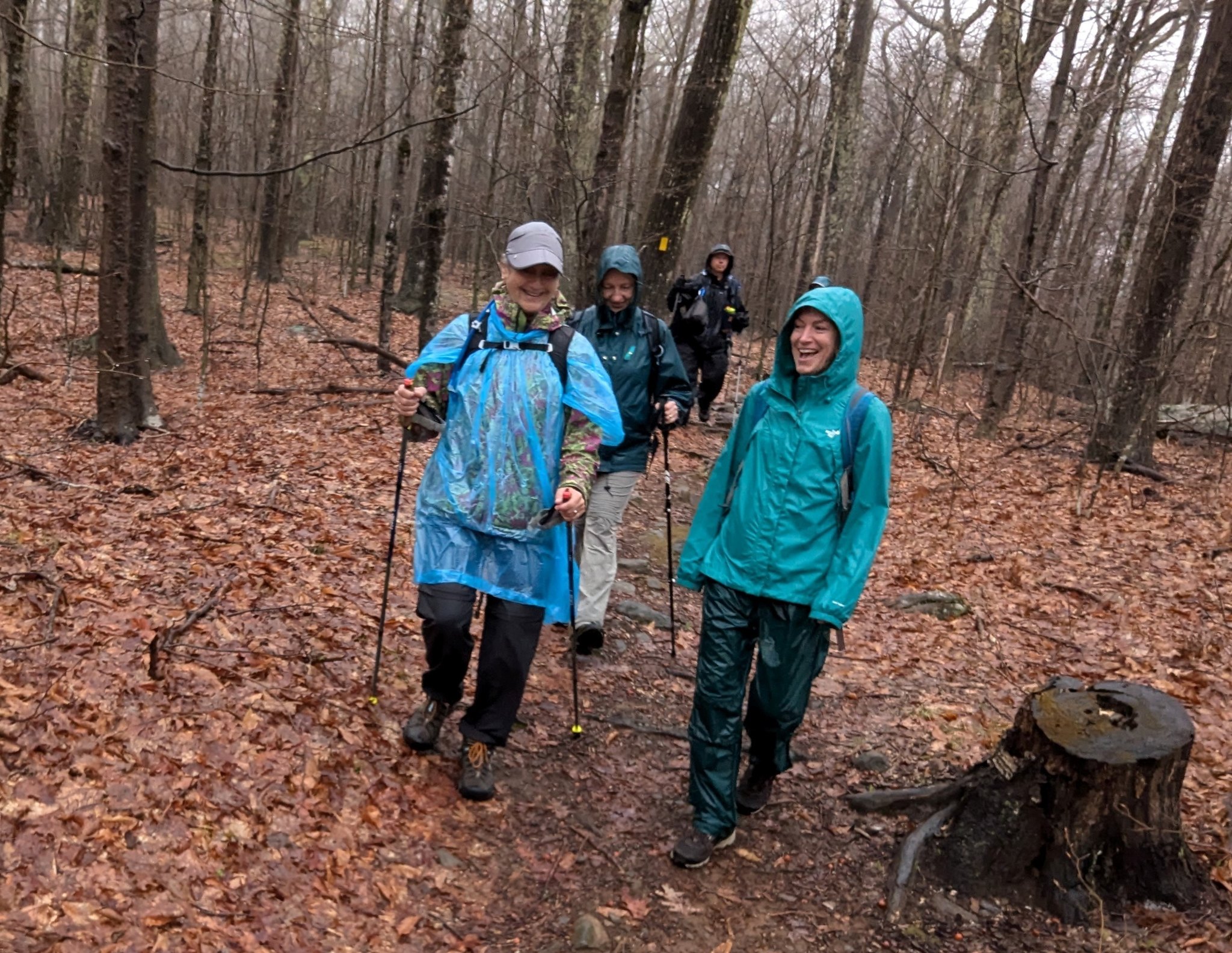
What are SAAM hikes? SAAM hikes are regular AMC hikes plus conversation. Sprinkled throughout each hike, typically at natural stopping points, we take the opportunity to discuss topics of personal safety, behavior, and trail etiquette. These are not “heavy” conversations or any form of professional therapy. They are merely an open conversation, one so often lacking, around the topic of sexual assault and how our presence on trail affects others for either good or bad. This April we will offer three independent Saturday hikes and a short presentation for those at AMC NH Chapter Spring School.
Last year was a first foray from which to learn and improve. It enabled us to listen and bring information to consider into our NH Chapter triennial training. It is all a work in progress, a running conversation. With that in mind, here is a recap of some of our feedback and findings.
In 2025, participants signed up for a variety of reasons. We did not ask, but many volunteered their “why.” Some just liked the hike being offered. Completely fair and welcome! Other offered reasons included:
- Topic resonates for personal reasons, including experience with sexual assault
- Wanting to support a person they know
- Feeling strongly it is an important topic
- Feeling this topic is not discussed enough
- Fearful to hike alone because of this issue
- Concern for a female loved one who hikes alone
- Wanting to know more about the topic
- Parents wanting to be able to discuss this topic with their child (specifically a dad wanting to be able to have these conversations with his teen daughter)
ALL of these are excellent reasons for the conversation.
Initial registrations were balanced in roughly the usual ratio of 3:1 women to men. Several registrants indicated a desire to sign up for all 4 hikes if schedules aligned. April experienced 4 weekends of wet weather and hike itinerary and participation varied accordingly. Hats off to the stalwart participants who stuck it out through the rain!
Feedback from women included:
- “THANK YOU” (universal and emphatic- this cannot be overstated)
- “This is so needed”
- “This doesn’t get talked about enough”
- Long list of anecdotal behaviors, both barrier raising and lowering
- “This empowered me to speak more openly”
Feedback from men included:
- “I didn’t know this was an issue”
- “What can I do to help?”
- “I never even thought about <potentially barrier raising behavior>”
- “ I always try to <barrier lowering behavior>”
The primary takeaway is that people enthusiastically welcome the conversation and find it helpful. People want to reduce this problem!
For my part, running the series originated with my awareness that I almost entirely missed out on the outdoors purely out of fear. I didn’t know! Finding my place in the woods again changed my life so fundamentally for the better that it feels intolerable that there are so many others who still don’t know. Moreover, I wanted to more comfortably speak to this issue openly and confidently. It’s not an easy topic, whether you have experienced sexual assault or not. I wanted to remove the “charge” that existed for me, especially rooted in my own experience, and be able to stand on my own two feet discussing this without a tremor in my voice. Those early conversations were scary! Only a year later, I discuss it as easily as I would the Wednesday Night Hike Series or any other AMC offering. That confidence is a gift that anyone who supported or participated in last year’s series, has given me.
Theodore Roosevelt is often quoted, “Do what you can, with what you’ve got, where you are,” ironically in a 1913 journal entry titled Outdoors and Indoors. Roosevelt himself attributes the words to Squire Bill Widener, of Widener’s Valley, Virginia.* Some of the reasons people signed up for last year’s series surprised me. The man who wanted to have these conversations with his teen daughter? It never even occurred to me as a reason someone would register, but it perfectly embodied my hopes for having a cross-gender dialog. Perhaps such open communication will result in more conversations with sons, too! Change is going to happen one conversation at a time. We are all presented with the imperfect human world as it is today. It is difficult. We also have this incredible, beautiful, restorative outdoor universe right at our feet. We have to do what we can, with what we’ve got, where we are.
* 1913 October 25, The Outlook, Outdoors and Indoors by Theodore Roosevelt, (The Ninth Installment of “Chapters of a Possible Autobiography”), Start Page 423, Quote Page 437, Column 1, The Outlook Company, New York. (Google Books Full View) link ↩︎
Why do we need sexual assault awareness in hiking?
 Communication is key. The AMC covers the outdoors in many environments. Our trails are not all the same. The “vibe” of the popular list hikes is different than near-suburbia logging roads. Hunting season feels very different than snowshoe season. A rainy April Wednesday in the Whites feels different than Franconia Ridge on a Saturday in July. My experiences across a wide swath of places in a wide range of conditions shapes my evolving perspective on safety. The common denominator most often comes down to communication and situational awareness. I could easily recount a dozen anecdotes just off the top of my head. Through leading the Sexual Assault Awareness hike series last spring, I heard dozens more anecdotes from others. I will share one of mine here. Your mileage may vary.
There is this small peak not all that far from my house. It’s not a place I like to run because the footing is not great and while pleasantly tucked away, it has a more suburban “feel.” But, in the spring when things are greening up, I return because it’s a means to a culinary end. That’s all I am going to say about that.
The trail starts out with what was once a class VI road, now washed out and no longer passable through to the other side in the next town. On my first spring visit of 2024 there was a dirt biker tearing up the trail where it’s posted against motorized vehicles. The guy was leaving ruts, visibly wrecking the trail for everyone else. It was just me, my dog Buttercup, and him on a dirt bike. I got out of the way and kept BC’s leash tight. He stopped (please, just don’t) and even apologized for my having to move. I was outwardly cheerful and all “no worries,” but… UGH. Even that feels a little like selling my soul. I believe my male hike leading counterparts would have set him straight. The rest of the trail was dug up by ATV tracks, also not great. The next day I returned and there was a vehicle parked partially down the washed out road where it ought not to be and there were more deep tracks. On the summit itself there was a man and woman who seemed impaired. This paints the picture of my mindset. I was already frustrated, which is almost never how I feel in the woods.
It annoyed me that my level of confidence did not extend to telling a solo male that he’s being a jerk and to please knock it off. In these situations I am more likely to play it very friendly and “chill” as my kids would say, and take an unspoken approach of “I am no bother to whatever poor judgement you’ve got going on, don’t worry about me” and get on my merry way. Stumble upon someone burying a body? “What lovely weather you have for it! I must be going now…” Is that the smart way to play it? Maybe, but it still irritates me. I guarantee you many women know exactly what I am talking about.
I was almost back to my car after the 3rd circus act when a Jeep Liberty was coming downhill into the depression that then climbs back up toward me. In the especially confined and obscured valley, he stopped his vehicle and got out, just as Buttercup and I were approaching downward. In my head, the “what now” mindset had me guessing he was trying to 4-wheel for fun, but I was unsure why he stopped and got out as we neared. My car was .2 miles up the hill beyond him, still well out of sight. Instant bells and whistles going off- he is standing blocking the trail next to his open car door in a completely invisible area. I bet you the women reading this are thinking “Oh… Hell to the NO…” The men reading this might see it because I am explaining, but imagine it in the moment from the man’s perspective. I stopped because I couldn’t move forward without knowing what I was up against. He was chatty. He claimed to be upset that he ran over a stick. Really. Not a very big stick, either. He was worried about his transmission line. I thought that wow, his 4-wheeling experience is nowhere near what I had just recently witnessed, he must be a newbie giving it a try? Is this for real? Am I on Candid Camera? Does this add up? It felt like he wanted me to also look under this car. He seemed genuine and I was torn because I like to help people but my gut said NO. I asked if he was headed to the peak, the place from where I just came. He surprised me by asking if he could drive to the top. I overly cheerfully informed him no, definitely not. He said this looked like a class VI road, that he hadn’t been here in many years, and asked if it got more difficult. I cautiously offered that it got a “little” worse in a few places with one difficult rock section (serious understatement) and if he wanted to go to the peak, he could just park and walk, but I was extremely eager to go and did not elaborate, wanting to just be agreeable and hopefully squeak by him to leave. I failed to see the bigger picture.
It wasn’t until I got home that it dawned on me. Some maps/GPS make this old “road” look more passable than others. I’ve seen it. He wasn’t trying to 4-wheel at all! He was simply trying to get through to the other side! Maybe he thought with a Jeep Liberty it’d be passable. He hadn’t been there in years, remembered it fondly, and got hopeful when I mentioned the peak by name. This is why he sounded genuinely bothered by the stick- he wasn’t a 4-wheeler. He was likely a nice guy who wanted as little trouble as possible. He had zero idea what I had just gone through.
From his perspective he had a map that made this look like a possibly drivable road, a reality in front of him that wasn’t backing that up, and someone (me) coming from the direction in which he was headed who he could ask for information. He was completely unaware how his behavior and obstructive position put me in a major bind. I was having a completely different experience. I was only hyper aware of being in a non-visible depression with a guy who stopped and got out, stood next to his open car door and blocked the trail between me and my car, which was also non-visible and .2mi over a rocky hill. He was outside his vehicle with the door open in the middle of the trail such that I’d have to veer way to the side to get any distance and I intended to go home. I was a 51 year old adult and was completely in my own element. By now I was already a hike leader, nearly done with my NH48, spent countless hours trail running all over the state, and I could not even see what was actually transpiring.
I had exactly the authoritative information he needed and I absolutely could have alleviated the whole situation with one stupid sentence. Instead, my only clear priority was to snap a quick pic on the approach, text it to my husband, be very visibly kind to Buttercup, and take a friendly and unspoken stance of ‘You do you, I must be going, bye.’ This frustrates me to no end.
What’s so unacceptably tragic is that my response was so reasonable. All of this outdoor awesomeness has utterly changed my entire life, I cannot overstate that, and this felt like hitting up against a hard wall. I should have been able to look under the guy’s car, help him with the stick, and tell him that the road does not go through. But… If I were to advise my highly capable daughter on how to respond if she encounters a man stopping his vehicle directly in front of her on a densely wooded trail in an especially non-visible valley, getting out with the door left open and blocking her path… Would my guidance be any different? I would tell her to do exactly as I did. Get the h*** out of there.
All of this, because the probably very nice guy and I were having very different conversations. I was aware solely of my risk. He was oblivious to how he was presenting. Some situational awareness and communication could have avoided the entire problem. Women encounter these situations in the woods all the time. So… Lets have those conversations.
Getting the Word Out
Whether you sign up for a series hike or not, there are ways to help no matter the month of the year. Here are ways you can help:
- Practice safe and welcoming trail etiquette.
- Discuss the topic openly. It takes practice but it does get easier!
- Be familiar with bystander intervention strategies and share them: https://rainn.org/articles/practicing-active-bystander-intervention
- Men, set the bar with your male friends. If you see something, NIP IT: “Dude, that’s not okay.” Normalize rejection of bad behavior.
- Visibility matters! When conversationally appropriate, reinforce the normalcy of women doing what they love outdoors.
- When someone who has experienced sexual assault shares their experience, listen. Help them amplify their own voice on their terms. Sometimes this simply means not interrupting and/or reframing their words.
- Be careful when spreading awareness that you are empowering vs. fear mongering. The woods are not statistically less safe than other public spaces women occupy as a matter of normal life.
Dos and Dont’s: Below is a curated list of behaviors raised in our 2025 hike series and is by no means a “rule book.” Trail etiquette in this respect is mostly about situational awareness. The gist is to behave in a way that respects others’ agency and personal space. Have a non-threatening presence. When in doubt whether something is okay, just ASK!
Helpful (barrier lowering):
- Position yourself such that you are not blocking someone’s direction of travel
- Stand only as close as is needed for comfortable conversation
- If a need arises to approach closer, ASK
- Always ask before approaching/petting someone’s dog
- Always ask before helping/assisting with gear
- ALWAYS ask permission before touching someone
- ALWAYS respect when the answer is “no”
Not helpful (barrier raising):
- Touching someone without permission
- Commenting on someone’s solo hike status
- Commenting on someone’s appearance beyond a safety concern
- Commenting on someone’s hike ability with respect to their gender
- Blocking someone’s direction of travel
- Reaching to fix someone’s gear without asking (“Here, I’ll tie that back for you…”)
- Approaching someone’s dog, getting between an owner and their dog, handling someone’s dog without permission
- Intentionally keeping pace with someone after meeting on trail
- Assuming someone wants help
- Assuming someone wants/needs a hike partner after meeting on trail
- Asking for someone’s phone number or their plans after a hike
- Inquiring where someone started or parked or specifics about their hike plan
- Openly carrying a visible weapon
- Not respecting a “no”