Tie This Rope Around Your Waist and Follow Me: The First Generations of AMC Rock Climbers – by Becky Fullerton, AMC Archivist
September 5, 2026
Posted in
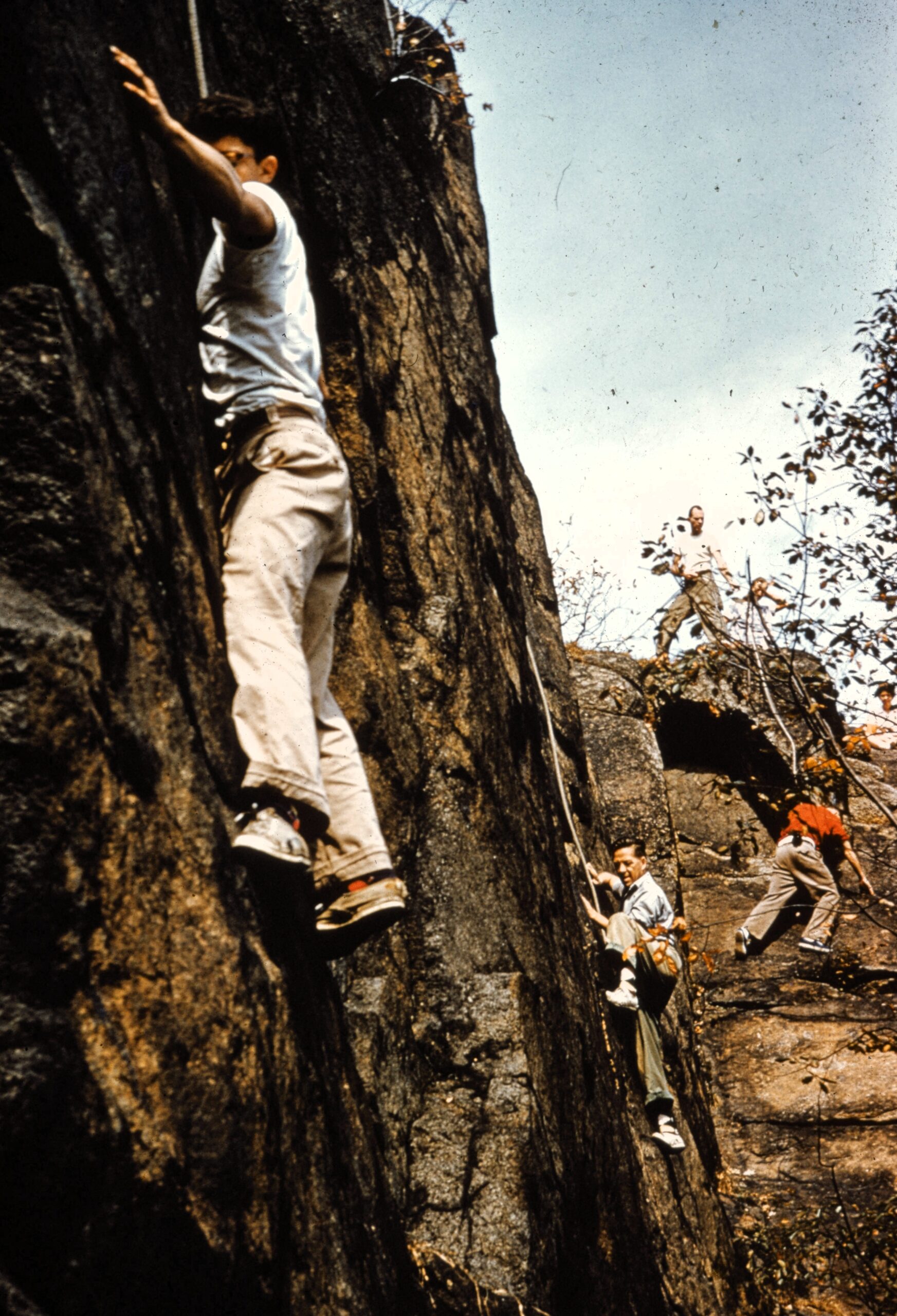
AMC rock climbing excurion, 1950s. Courtesy of AMC Archives.
The Appalachian Mountain Club (AMC) celebrates the 150th anniversary of its founding in 2026. Leading up to this auspicious milestone, we’ll be sharing historical highlights about the founding and development of the club. Everything from trails to trips, conservation to canoeing, lodges to lean-tos, with surprising stories and little-known facts in between. Though not a comprehensive history of AMC, this series is meant to help us connect to our heritage as the country’s oldest conservation and outdoor recreation nonprofit and to better understand our own place in this special community that has been helping people know and love the outdoors since 1876. Becky’s latest chapter found below describes the club’s activities and accomplishments in its first year. Becky has published siseven other chapters to date:
- Chapter 1: The origins of the Appalachian Mountain Club in 1876
- Chapter 2: Our Founding: “The Association Shall Be Called the Appalachian Mountain Club”
- Chapter 3: Death in the Mountains: The Curtis and Ormsbee Tragedy
- Chapter 4: Early AMC Land Conservation in New Hampshire
- Chapter 5: Appalachian Water Club: How Paddling Became Part of AMC
- Chapter 6: Oh, Canada! AMC’s Early Adventures North of the Border
- Chapter 7: From Charles E. Fay’s vision to the AMC 150 Relay
You can read a compendium of all chapters here
Today, it is difficult to imagine the Appalachian Mountain Club without rock climbing. Climbers tackle the sheer faces of Cannon Cliff, Cathedral Ledge, Whitehorse, and Huntington Ravine using ropes, protection, helmets, and carefully honed technical skills. Yet for much of AMC’s early history, “rock climbing” as we understand it scarcely existed within the club.
The AMC’s founders and earliest members were hikers, explorers, and naturalists. A few had experience in the European mountaineering tradition and were comfortable using rope and alpenstock on difficult terrain, but most did not seek out steep rock for its own sake. In the late nineteenth century, even the handful of AMC members traveling to the Canadian Rockies considered themselves mountaineers rather than climbers. If they clambered up a cliff or negotiated exposed ledges, it was simply because those obstacles stood between them and a summit.
The White Mountains offered plenty of opportunities for this kind of adventurous scrambling. Huntington and Tuckerman Ravines challenged early visitors with steep slabs, gullies, and loose rock. Yet these places were regarded as difficult routes rather than climbing destinations. AMC’s Guide to Paths and Camps in the White Mountains (1907) reflects this mindset perfectly. The guide observed that “trampers who are accustomed to rock climbing” might enjoy ascending the right wall of Huntington Ravine but quickly warned that the route was dangerous and unsuitable for inexperienced travelers. The implication was clear: rock climbing was an unusual skill possessed by only a few adventurous individuals.
By the 1910s, however, winds of change were blowing across the mountain world. In Britain, climbers were flocking to the crags of Wales, the Lake District, and Scotland’s Isle of Skye. New books celebrated climbing not merely as a means of reaching mountaintops but as a sport in its own right. George Dixon Abraham’s The Complete Mountaineer and Ashley P. Abraham’s Rock-Climbing in Skye, both published in 1908, helped popularize technical climbing and inspired readers to seek out cliffs specifically because they were difficult.
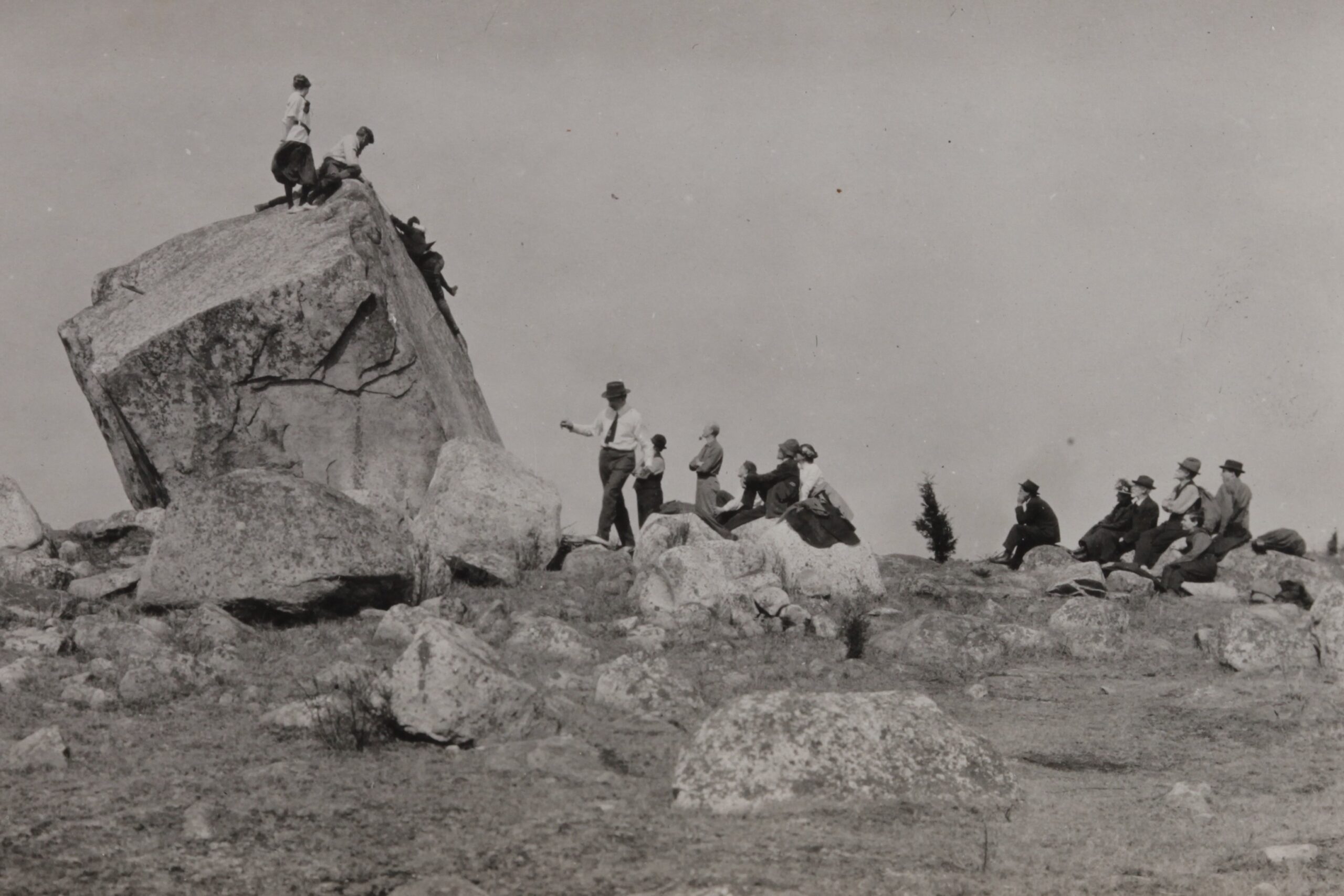
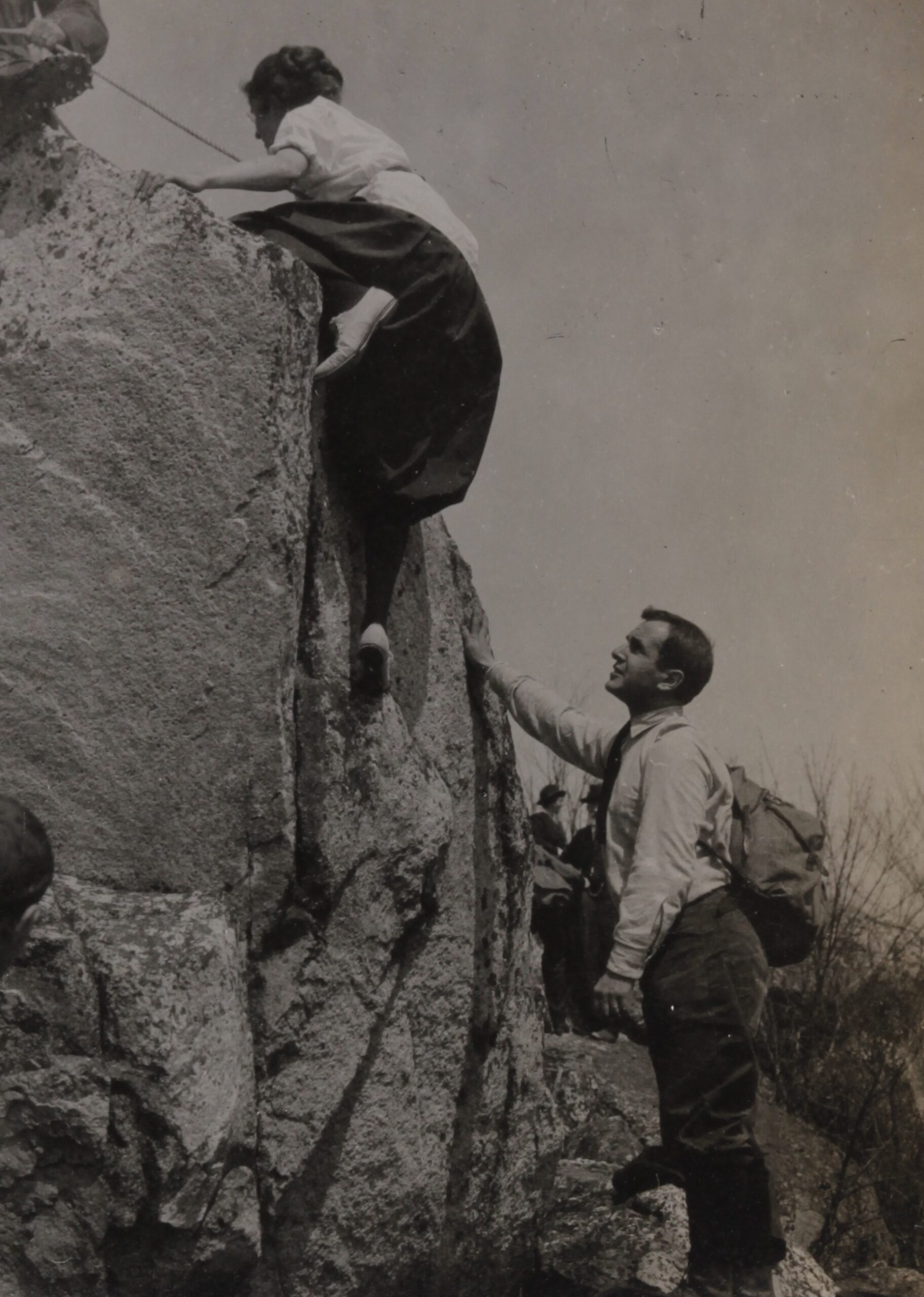
Bouldering at Dogtown Commons on Cape Ann c. 1915
Bouldering at Dogtown Commons on Cape Ann c. 1915. Courtesy of AMC Archives
The first glimpse of this new spirit in AMC publications appears in October 1916. In an article for Appalachia, H. L. Emerson recounted a climb he and a companion identified only as “H.B.” made on Joe English Hill in New Boston, New Hampshire. Their equipment would make modern climbers shudder: fifty feet of half-inch hemp rope and a pair of rubber-soled shoes. As they inched their way up the cliff, they overheard a conversation from two locals standing on the road below:
“What’s he doing up thar?”
“Climbing that ar wall,” replied the other.
“Well, he’ll get his’n, if he don’t look out. I wouldn’t be thar for a thousand dollars.”
The exchange is one of the most charming snapshots of early rock climbing in New England. At a time when climbing was virtually unknown as a recreational activity, seeing people intentionally scale a cliff seemed absurd to outside observers.
Only a few months later, evidence emerged that these pioneers were beginning to organize. In January 1917, readers of the Appalachia Bulletin encountered an intriguing notice from a previously unheard-of “Rock-Climbing Group.” Its author, Frank Stillman Mason, asked members to submit records of climbs made on the buttresses and gullies of Huntington Ravine. Today this might sound routine in the climbing community, but it was actually a remarkably forward-thinking request. Mason was attempting to create one of the earliest climbing records in the White Mountains, documenting the details of each crag and cliff.
Mason was an unlikely catalyst for AMC climbing. A Charlestown salesman by profession, he had founded the Bunker Hill Boys Club in 1893 and devoted much of his life to youth development and outdoor recreation. After joining AMC in 1910, he became captivated by climbing literature, especially C. T. Dent’s influential Mountaineering. Before long, he had assembled a small circle of enthusiasts willing to practice rope techniques on local cliffs in places like West Roxbury and Peabody, Massachusetts.
Their equipment reflected another era entirely. Climbers tied hemp ropes directly around their waists for protection. There were no helmets, harnesses, spring-loaded camming devices, or sticky rubber shoes. Falls were potentially disastrous, and success depended heavily on judgment, balance, and nerve. Despite these limitations, Mason’s group was laying the groundwork for organized climbing within the club.
One of the most remarkable pieces of evidence from this period survives in the form of five photographs taken during an excursion to Cape Ann in April 1915. Officially, the outing was described as an 8.5-mile walk around Rockport, Pigeon Cove, and Annisquam. Tucked into the announcement was a brief note: “The Rock Climbers, F. S. Mason, leader, will accompany and return with party.”
What happened next may represent AMC’s first organized bouldering session. At Dogtown Commons, participants scrambled up a massive glacial erratic while their companions watched from below. The photographs show several climbers roped around the waist, including at least one woman. More than a century later, the images remain extraordinary. They capture an activity that was still experimental within the club and document female participation at a time when women climbers were relatively rare throughout North America.
Among Mason’s recruits were his own daughters, Margaret Kent Mason and Dorothy Choate Mason. Margaret, who married early climber Julian Willard Helburn in 1914, became part of the growing community of climbers and mountaineers emerging within AMC. Helburn himself would prove immensely influential. In 1923, he and Margaret gathered friends at Crawford Notch for a winter week of hiking, snowshoeing, and climbing. The gathering became known as the Bemis Crew, a social institution that endured for decades and nurtured many future AMC leaders.
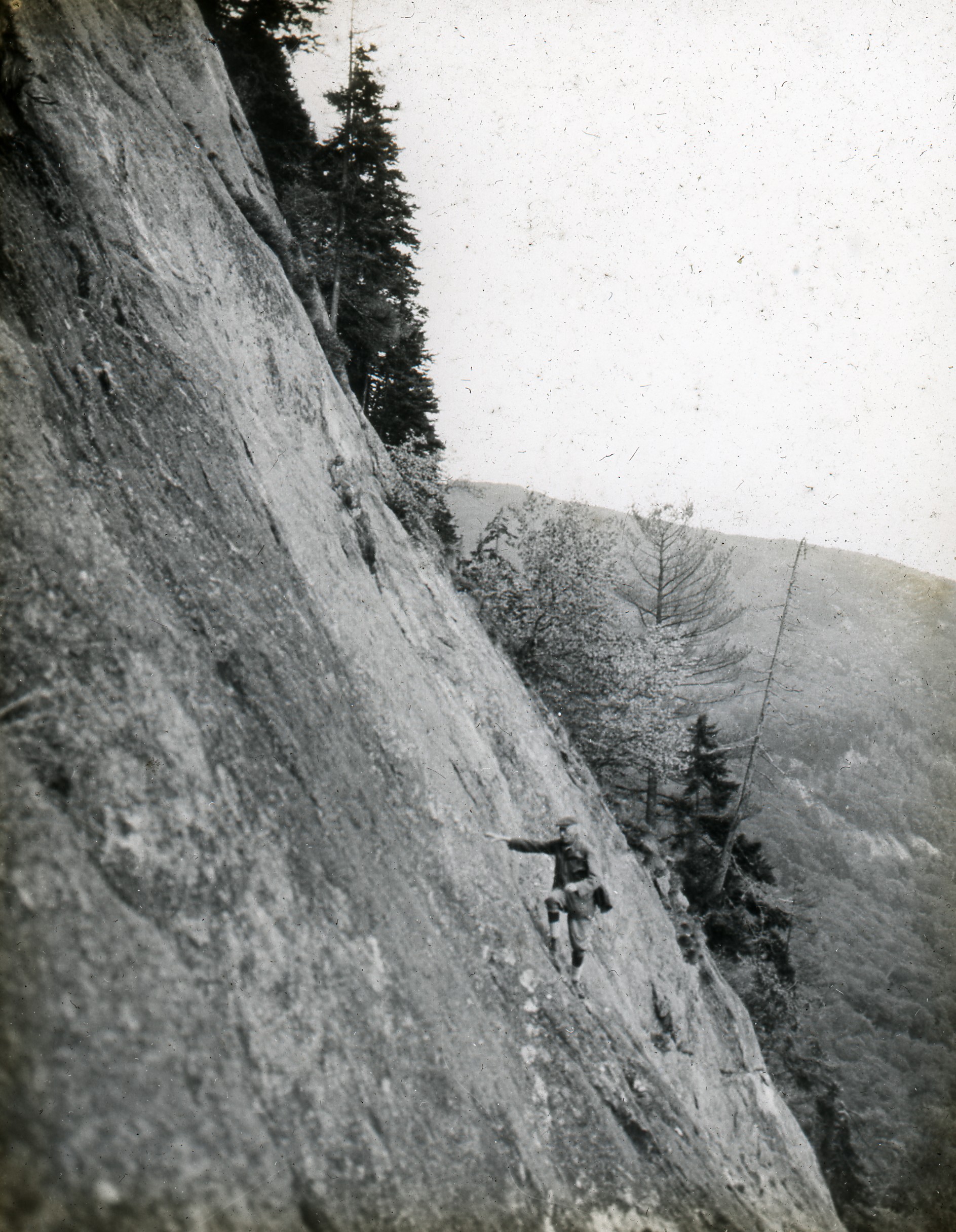
Frank Mason scaling a cliff near Basin Rim Trail – Chatham, New Hampshire, 1920. Courtesy of AMC Archives
By the 1920s, climbing had achieved enough momentum that the Appalachia Bulletin was filled with announcements for climbing trips throughout eastern Massachusetts and the White Mountains. Future legends such as Miriam O’Brien, Robert L.M. Underhill, Kenneth Henderson, Chester Dodge, Stanley Banfield, and John C. Hurd appeared regularly as leaders.
The sport took another major step forward in 1926 when John C. Hurd organized a climbing weekend at Pinkham Notch Camp. Unlike earlier outings, the event explicitly welcomed climbers of all abilities and included instruction for beginners. The response was so enthusiastic that AMC established a Rock Climbing Subcommittee the following year, with Hurd as chairman. For the first time, climbing had an official place within the club’s organizational structure.
The committee thrived through the 1930s. When participation sagged during the Depression, leaders responded by creating climbing weekends that doubled as instructional courses. These programs attracted newcomers while also giving experienced climbers a chance to refine their leadership skills. In 1934, the committee sponsored an ambitious trip to the Wind River and Teton ranges, exposing dozens of eastern climbers to the dramatic mountains of the American West.
World War II brought inevitable disruptions. Many climbing leaders entered military service. Gasoline rationing and tire shortages limited travel and even climbing rope became difficult to obtain. Yet the community endured. By 1950, AMC reported averages of twenty participants on each of eighteen climbing trips. That same year, members produced a color motion picture titled “The Climbing of White Horse Ledge.” Filmed with three cameras, it was likely among the earliest club-produced climbing films in New England. The movie itself appears to have vanished, but one can easily imagine reels of footage tucked away in an attic waiting to be rediscovered.
During the decades that followed, AMC climbers became deeply involved in the exploration and development of New England’s premier climbing areas. They helped establish the region’s reputation for traditional climbing, mountaineering competence, and leadership development. By 1951, the club’s climbing activities were prominent enough to be noted in the American Alpine Journal, one of mountaineering’s leading publications.
For a couple more recent articles on the history of rock climbing in the Northeast, check out “A White Mountain Legacy of Climbing & Stewardship” by Mike Morin in the Summer 2026 issue of the Mt. Washington Valley Vibe , and “Thelma and The Lead: Becoming an “Appie” in the 1930s,” by Becky Fullerton in the Fall/Winter 2026 issue of AMC Outdoors.
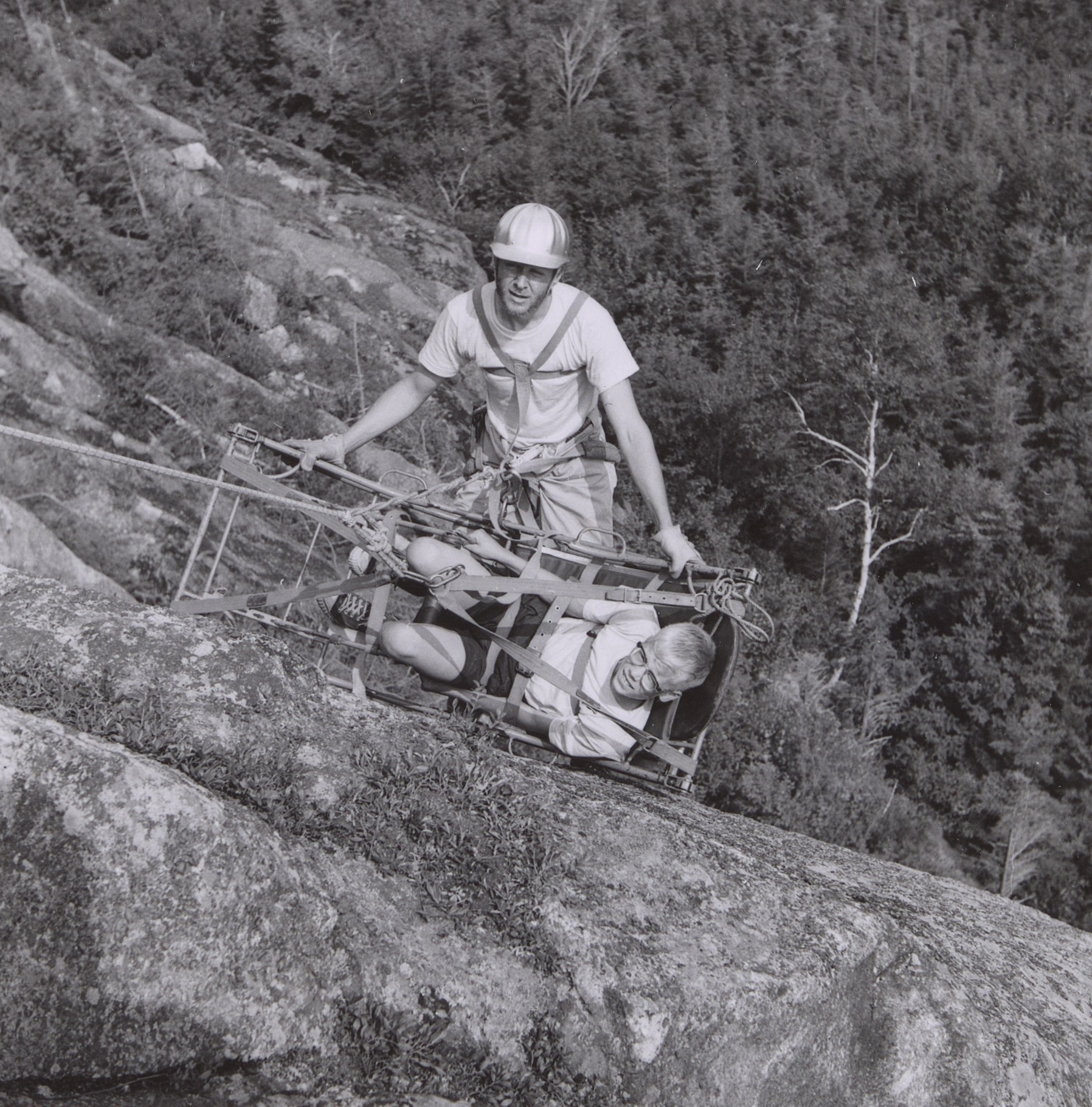
Staged litter rescue on Artist Bluff for AMC Mountain Day in Franconia Notch, 1960s. Courtesy of AMC Archives.