A Continuous Journey: From Charles E. Fay’s Vision to the AMC 150 Relay – by Becky Fullerton, AMC Archivist
May 21, 2026
Posted in
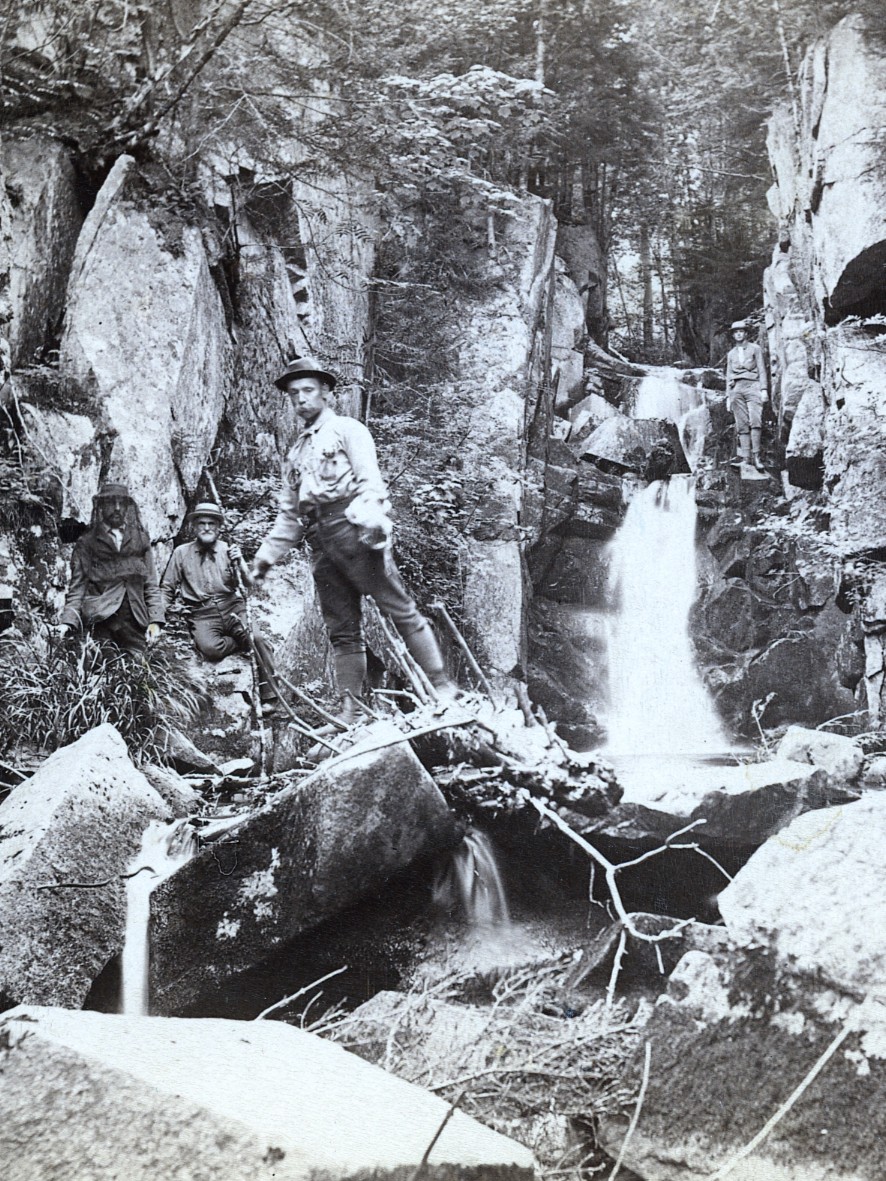
Four AMC hikers at dixville Flume, NH 1889
The Appalachian Mountain Club (AMC) celebrates the 150th anniversary of its founding in 2026. Leading up to this auspicious milestone, we’ll be sharing historical highlights about the founding and development of the club. Everything from trails to trips, conservation to canoeing, lodges to lean-tos, with surprising stories and little-known facts in between. Though not a comprehensive history of AMC, this series is meant to help us connect to our heritage as the country’s oldest conservation and outdoor recreation nonprofit and to better understand our own place in this special community that has been helping people know and love the outdoors since 1876. Becky’s latest chapter found below describes the club’s activities and accomplishments in its first year. Becky has published six chapters to date:
- Chapter 1: The origins of the Appalachian Mountain Club in 1876
- Chapter 2: Our Founding: “The Association Shall Be Called the Appalachian Mountain Club”
- Chapter 3: Death in the Mountains: The Curtis and Ormsbee Tragedy
- Chapter 4: Early AMC Land Conservation in New Hampshire
- Chapter 5: Appalachian Water Club: How Paddling Became Part of AMC
- Chapter 6: Oh, Canada! AMC’s Early Adventures North of the Border
- Chapter 7: From Charles E. Fay’s vision to the AMC 150 Relay
You can read a compendium of all chapters here
In January 1878, Charles Ernest Fay was elected President of the AMC, succeeding Samuel Hubbard Scudder, an entomologist and paleontologist. During his presidency, Scudder also served as a leader within the Boston Society of Natural History, an assistant librarian at Harvard, and librarian for the American Academy of Arts and Sciences. He was, in every sense, a scientist and data specialist. Fay, by contrast, claimed he was not a man of science, though he was a professor of mathematics and modern languages. In his retiring address, he noted that he had been elected for precisely that reason. Fay was deeply committed to what he described as the club’s “dual nature,” its devotion to science and knowledge alongside the physical, social, and aesthetic dimensions of outdoor recreation. This distinction set the AMC apart from its peers. He recognized the pure joy inspired by time in nature and believed the club was “perhaps the sole representative on this continent of the interests of aesthetics as related to the realm of nature,” and therefore duty-bound to encourage people outdoors. While the club continued its work exploring, mapping, studying, and analyzing the region’s mountains, Fay also expressed a central truth: people wanted to hike, and they wanted friends with whom to hike.
It took time to work out the logistics of hiking as a group. In the club’s first year, the only organized excursions were those associated with the inaugural Field Meeting in North Conway, New Hampshire, in July 1876. After a day of meetings, lectures, and discussions, a party of thirty climbed Kearsarge North. The following day, 175 members rode the Portland and Ogdensburg Railroad through Crawford Notch to the Crawford House, where some climbed Mount Willard. The following year’s Field Meeting, again in the White Mountains, accounted for most club hikes in 1877, though two day trips near Boston were also organized. Otherwise, hiking was largely undertaken by individuals or small groups in support of committee work in exploration, mapping, and trail building.
It took more than six years from the club’s founding to organize excursions in every season and just as long to venture beyond Massachusetts and New Hampshire. However, the hikes that were organized were strikingly well attended. It was not unusual to find a party of twenty or more hiking into Tuckerman Ravine. In August 1879, one hundred members made that journey, arriving by wagon and leaving forty-one horses tethered at the trailhead for the day. In May 1883, 210 participants joined an outing to the Middlesex Fells just north of Boston. Despite this success, the club did not establish a formal Committee on Field Meetings and Excursions until 1888.
AMC 150 RELAY CLEBRATION
In celebrations like the current AMC 150 Relay, where participants collectively traverse hundreds of miles in a continuous journey, we see a living expression of those early outings: a little bit nerdy, obsessed with maps and route planning, well-organized, safe, welcoming, and brimming with AMC’s classic exuberance for all things outdoors. As the Relay enters New Hampshire at the end of June, I hope you will find yourself on one of over sixty legs and events happening across the state to mark 150 incredible years. See Here for more information about AMC 150 – Becky Fullerton
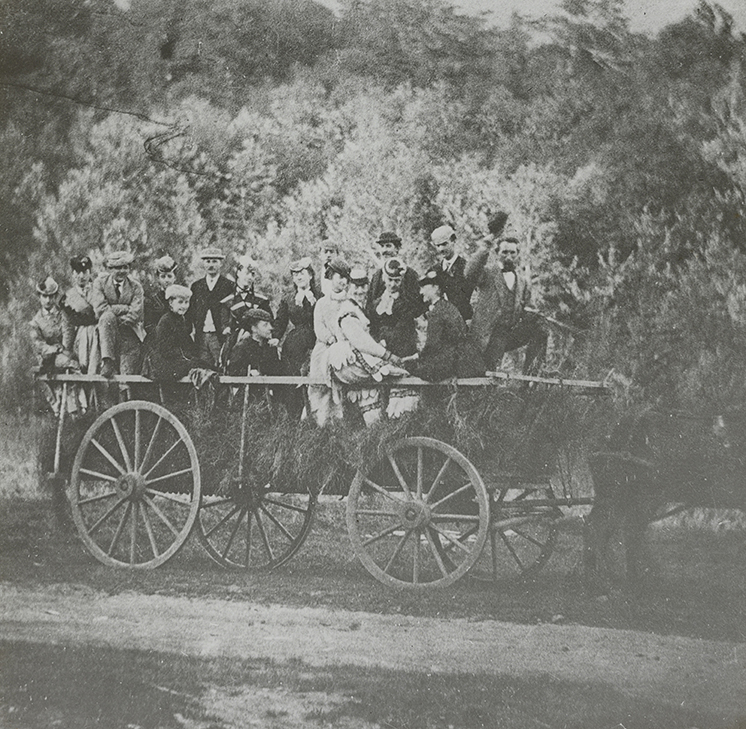
Straw wagon ride for AMC members circa 1870’s
Much about the logistics of these early outings remains unclear. Advance notice appears to have been limited to occasional mentions in Boston newspapers, and it is unknown whether members registered beforehand or how attendance was managed. Travel and lodging arrangements were left to individuals, and it is not always evident whether hikes had designated leaders. The group size limits and liability waivers familiar today were entirely absent.
Scientific inquiry remained central to many excursions. During a one-day Field Meeting at Lexington, Massachusetts, in June 1877, about one hundred members were hosted by the Lexington Field and Garden Club, an organization founded just after AMC in May 1876 and still recognized as the oldest garden club in the United States. The AMC party traveled together by train from Boston, arriving at nine o’clock in the morning and remaining for the day. An article in the Boston Home Journal describes the inquisitive visitors ascending Hancock Heights, also known as Granny Hill (elevation 362 feet), where they “produced their barometers and angle-measuring telescopes, and other instruments, and made such an investigation and analysis of the position and field of view as time would permit.” In keeping with another longstanding AMC tradition, the group was provided a lavish lunch, reportedly more than even their “mountain appetites” could finish.
Journalistic observers, who likely did not know what our hikes into the backcountry of the White Mountains were like, often described us in more pedestrian terms. A writer for the Davenport Daily Gazette of Davenport, Iowa, observed in 1883: “There is an Appalachian Club in Boston, the members of which take long walks, always making their route along a railroad or a shore, so that they can get into a car or boat when overcome by fatigue.” It is true that we were fans of outings accessible via public transit before it was cool, but not every hike was overseen by bail-out vehicles.
The majority of contemporary press coverage, however, was positive, if occasionally tinged with curiosity. The Bangor Whig and Courier writes in July 1888: “It is the custom of the Appalachian Club to spend a week during the early part of the season at some of the summer retreats where there are numerous mountains to climb, and they go climbing like a swarm of bees, usually a hundred strong. The club, as now constituted, has nearly 1,000 members of a class whom it is delightful to meet, and their week among the mountains is one of the keenest enjoyments of the season.” A journalist in Staunton, Virginia, encountering an AMC group during its first trip to the Southeast in 1886, called them “one of the happiest parties we have ever seen.”
The descriptions largely fit all these decades later. These early accounts reveal that AMC’s greatest achievement was not simply in charting peaks or cataloging natural history, but in discovering how to bring people together in the landscape itself. What began as loosely arranged outings; part scientific inquiry, part social experiment, quickly evolved into something far more enduring: a community bound by shared effort, curiosity, and joy. Fay’s conviction that the club must serve both intellect and spirit proved prescient, as the AMC’s identity took shape not in lecture halls alone, but on trails filled with conversation, laughter, and discovery. Long before formal structures caught up, the spirit of the club had already found its footing, rooted in the simple, powerful idea that the outdoors is best experienced together, and that in seeking it out, people were also finding one another.
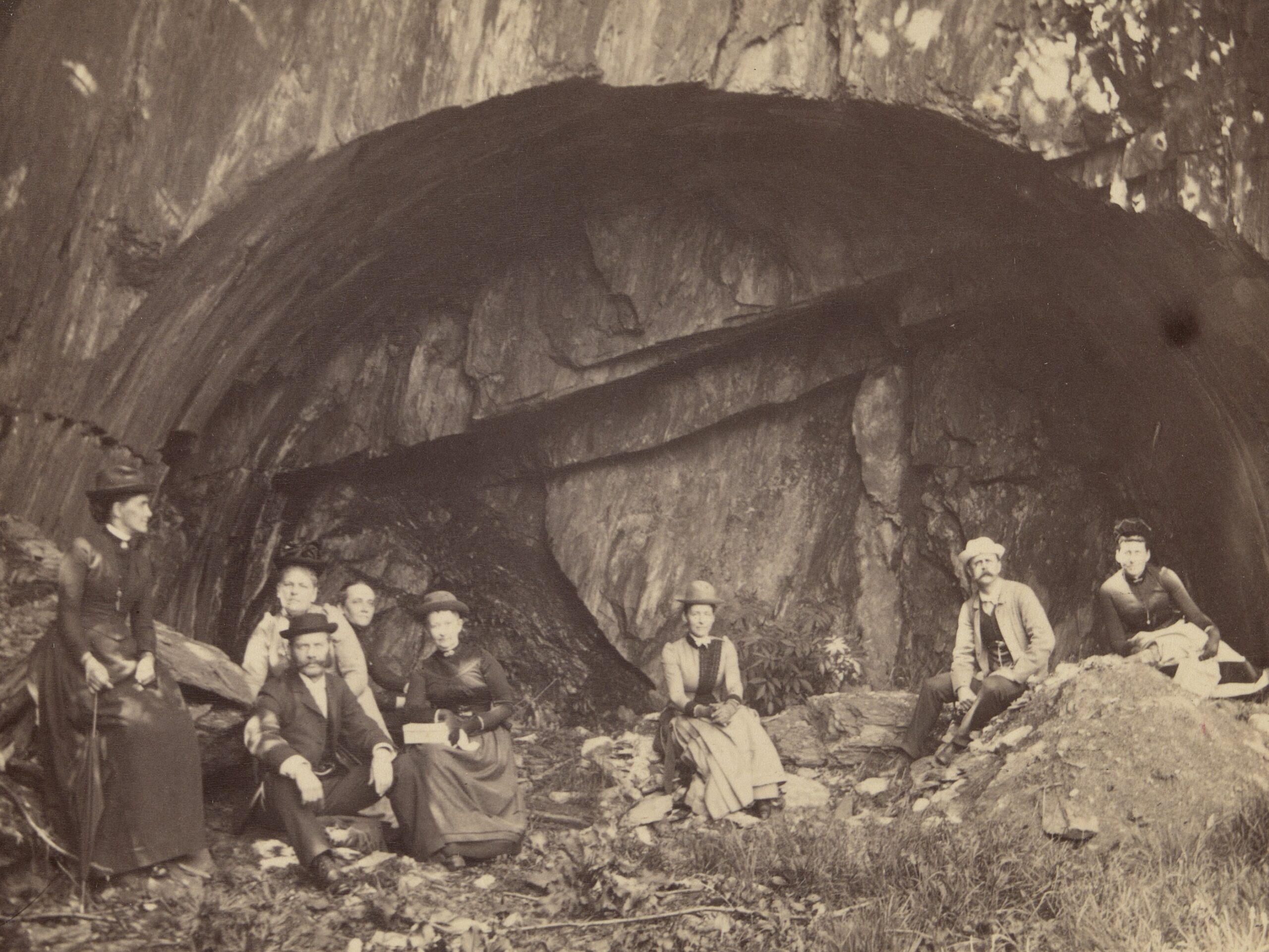
AMC group at Hoosac Tunnel test portal in Florida, MA – 1890