AMC 150 HISTORY SERIES: Chapter 4 – Appalachian Water Club: How Paddling Became Part of AMC – by Becky Fullerton, AMC Archivist
September 10, 2025
Posted in
The Appalachian Mountain Club (AMC) celebrates the 150th anniversary of its founding in 2026. Leading up to this auspicious milestone, we’ll be sharing historical highlights about the founding and development of the club. Everything from trails to trips, conservation to canoeing, lodges to lean-tos, with surprising stories and little-known facts in between. Though not a comprehensive history of AMC, this series is meant to help us connect to our heritage as the country’s oldest conservation and outdoor recreation nonprofit and to better understand our own place in this special community that has been helping people know and love the outdoors since 1876. Earlier chapters (scroll down this link) chronicle the tragic climbing deaths of AMC members William Curtis and Allan Ormsbee on Mt. Washington in 1900 (Chapter 3), AMC’s interest in conservation Chapter 2) and the origins of the Appalachian Mountain Club in 1876 (Chapter 1).
Chapter 4 – Appalachian Water Club: How Paddling Became Part of AMC
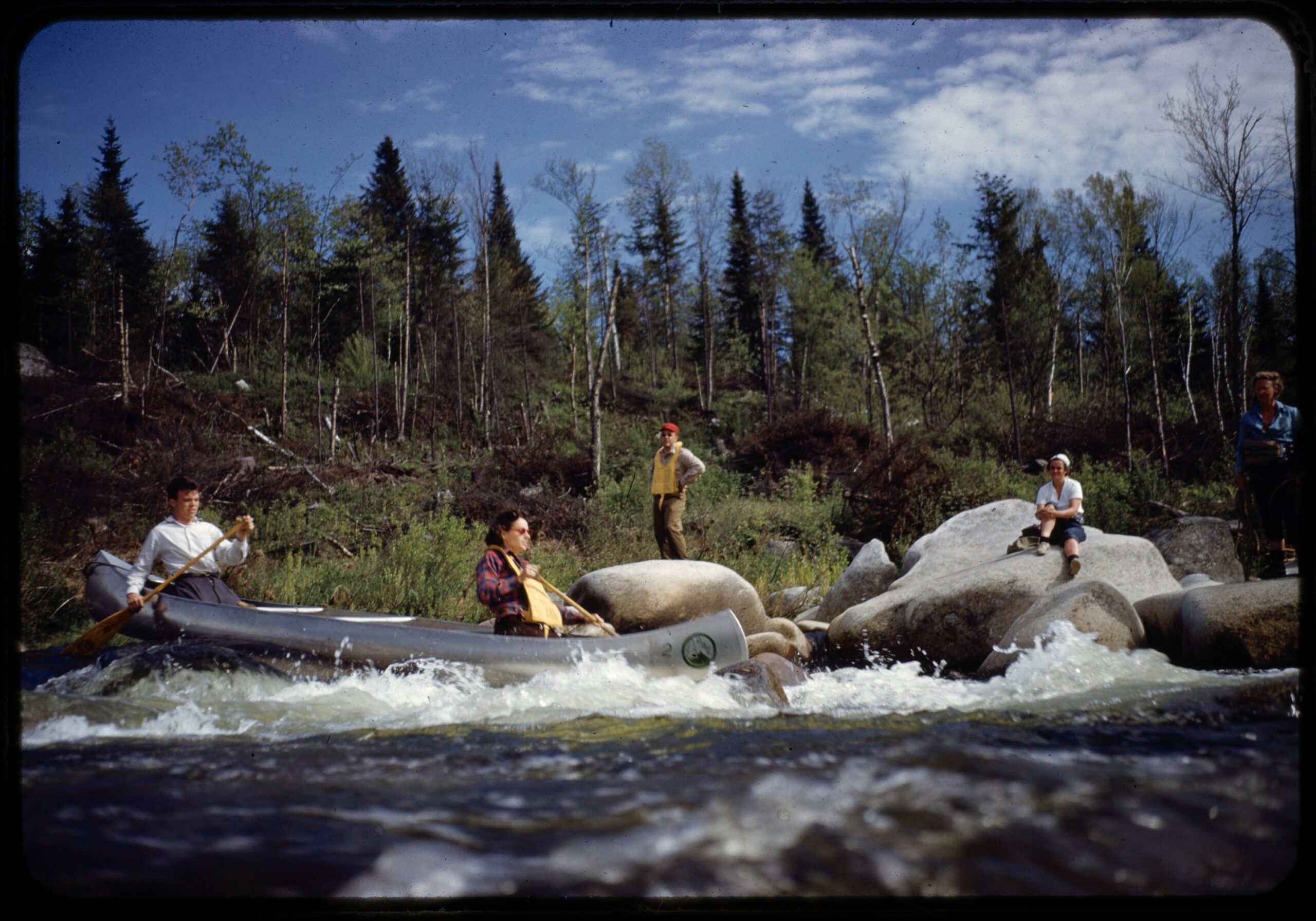
AMC members running the Ammonoosuc River in New Hampshire in the 1950’s – courtesy of AMC archives
Although initially dedicated to exploring mountainous regions, Appalachians have enjoyed water travel from an early stage. There were boating enthusiasts among the first members, and a few accounts of canoe expeditions, especially in the Maine Woods, appeared in Appalachia in the 1880s. Two frequent visitors to Katahdin and its surroundings on foot and by water were George Henry and Sarah Pattee Bean Witherle of Castine, Maine. Among other accounts, they published a story on their month-long trip with guides in the autumn of 1883 from Medway up the West Branch of the Penobscot River to Abol Stream, where they set off on foot to climb Katahdin. The paper was read before AMC in Boston in June of the following year, sparking the imagination of those present. The lore of Thoreau’s travels through the area in the 1850s was canonical by this time and further motivated visitors with an adventurous spirit.
In an even longer expedition starting on the last day of July 1889, two women and a man set off from Boston for the wilds of Maine for four weeks of canoeing and camping. In a report published by the women in Appalachia, they dubbed themselves the “Old Camper, a Younger Camper, and a Novice.” The Young Camper was 24-year-old Ellen Leonice Sampson of Newton, Massachusetts. The Novice was Mary Elizabeth Hardwick of Quincy, Massachusetts. The Old Camper is unnamed in the article, but in 1900, Robert Luce gave an illustrated lecture to the club on a remarkably similar trip. Was he the Old Camper?
The three campers travelled by train as far as Greenville, Maine, then took a steamer across Moosehead Lake to the Mt. Kineo House, where they met their guides: two Penobscot men and one white man from Downeast Maine. The group of six travelled two hundred miles by canoe, visiting twenty lakes and ponds. From Moosehead they headed to North East Carry where their boats were taken by wagon to the West Branch of the Penobscot River. From there they followed the river in a wide, northeasterly arc through Chesuncook and Ripogenus Lake, making a diversion on foot to climb Katahdin. Swinging back south, they continued on the West Branch to Medway where it joined the main Penobscot River. They eventually floated into Old Town, greeted by the sounds of sawmills and civilization.
Even fewer members were finding themselves on rapid rivers in the region, paddling short stretches just for fun. A small selection of images in the AMC Archives depict boaters shooting rapids on the Millers, Souhegan and Ammonoosuc Rivers between 1908 and 1910. However, canoeing and kayaking were slowly becoming a significant part of the club’s activities. By the 1890s, large, organized trips like August Camp included canoes as essential gear. The August Camps of 1889, 1891 and 1896 at Mooselookmeguntic and Moosehead Lakes all relied on canoes to explore the scenic gems beyond their camping grounds. When Three Mile Island Camp on Lake Winnipesaukee was established in 1900, canoes and motor launches were the only way to reach the camp (other than walking across the frozen lake in winter).
The first official “Canoe Trip” was organized by Boston realtor Charles Alexander Newhall over the Memorial Day weekend of 1914. Twenty-seven members in eleven canoes paddled the Saco River from Bartlett, N.H. to Lovewell Pond in Maine over four days. Their baggage was sent to their lodgings for the night, and the paddlers were shuttled to and from their put-in and take-out points by rail, wagon or on foot each day. This section of the river is mostly smooth, with a few easy stretches of rapids. In more challenging stretches, the experienced paddlers shuttled willing passengers through while others watched from the shore. There were plenty of capsizes the first day as the paddlers became accustomed to their boats, but the weather being warm and sunny, no one minded the impromptu bath. Though seemingly fun, canoe trips like this were rarely replicated over the next decade. Though a few paddlers were visiting lakes and ponds and running rivers for fun from the 1900s through the 1910s, the logistics of getting people and boats to the water made it difficult as a club sport.
The Saco River trip was revived in 1923 and 1924, and in 1926 a young man named John Coolidge Hurd led a weeklong trip down the Piscataquog River. The water was high that year and the river fast, but the many inexperienced paddlers came out unscathed. This kind of single day or weekend trip presented even more challenges. Hurd records the difficulties in “Twenty Years of White-Water Canoeing,” published in the June 1947 issue of Appalachia, looking back on AMC paddling:
We had to hire canoes and have them trucked in near the rivers during the fall, because in the spring all but a few main roads were deep in mud. We had to go north by train and team. Hotel accommodations had to be planned far in advance. After the run, Canoes were inspected and damages recorded. Then they were trucked back to the canoe house, and a bill of fifty to one hundred dollars for repairs was not unusual, for livery canoes have to be kept in first-class condition.
Nonetheless, with each year new rivers were scouted and more trips planned. As enough boats and private vehicles could be borrowed to help paddlers reach the quickwater rivers in spring, the club’s General Excursion Committee lent its support. In 1933, Lawrence Irving Grinnell also introduced the use of motion-picture cameras on the riverbank, filming club paddlers as they navigated rapids. It was an effective way to show new paddlers proper technique in the off-season and drum up interest. Some of these film reels still exist in the AMC Archives.
For almost ten years, paddling trips were managed under the umbrella of this general committee, but a Special Canoe Committee formed briefly around 1934, to investigate the idea of the club owning its own fleet of canoes for use by whitewater paddlers in the spring and on the calm waters at Ponkapoag Pond Camp outside Boston in summer. By the next paddling season, the club was the proud owner of six used canoes with paddles and back rests secured for $115.
Kenneth Atwood Henderson took up the reigns of the canoe sub-committee just after Hurd. Henderson was a world-class mountaineer, rock and ice climber who dressed in old business suits he no longer wore to the office as an investment banker. On rivers, he was often found paddling with Marjorie Hurd, an attorney from Cambridge and the older sister of John C. Hurd. Women were welcomed into the paddling group from the start, though at first, they were not allowed to navigate canoes on their own or in tandem on club trips. They were generally placed in the bow with a man at the stern.
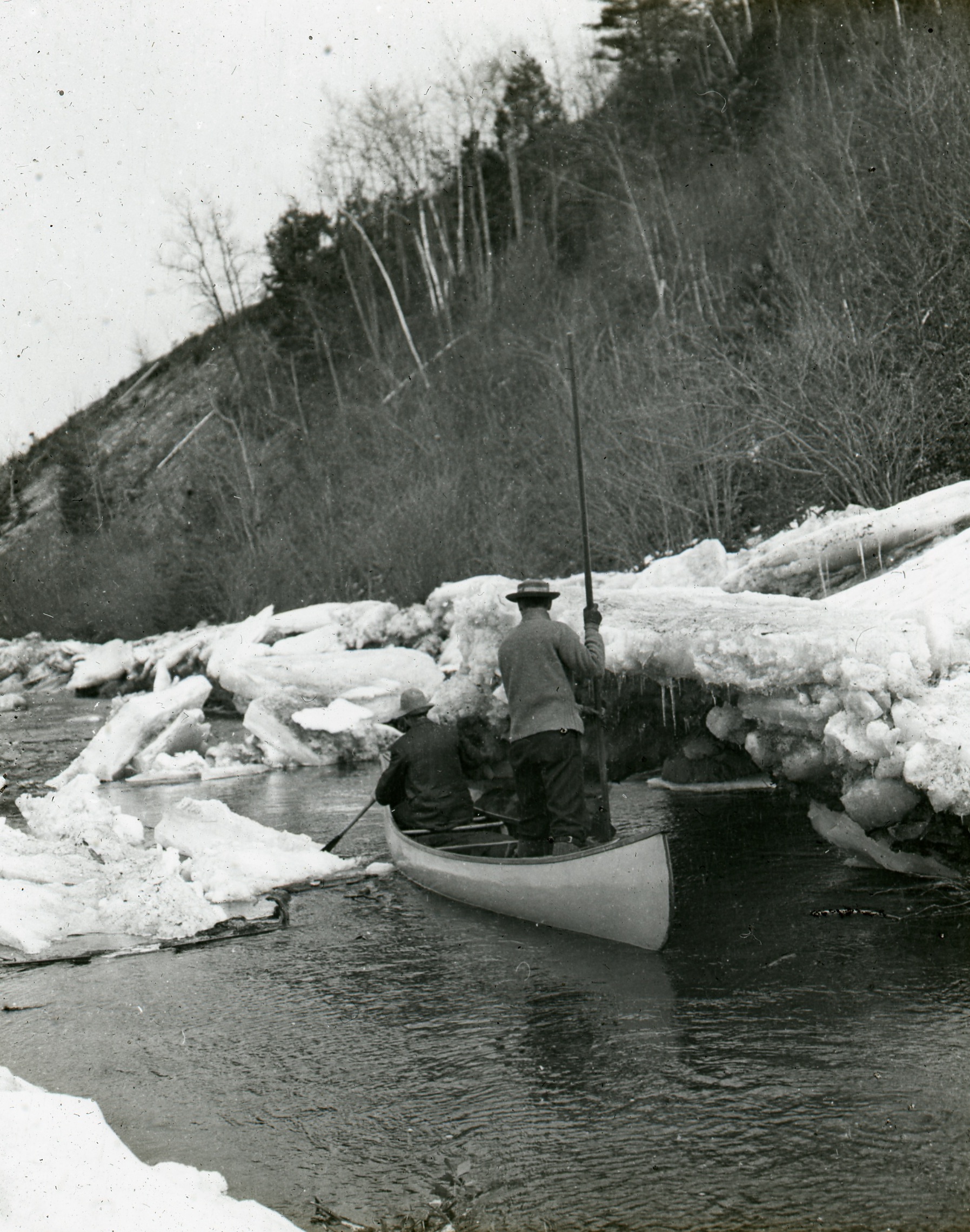
AMC canoers navigating the ‘bergs on the Souhegan River in New Hampshine in Spring, 1910. Photo taken by Sinclair Kennedy – courtesy of AMC archives
An official, freestanding Canoe Committee formed in 1942, just in time for wartime gasoline and rubber rationing to put a damper on their fun. They were able to run eight trips during the spring but had to cancel a Memorial Day weekend paddle on the Saco in exchange for a day on the Sudbury River close to Boston with a night of camping out. The following year, they managed only one run in April. Although they discussed the possibility of running trips using railroads to transport boats and boaters, coordination proved impossible. The committee ceased operations until the war was over. Joyous reintroduction to club whitewater trips occurred in March 1946, with an introductory meeting, the showing of color films, and work parties to repair and repaint the committee’s four remaining wood and canvas canoes that had lain dormant in storage for several years.
Although their activities had been curtailed during World War II, the Canoe Committee benefitted in one way from this world-shifting event. During the war, Grumman Aircraft Engineering Corporation (now Northrop Grumman) was building planes for the U.S. Navy. When the demand for aircraft dried up at war’s end, the company sought other commercial opportunities with plentiful materials like aluminum. After lugging a sixty-plus wooden canoe around the Adirondacks on a fishing trip, Grumman’s chief tool engineer William Hoffman proposed building lightweight boats from aluminum. At the same time, sportsman and designer Russell Bontecou was working on his own aluminum canoe idea. The two men were brought together, and Grumman soon released a 13-foot, 38-pound canoe in 1945. The AMC Canoe Committee purchased two in 1946, and they proved superior in their durability and handling. Instances are recorded of aluminum canoes wrapped around rocks. Where such accidents would have proved fatal to a wooden boat, the metal ones need only be pounded back into shape to paddle another day. With further Grumman purchases, the committee’s major problem became where to store them in the off-season.
Whitewater paddling was becoming ever more accessible to members with the Canoe Committee’s equipment, planningand low-cost trips (a general trip and canoe rental fee applied). Safety and the need to effectively train new paddlers before releasing them into serious rapids was a priority, but accidents were inevitable. The committee witnessed its first fatalities during a trip on the Deerfield River in April 1950, when tandem paddlers Joseph W. Hammond, 42, and his fiancé Mary Jane Marston, 24, were one of three boats that capsized in the aggressively high water. Hammond had paddled with the club before the war but had only come out once since 1949. He brought Marston along as a guest, introducing her as a “competent paddler.” As they shot the rapids below the New England Power Company’s Deerfield Number 5 Station hydroelectric dam in Monroe, Mass., their boat became swamped. Marston disappeared under the water first and her body was recovered about two miles below the put in. Hammond was seen clinging to the canoe after falling in. He eventually let go and missed a rope thrown at him. After disappearing, his body would not be found until three days after the incident, when the dam gates were closed to allow the water level to sink in aid of the search. His body was spotted caught on a stick mid-river less than half a mile from where he was last seen.
It is not recorded in any reports of press if any of the paddlers in this group were wearing life jackets (descriptions of Hammond and Marston’s outfits indicate they were not) and this was not a required item at the time. Vetting of paddlers was far more casual. In this case, Hammond had paddled little with the group since before the war, and he needed only to vouch for Marston’s abilities for her to join the trip. In the wake of the tragedy, the Canoe Committee addressed these serious issues by instituting more instruction on safety into workshops and trips, closer screening of would-be paddlers, and by requiring participants to bring life jackets on every trip (they did not have to be worn unless the trip leader deemed them necessary). Not long after, these were required regardless of conditions. By 1955, paddlers wishing to join the group had to prove they knew how to swim, handle a canoe on flatwater, and be in good physical condition. You had to verify your abilities on an instructional trip to be allowed on subsequent trips.
As interest in the sport grew, the Canoe Committee strove to fill its season and beyond with new trips. A weeklong wilderness canoe camping trip on rivers like the Saint John River in Maine and Quebec sprang up, as did autumn whitewater runs on regional streams when water levels were sufficient. Members participated in New England whitewater slalom races as that twist to the sport took hold. Flatwater boating excursions pulled up almost even with their quickwater counterparts. In 1960, the committee, whose name had morphed into the White Water Canoeing Committee, changed its name to just the Canoeing Committee to account for its broader interests.
Early season instruction went indoors around this time, with the first pool sessions to demonstrate and teach technique. Kayaks begin to appear among the boaters in this period as well. An announcement for a kayak practice session using folboats (kayaks made with a waterproof fabric skin stretched over a wood frame) appears in the June 1960 issue of Appalachia Bulletin. When hardshell kayaks and decked canoes began to appear on rivers, the club quickly welcomed them among its ranks. The club therefore had a thriving paddling community on all kinds of water as the sport of whitewater boating took hold in the 1970s. AMC paddlers had also taken to saltwater in the prior decade with coastal camping trips in Maine. The club purchased Beal Island, Maine in 1969, after years of exploring and camping in the area, and later established Knubble Bay Camp as a permanent launch site. In addition to the club-wide Canoe Committee, all of the existing chapters had paddling committees by 1970.
Now almost as old as the club itself, enthusiasm for people-powered boating is alive and well within AMC. From the first wood and canvas Old Town and E.M. White canoes of the 1880s to the slickest fiberglass slalom and touring boats of today, the club still strives to introduce new boaters and continually sharpen the skills of old hands in the joys of travel by water.
