AMC 150: Oh, Canada! AMC’s Early Adventures North of the Border – by Becky Fullerton, AMC Archivist
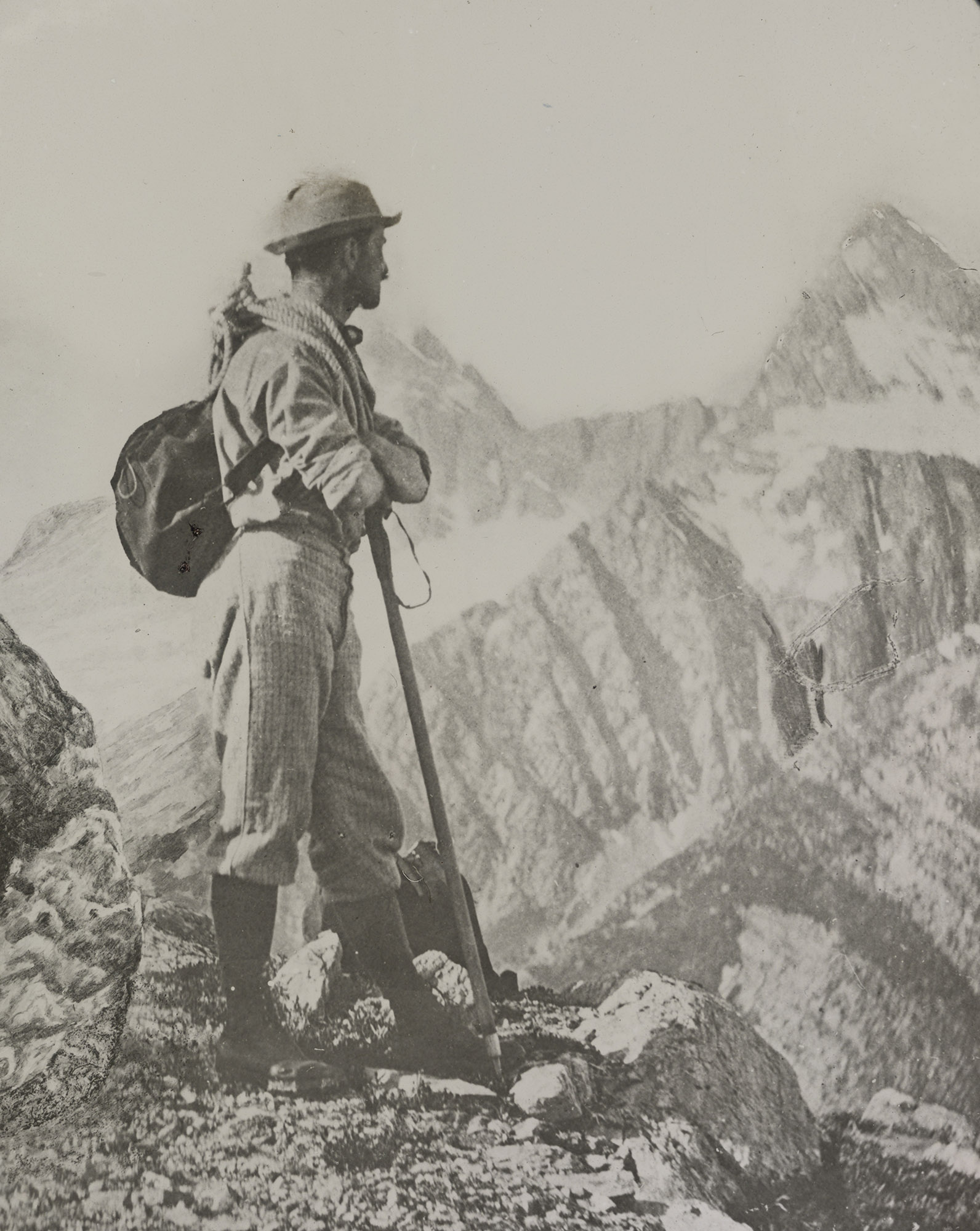
Philip Stanley Abbot at Glacier Crest, British Columbia ~1895. Courtesy of AMC Archives
The Appalachian Mountain Club (AMC) celebrates the 150th anniversary of its founding in 2026. Leading up to this auspicious milestone, we’ll be sharing historical highlights about the founding and development of the club. Everything from trails to trips, conservation to canoeing, lodges to lean-tos, with surprising stories and little-known facts in between. Though not a comprehensive history of AMC, this series is meant to help us connect to our heritage as the country’s oldest conservation and outdoor recreation nonprofit and to better understand our own place in this special community that has been helping people know and love the outdoors since 1876. Becky’s latest chapter found below describes the club’s activities and accomplishments in its first year. Becky has published six chapters to date:
- Chapter 1: The origins of the Appalachian Mountain Club in 1876
- Chapter 2: Our Founding: “The Association Shall Be Called the Appalachian Mountain Club”
- Chapter 3: Death in the Mountains: The Curtis and Ormsbee Tragedy
- Chapter 4: Early AMC Land Conservation in New Hampshire
- Chapter 5: Appalachian Water Club: How Paddling Became Part of AMC
- Chapter 6: Oh, Canada! AMC’s Early Adventures North of the Border
You can read a compendium of all chapters here
On September 8, 1890, Tufts College Professor Charles Ernest Fay and Harvard Observatory librarian John Rayner Edmands stepped off a Canadian Pacific Railway train at Glacier House in Rogers Pass, British Columbia. They were returning east by a circuitous route after a trip to southern California, with stops along the Pacific Coast, where Edmands frequently misidentified in newspaper social pages as “J.R. Edwards.” Their stay in the Selkirks would be brief: less than twenty‑four hours before their eastbound train departed the following day.
Though neither man had climbed mountains during the rest of the journey, and Fay later remarked that he had not felt particularly tempted to do so, the ascent through Rogers Pass stirred him deeply. That afternoon he hiked to the terminus of the Illecillewaet Glacier, gazing up at the surrounding peaks and weighing which might be climbed the next morning. These two modest outings marked the beginning of Fay’s lifelong, and sometimes turbulent, devotion to mountaineering in the Canadian Rockies.
Fay’s early climbing experience had been limited to the White Mountains of New Hampshire and other northeastern ranges. In his twenties and thirties he favored long hikes and wooded summits over technical ascents, often climbing trees to gain views. He did not climb above 10,000 feet until his forties, during his first western expedition in 1888. That summer, with Frederic H. Chapin, Edmands, and others connected to the Appalachian Mountain Club, he climbed Mount Shavano and Blanca Peak in Colorado. Although impressed, Fay would later find that the Canadian Rockies exerted a far stronger pull on his imagination.
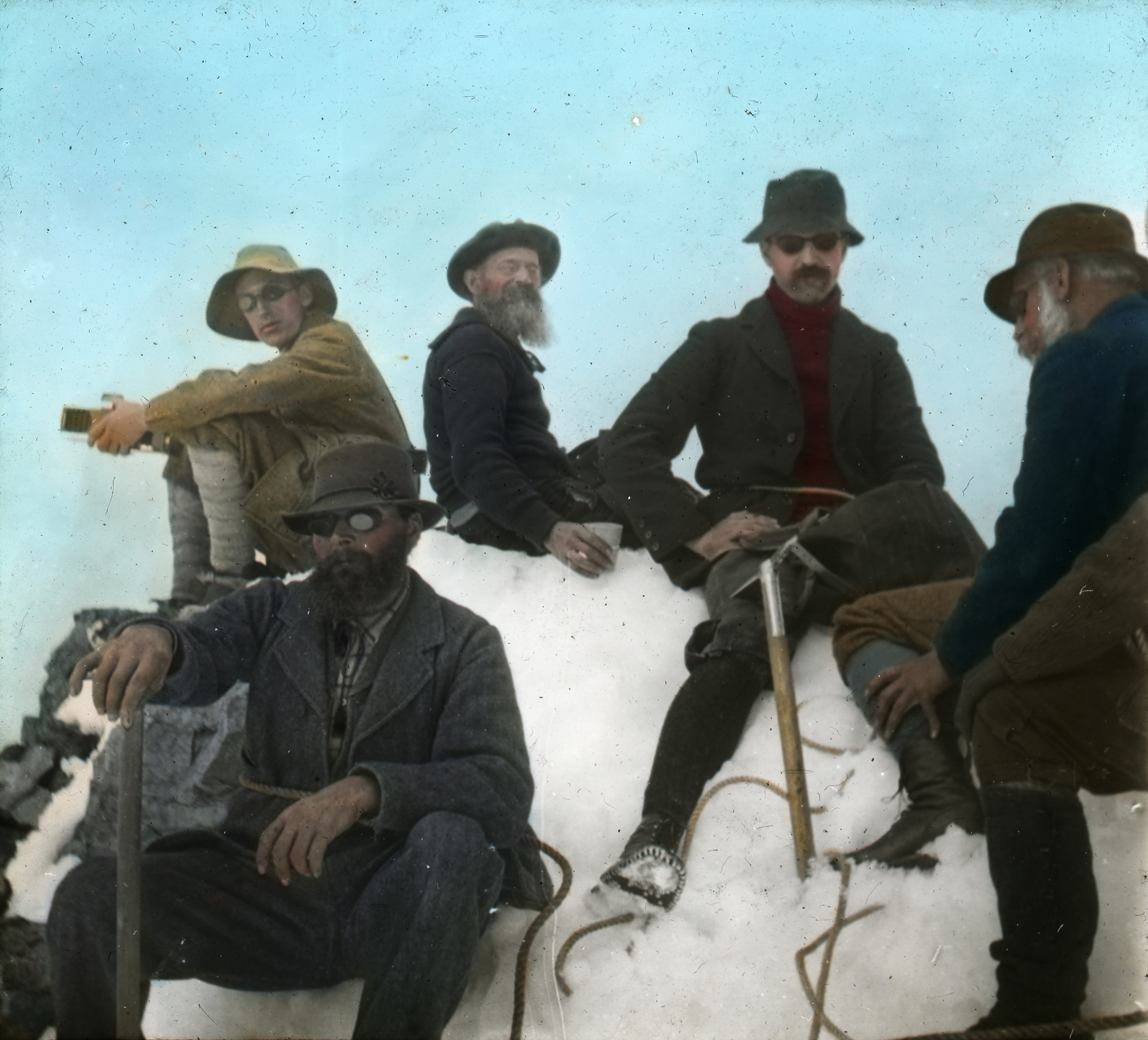
Peter Sarbach (foreground L), J. Norman Collie, Charles E. Fay, Charles Thompson and Harold Dixon (L to R) on Mount Lefroy summit, British Columbia. August 3, 1896. Courtesy of AMC Archives
At 7:45 a.m. on September 9, Fay set out alone toward 10,774‑foot Mount Sir Donald, first climbed only two weeks earlier by Swiss climbers Emil Huber and Carl Sulzer with their porter Harry Cooper. Coincidentally, Huber and Sulzer had departed Glacier House the previous day; their westbound train had passed Fay’s eastbound one en route from Vancouver. Unable to persuade Edmands to accompany him, Fay climbed rapidly, reaching the glacier’s foot within half an hour. Dense scrub soon halted his progress, forcing him onto open rocky slopes and snowfields higher up. Near the base of a ridge descending from the summit, he was overcome by a sense of “powerlessness,” unsure whether fatigue or altitude was the cause. Pressing on, he encountered a sheer rock wall barring the final cone. With time running short before his train left, Fay turned back, reaching Glacier House at 12:45 p.m. in time to pack and depart.
Though he did not summit Sir Donald, Fay returned east transformed. He would come back to the Rockies repeatedly, each time with greater technical skill and deeper commitment.
Fay did not publish an account of this first Canadian trip until December 1893, in Appalachia, but word of his exploits spread quickly. In July 1891, the White Mountain Echo of Bethlehem, New Hampshire, described him as “a lithe and slender man of 40 or so [he was actually 46], bearded and spectacled…[who] climbs like a goat,” recounting his near‑summit attempt on Sir Donald without rope, alpenstock, or ice axe.
The next AMC figure to explore the Canadian Rockies was Reverend Harry Peirce Nichols, an Episcopal priest from Salem, Massachusetts. Unlike Fay, Nichols had climbed extensively in the Alps beginning in his late twenties. In 1881 he encountered Theodore Roosevelt in Zermatt, where Roosevelt was attempting the Matterhorn. Nichols would later become a founding member of the American Alpine Club in 1902 and serve as its president from 1923 to 1925; Fay would serve as its first and fifth president.
Nichols was also deeply rooted in the White Mountains, staying at the Ravine House in Randolph, later purchasing property in Intervale, and helping lay out trails on the Presidential Range. He befriended Joe Dodge shortly after Dodge became the manager at Pinkham Notch Camp in 1922, officiated at Dodge’s wedding, and baptized his children. Even in retirement Nichols remained vigorous, climbing Mount Washington twice in one week at age seventy‑nine.
In 1893 Nichols spent six weeks climbing around Glacier House. With Charles Sproull Thompson and Samuel Evans Stokes Allen, he made the second ascent of 10,486‑foot Mount Fox, first climbed in 1890. Fay later credited Nichols with “putting upon record the first ascent of importance” in the Selkirks by an AMC member. Following this climb, Nichols preached a sermon at Glacier House on “The Glory of Aspiration,” then spent the remainder of his stay teaching his son, John Donaldson Nichols, to climb.
Nichols was captivated by the region, writing enthusiastically of a mountain range “rivalling the Alps…with peaks not only unexhausted, but even unnamed and unseen.” During the trip he climbed an unnamed peak with Allen, who proposed naming it for Nichols. The name did not endure; the mountain was later designated Collier Peak after Dr. Joseph Collier, who climbed it in 1903. Nevertheless, Nichols’ and Fay’s advocacy firmly established the Canadian Rockies as a destination for American mountaineers.
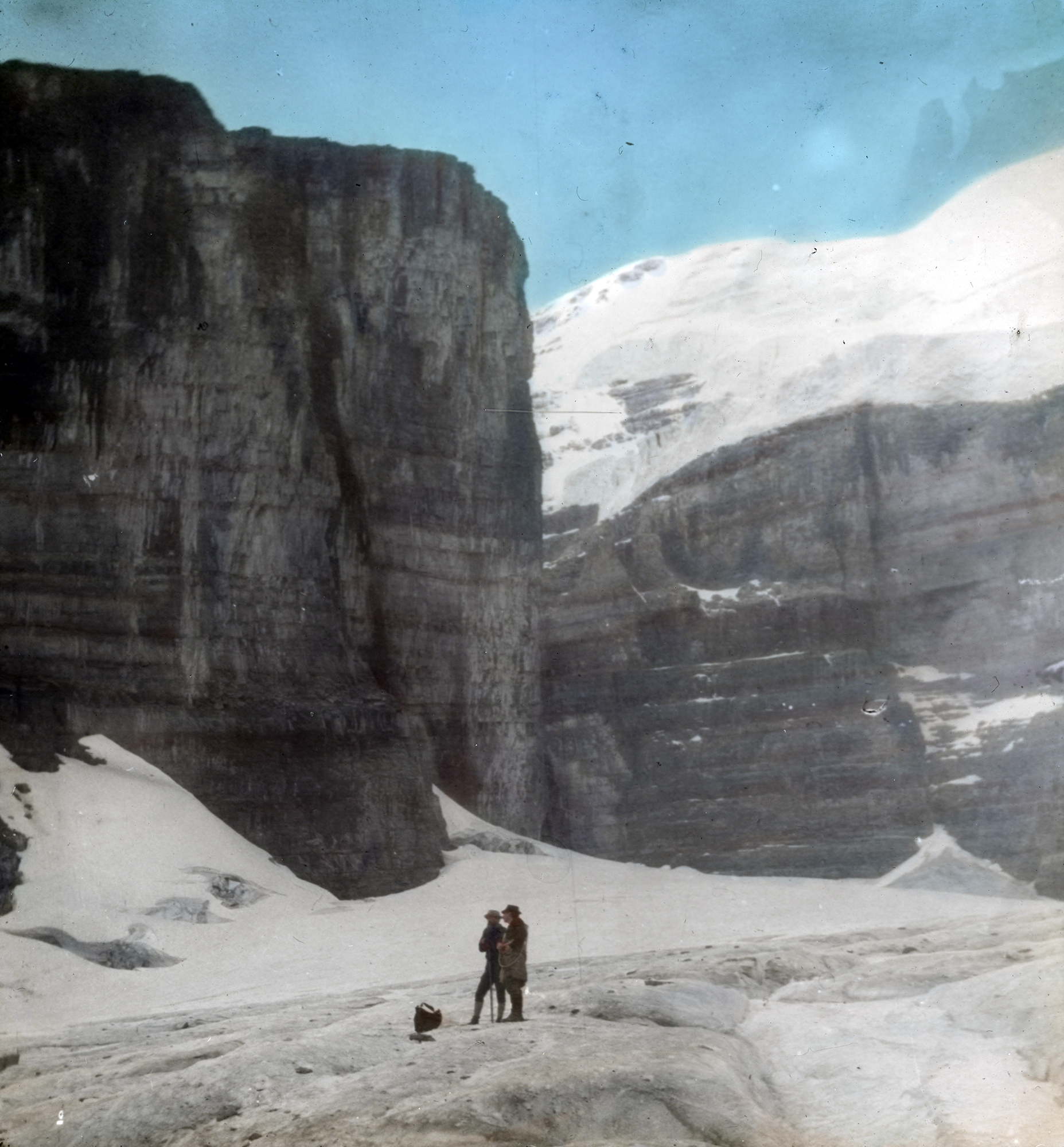
Cliffs on the western face of Mount Lefroy, British Columbia by Charles S Thompson. Courtesy of AMC Archives
AMC climbers returned in force in 1894. Fay climbed Mount Stephen with Rest F. Curtis (without reaching the summit), successfully ascended Mount Abbott, and bivouacked on Eagle Peak after failing to summit. Samuel E.S. Allen returned to complete the ascent of Mount Temple after an unsuccessful attempt the year before. Accounts of these climbs filled the opening articles of the June 1895 issue of Appalachia.
As AMC members were “discovering” the Canadian Rockies, a younger climber was assembling a remarkable résumé. Philip Stanley Abbot, born in Brookline, Massachusetts, in 1867, was introduced to climbing as a teenager in England’s Lake District. In 1887, while on leave from Harvard for health reasons, he traveled with novelist Robert Welch Herrick from Cuba through Mexico, California, and Alaska. During this journey Abbot climbed Popocatepetl, explored Yosemite and the Sierra Nevada, and visited Alaska’s Muir and Davidson Glaciers.
After graduating from Harvard in 1889 and later completing a law degree, Abbot devoted the summer of 1892 to intensive alpine training. He hired Swiss guide Peter Sarbach and climbed widely in the Alps, later describing the experience as attending “the university of mountain‑climbing.” Upon his return, Abbot presented papers to AMC on his climbs. When Fay organized a major AMC expedition to Canada in 1895, Abbot was a natural choice to invite.
The 1895 expedition marked a turning point for AMC. It was the first trip planned more than a year in advance and the first to extend far beyond the White Mountains. The itinerary included Banff and Field in British Columbia, followed by the Selkirks. Twenty members departed Boston on July 22, traveling by rail to Montreal, then west in a private Canadian Pacific Railway car for three weeks. Reverend Nichols joined them in Minneapolis. After three weeks in the mountains, the group continued to Vancouver and Victoria, sailed to Tacoma, and returned east via Seattle and the Great Northern Railway, with additional steamship excursions on the Great Lakes. They arrived back in Boston on August 31 after nearly six weeks of travel, drawing praise in newspapers along the route.
At least six women were among the participants. They joined every excursion except the most technical climbs and ascended partway up Mount Stephen before being asked to turn back. The climbers sorely wanted the women to reach the summit. Fay, in a published account, decried, “Did not Club loyalty – to say nothing of gallantry – demand of us to make an effort at least to put one high summit of the Canadian Rockies under the foot of feminine “Appalachians”?”
Although the women did not complete first ascents, they were instrumental in another lasting contribution. Before leaving, the party persuaded the Canadian Pacific Railway to construct a trail along the ridge between the Illecillewaet and Asulkan Glaciers, naming it Glacier Crest. Women in the party assisted in this trail building effort.
Several first ascents were achieved. On July 30, 1895, Abbot, Fay, and Charles Thompson, with guide T.E. Wilson and a porter named Hiland, climbed 11,135‑foot Mount Hector. Abbot described the climb as straightforward and uneventful. On the summit, Thompson built a cairn, Fay took photographs, and Abbot took a nap. They sealed their names in a jam jar inside the cairn. Later, near Glacier House, they made the first ascent of Mount Castor (now Jupiter) and named another peak Mount Afton, from their initials.
Between these climbs, the trio reconnoitered Mount Lefroy on the Continental Divide, coming close to the summit before retreating due to failing daylight. The following morning they missed their train deliberately to attempt Lefroy again, but warming temperatures and water‑filled ravines forced another retreat. Lefroy would wait until the following year.
The 1896 return trip began poorly. Luggage was misrouted, and Fay was incapacitated by an injury sustained on Mount Chocorua back in New Hampshire. On July 29, Charles Thompson and George T. Little attempted a training climb of Ross Peak wearing inadequate footwear. A steep snowfield delayed their descent until twilight. The next day, Little, Thompson, and Abbot completed a grueling twenty‑three‑hour first ascent of Mount Rogers. After resting, the group traveled east to Lake Louise.
On August 3, 1896, the now recovered Fay joined Abbot, Little, and Thompson for a full attempt on Mount Lefroy. They crossed Lake Louise by rowboat at dawn and climbed the moraine to the Victoria Glacier. Roping up, they entered a narrow gorge known as the “Death Trap,” notorious for avalanches and icefall. Before noon they reached the Continental Divide. Looking out over the incredible panorama of mountains and up toward the summit of Lefroy itself, Abbot proclaimed, “The peak is ours!” It was here the group left the remainder of the food and extra clothing they were carrying to speed the final push to the summit.
The party had hours of climbing left to do. The next stretch included the monotonous cutting of steps over ice and snow as they inched forward. At five-thirty they reached the base of a wall they estimated to be seventy-five feet high. To their right lay a rough ridge that they deemed impassible. To the left was a gently sloping icefield over which they might have trod, but the time needed to carefully cut steps over it would leave them descending the mountain in the dark; something for which they were sorely unprepared in the era before headlamps and flashlights.
Abbot, who was leading the group, discovered a cleft in the rock just beyond where they were standing. Here he asked Fay and Thompson to unrope from him and Little before clambering ahead some thirty feet further to a ledge. Little, one of the strongest rock climbers in the group, began to follow but he was given a glancing blow from a small rock loosened by the rope running over it. Another rock came down, partially severing the rope between him and Abbot. At this juncture, Fay suggested that they give up on this route, but the idea was dismissed. Next Abbot requested that Little disconnect his now damaged rope as well. He then proceeded around a corner of the ledge to where he found a gully to ascend. Now Little voiced his concern as well, suggesting that they continue further along the ledge to a better point of ascent. Abbot declined, replying, “I think not. I have a good lead here.”
These words would be his last. Be it from a foothold or handhold that gave way, Abbot suddenly fell, plunging past the men backwards and headfirst. He struck the ice slope below and began to roll, quickly tangling up in every foot of rope that the party had with them. The remaining three climbers watched in horror as their friend rolled nine-hundred feet down the mountain. In Fay’s description of the accident, he notes with irony that although their rope was now gone, it slowed the relentless descent of Abbot’s body and kept it from falling off the cliffs below and into a gorge. Under the extreme shock and trauma of this moment, the men now had to cope with the additional, immediate problem of Little being stranded above them and their overall precarious situation. Little urged them to attend to Abbot, but there was clearly no living soul there left to save. With the aid of their ice axes, which they still fortunately possessed, they helped Little down from the ledge.
Making the long descent to where Abbot lay, they found him unconscious but mortally wounded and he soon died. They bivouacked in freezing conditions and returned to Lake Louise the next morning to report the tragedy. Abbot’s body was retrieved several days later and returned to Cambridge, Massachusetts. He was buried at Mount Auburn Cemetery on August 12, 1896, three weeks before his twenty‑ninth birthday. The accident was the first fatality associated with AMC and the first recorded mountaineering death in North America, and it sparked widespread debate. Some called for bans on mountaineering. Fay defended the sport, arguing that its rewards outweighed its risks in an age increasingly devoted to comfort.
In 1897 AMC returned to the Rockies with British climbers, including Harold Baily Dixon and Dr. John Norman Collie, and with Swiss guide Peter Sarbach. On August 3, 1897, the first anniversary of Abbot’s death, nine climbers summited Mount Lefroy, quietly triumphant. They placed a written record in a cairn on the summit. The party continued climbing for weeks, summiting Mount Victoria, exploring the Bow River Valley under guide “Wild Bill” Peyto, and conducting scientific observations. The success of Sarbach’s guidance led to the hiring of Swiss guides by the Canadian Pacific Railway, shaping the future of mountaineering in the region.
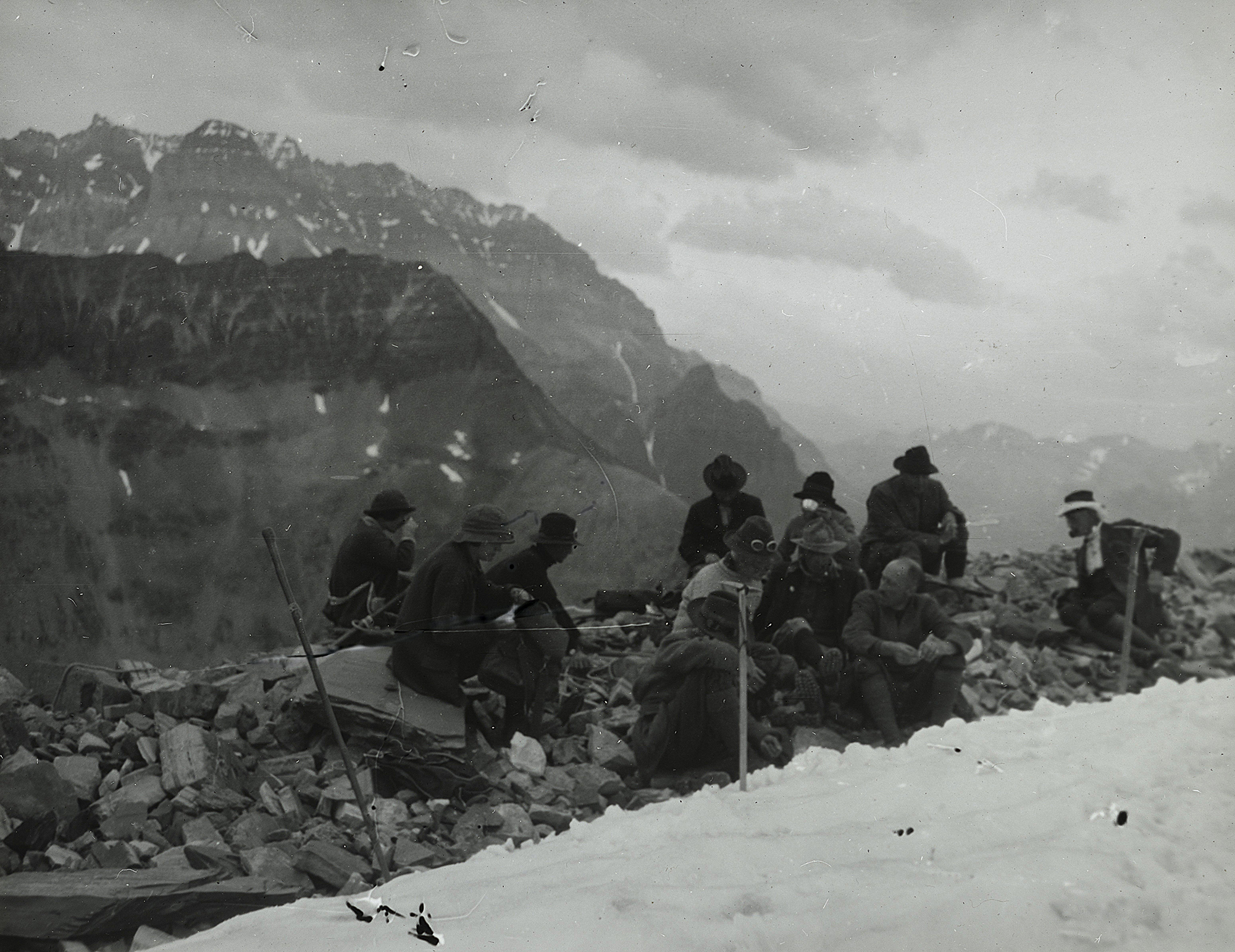
AMC climbers on Park Mountain, British Columbia, 1921. Courtesy of AMC Archives
AMC members continued to return in subsequent decades. In 1923, Dean Peabody Jr. led a six‑week expedition that included attendance at the Canadian Alpine Club’s dedication of Abbot Pass Hut, built near the site of Abbot’s fatal fall. (Due to erosion from melting glacier ice, the hut was demolished in 2022). Another hut would be built and named for Charles E. Fay in 1927. The 1923 party was thrilled to see glaciers up close, climb peaks over ten thousand feet, and behold the landscapes their predecessors had witnessed. Additionally, the trip included a 320-mile horseback trek from Field, B.C. to Mount Robson in Alberta, requiring eleven staff, two pack trails and sixty horses. Despite their wide roving, the group acknowledged having just scratched the surface in experiencing the Canadian Rockies. Writing of the trip in Appalachia, Peabody proclaims:
“That is just the way the trip left us. We want more. More time to camp beside some gem of a lake, or by some rushing, storming river. More time to choose our peak, according to our daring and ability, and make each one his individual first ascent. We want more days in sun or shower, trailing behind the pack horses, munching our lunch, or crossing our feet on the horse’s backbone to ride dry shod at some deep ford. We have not seen it all, but we console ourselves by remembering that we did see perhaps quite as much as any other mountaineering party in the same short time of six weeks.”
We continue to visit this incredible landscape. August Camp has been to the Canadian Rockies a handful of times since 1959, AMC’s President’s Society last visited in 2022, and two Adventure Travel trips are listed for 2026. Though few go realizing the deep AMC history present in the region, the signs are present in place names like Abbot, Allen, Afton, Fay, Little and others; along the Glacier Crest Trail that members helped lay out in 1895, and in the descendants of Swiss guides that still reside there.